
Blurry Moon
sun@shitposter.world

 5
5
 6
6
 8
8
Trash Panda - now diagnosed edition!
raccoon@hollow.raccoon.quest@sun@shitposter.world
Still can't get a printer to work on arch, same printer worked OOTB on mint.
I'm so annoyed.
1
0
1

Zergling_man - fedicon 2026 @ C109
Zergling_man@sacred.harpy.faith
1
4
7
Blurry Moon
sun@shitposter.world
1
0
1
Blurry Moon
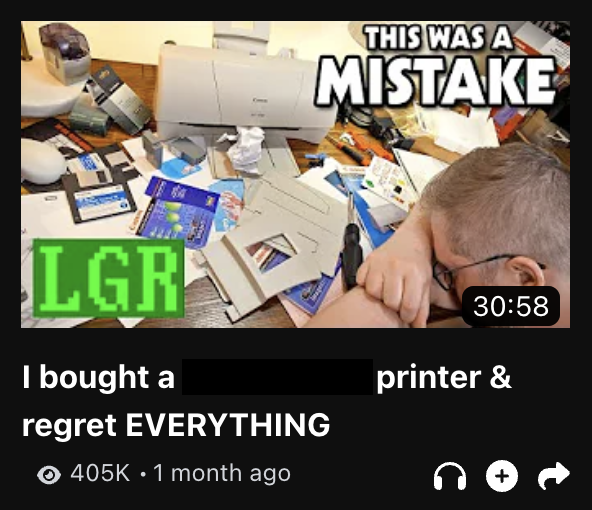
sun@shitposter.worldIt is hard enough getting a present-day printer working on present-day Windows, let alone setting up a parallel port printer in Windows 3.
0
0
2

Haelwenn /элвэн/ 
lanodan@queer.hacktivis.me
Like disasters happening to people represents a lot of youtube videos.
2
0
2
Zergling_man - fedicon 2026 @ C109
Zergling_man@sacred.harpy.faith
0
0
0
Blurry Moon
sun@shitposter.worldThe last printer I owned was an HP, and it finally angered me so bad that I picked it up, took it outside and threw it as hard as I could at the cement driveway, in rage. I have never owned a printer since then and I never will. The rare times I need to print, I take it to a FedEx Store.
5
1
3

mangeurdenuage 
 🌿
🌿 


mangeurdenuage@shitposter.world
2
0
2
Haelwenn /элвэн/
lanodan@queer.hacktivis.me
Scanners meanwhile? Fuck them, I typically just use my photo camera instead.
2
0
2
Haelwenn /элвэн/
lanodan@queer.hacktivis.me
(Funnily the only reason printers are getting better is due to things the FSF would choke on)
2
0
1
Blurry Moon
sun@shitposter.world
2
0
1
Blurry Moon
sun@shitposter.world
0
0
1
Haelwenn /элвэн/
lanodan@queer.hacktivis.me
Also proprietary cartridges is yet another issue with inkjets but even with rechargeable ones (pro laser printers are btw) inkjets are high-maintenance horseshit which everyone should have stopped buying ~10 years ago.
0
0
1
Blurry Moon
sun@shitposter.world
0
1
0



What are you even on about?
Printers are getting worse and even less reliable.
I've come across a HP printer that had a "don't plug this in, use wireless" sticker over the usb connector and surprise, surprise wireless did not work, but wired did at first (but soon proceeded to stop working).
Sure more now supports IPP, but even then they always find a way to fail to print.
0
2
1

meso
meso
1
0
1

susie@blob.cat
susie@blob.cat
"Yes please, print this text document as an image"
 1
1
3
1
1
3
mangeurdenuage 🌿
mangeurdenuage@shitposter.world
It's pretty simple, if hardware doesn't work with Trisquel, you can defacto blame hardware manufacturers for it.
0
0
1

Dumb Idiot Retard
idiot@shitposter.world
2
0
2
susie@blob.cat
susie@blob.catSo in reality my printer has been unplugged and turned off for a long time lol If there is something I really need printed out it is quick to put back to work though.
0
0
1

Pawlicker 🐾😹
PurpCat@clubcyberia.co
2
0
1


Pawlicker 🐾😹
PurpCat@clubcyberia.coHe should have gone with a printer easier to obtain ink and print heads for like the old HP desk jets
0
0
2
There is a "Digital Freedom Foundation" that may be want you want; https://digitalfreedoms.org/hfd
Although, my GNU/bro has told me that he smells a proprietary rat within the foundation, as he found that many things they publish are under proprietary licenses and a related blog recommends proprietary things and doesn't accept patches, as the author refuses to publish the blog article markup under a free license.
0
0
1

Sinistra delenda est.
ThatWouldBeTelling@shitposter.world@mangeurdenuage @idiot @Zergling_man @lanodan @sun You also need a lot of money especially if you want your hardware to be affordable, and much, much better governance than the FSF for example.
For profit companies have an implicit advantage there, if they completely screw up they stop making money. Whereas Gnu Hurd is still on its road to nowhere thirty four years after it formally started.
But with money also comes temptation, see the Raspberry Pi for example (switched over to prioritizing companies that embed their stuff, is now doing an IPO).
I can't think of any high volume open hardware projects that either avoided that fate (of course Raspberry Pi actually wasn't very open, but that's in part on Broadcom etc. and the latter's making too many of a certain chip) or got anywhere, see for example lowRISC which was founded to make a very interesting RISC-V chip, as in they talked about what it would cost to make N-thousand working ones, and ended up being a consulting company.
See also how much it costs up front to make good injection molded plastic parts for packaging, that's generally needed for high volume parts for consumers. Every time you see something that's metal, CNC machined, and/or 3D printed you know it's going to be extra expensive.
1
0
3
Dumb Idiot Retard
idiot@shitposter.worldThe problem is that Electrical Engineers with a love of freedom are a lot scarcer to come by than programmers. Even if the FTC ruling doesn't get overturned and there's no more non-competes ever again (rest in piss), you're still asking a professional engineer that gets at least six digits to work in their spare time for free.
 4
1
1
4
1
1

Account: Computers
pro@mu.zaitcev.nu
1
0
3

ロミンありん
romin@shitposter.world>The correct answer for Free Hardware
except fabs are a 8-9fig endeavor, free hardware isn't something we're gonna see in our lifetimes
2
0
2
mangeurdenuage 🌿
mangeurdenuage@shitposter.world
1
0
3
mangeurdenuage 🌿
mangeurdenuage@shitposter.world
>you're still asking a professional engineer that gets at least six digits to work in their spare time for free.
Since when they don't get paid for their work ?
The only thing hardware freedom does is to enable other people to also be able to work (and own) on the said hardware with no restriction. Aka a true free market.
0
0
2
Sinistra delenda est.
ThatWouldBeTelling@shitposter.world@idiot @Zergling_man @lanodan @mangeurdenuage @sun Cross our fingers on the FTC non to non-competes, but its prospects aren't generically good since its head is an activist who doesn't care if what she orders is legal, and is being regularly slapped down by the courts.
Would also severely screw over California for what that's worth....
Speaking as someone who's worked for a few hardware companies back in the days, and did some fiddling around with electronics before college (OK, got some mad soldering skills out of that) and my family was also in the business, I think much of the rest of what you say is wrong including on salaries, but I don't have real knowledge of the latter today.
So I see "sharing schematics, drawings, and BOMs, and assembling the computer/printer/whatever together your own bad self...."
And I also see "and then a miracle occurs" where a bunch of surface mount parts get placed on a (multilayer??!?!!!???) PCB and soldered into place.
See also connectors, cables, and all the fun that comes with them and how they too can fail. I see people tearing their hair out trying to debug all the things which can go wrong.
You're also going to either go crazy trying to buy the parts in tiny or normal quantities which will be insanely expensive, or now you're back to a company buying them in normalish quantities and parceling them out into kits, along with PCBs that I hope they test.
And not entirely cheaply because they'll have to do something about customer support for those debugging issues, which can also include replacing damaged stuff.
Software is massively more tractable.
2
1
1
Dumb Idiot Retard
idiot@shitposter.world 1
0
2
1
0
2
ロミンありん
romin@shitposter.world
3
0
3
ロミンありん
romin@shitposter.world>RISC-V
>no carry flag
wow such useful
2
0
2
mangeurdenuage 🌿
mangeurdenuage@shitposter.world
>You're also going to either go crazy trying to buy the parts in tiny or normal quantities which will be insanely expensive
The market is really fucked because of that already if you at https://yewtu.be/search?q=channel%3AUCl2mFZoRqjw_ELax4Yisf6w+parts
He already explains that brands like apple even go as far as forbidding manufacturers from selling smd components aside them, idk how that's legal in the US, but it shouldn't be allowed. But still people are able to find some because black market and other various ways because the demand is high.
0
0
3
mangeurdenuage 🌿
mangeurdenuage@shitposter.world
>And not entirely cheaply because they'll have to do something about customer support for those debugging issues, which can also include replacing damaged stuff.
That's up to the agreement people and yourself have done.
Is it fair ? Maybe, depends on the proposed price. Debugging ? Why no, people should pay a regular fee for that then.
0
0
2
Dumb Idiot Retard
idiot@shitposter.world
1
0
2
mangeurdenuage 🌿
mangeurdenuage@shitposter.world
1
1
2
mangeurdenuage 🌿
mangeurdenuage@shitposter.world
1
0
2
Dumb Idiot Retard
idiot@shitposter.worldI'm already roasting to death in the summer with a 65W CPU.
 1
0
3
1
0
3
ロミンありん
romin@shitposter.world>they shouldn't be able to get any without the proper training
>the guvment should regulate this
how about no
1
0
3
mangeurdenuage 🌿
mangeurdenuage@shitposter.world
A lot of people said the same thing in 2016 and now they're crying for it because things have gotten so bad due to the enabling of usage of sub 80 IQ people using tactile phones and tablets.
I also agree in the current state of thing have the govs intervene would make things even worse. But they're already intervening in the worse possible way so
 0
0
2
0
0
2
Sinistra delenda est.
ThatWouldBeTelling@shitposter.world@romin @idiot @Zergling_man @lanodan @mangeurdenuage @sun Yeah, RISC-V is totally a Worse is Better, New Jersey macroarchitecture, they even go so far as to say "well, C and Java don't care about this..." in the official architecture document not long after they launched.
But you're already going to have to compromise a lot to have open hardware, so adding instructions to check for integer overflow etc. probably isn't a huge thing if you can get a fast enough part to begin with.
As to your two previous comments, we're talking about the 1% who for example already run a Linux/BSD desktop. And we have to start somewhere, there's always going to be a supply chain, software or hardware.
1
0
3
mangeurdenuage 🌿
mangeurdenuage@shitposter.world
1
0
2
Dumb Idiot Retard
idiot@shitposter.world
1
0
2
Haelwenn /элвэн/
lanodan@queer.hacktivis.me
And I don't think the hardware part should be anywhere near gratis, heck even back when distros needed floppies/CD/DVDs to be shared around you'd pay for those (which is one of the many reasons why libre software must also waive commercial rights).
0
1
0
Haelwenn /элвэн/
lanodan@queer.hacktivis.me
But I wouldn't be surprised to end up seeing things like FCC / CE / … take a lot more care in certifying electronics in like a decade, specially ones where internet and radio is involved (which is like 99% of computers).
Quite like how at first cars were something you could just build in your garage while now you need multiple certifications to do this.
0
1
0
Haelwenn /элвэн/
lanodan@queer.hacktivis.me
Meanwhile your average Unix user could use a more or less fanless computer as thin client and then server in another room.
1
1
0
Haelwenn /элвэн/
lanodan@queer.hacktivis.me
0
0
1
 3
1
2
3
1
2

 Cocoa Hoto (real)
Cocoa@nekosat.work
1
0
3

gray
gray@clubcyberia.co
0
0
2

 +bonifartius 𒂼𒄄
bonifartius@qoto.org
@mint @PurpCat @lanodan @Zergling_man @sun my refurbished laserjet works fine as well. complains about almost empty toner for half a year now, still prints. scanner works too, only the document feeder is kinda broken and jams often.
0
0
1