
Kade Elphinstone
KatyElphinstone@mas.to
I see 'free speech' routinely presented as virtuous. But... whose freedom, to do what, at whose expense, and under whose control?
In the mouths of billionaires, it means freedom to make a lot of money... while people rip one another to shreds like dogs in a pit.
Dogs prodded to keep fighting, by algorithms rewarding conflict and polarisation – because outrage generates engagement, and engagement generates advertising revenue.
A noble defence of freedom of expression? Nope.
As usual, follow the money. 💰
Hate makes more money than love.
#FreeSpeech #SocialMedia #Polarisation
#BigTech #Billionaires #OutrageEconomy #FollowTheMoney #Mastodon #Fediverse

 5
 1
 1

I keep hearing this argument about free speech: "but it allows bad people to talk, too."
Very correct, but the point is, it is speech, and we need to know who is fooled.
1
0
0
Without open discussion, humanity is doomed.
While I oppose freedom, I believe in freedom of speech.
0
0
0

🐘🐘 Humpleupagus 🐘🐘
Humpleupagus@eveningzoo.club
1
0
1
Free speech is essential to eugenics.
We need to have discussion that makes it clear what is logical and good.
Then the people who are obviously stupid and/or insane need to quietly disappear into the bogs.
1
0
0
🐘🐘 Humpleupagus 🐘🐘
Humpleupagus@eveningzoo.club
1
0
1
The two probably have to go together. We talk, we learn, then we act.
Sort of like how one needs to be open-minded until one has answers... then it is time to stop considering every random possible objection or tangent.
1
0
0
Taylan (GNU+Feminism Cat)
taylan@feministwiki.orgVery puzzled by this post. You didn't offer a solution, so one has to assume you are simply asking for censorship and speech control?
The moment that's normalized, it will be the billionaires (through the governments they control with their lobbying) who decide who's being censored and why.
"You were very passionate in that anti billionaire social media post of yours. It seemed very hateful, so the police will be giving you a visit."
0
0
0

@KatyElphinstone
This!
I really wish people would understand that speaking is acting. We speak because we want to enact our will on the world by influencing other people's behaviour. And just like we put limits on behaviour in general, the idea to put limits on "speech acts" should not be as anathema as most people treat it.
3
0
0
Taylan (GNU+Feminism Cat)
taylan@feministwiki.orgIt's already illegal in most places to verbally threaten, harass, etc. another person, so what other "speech acts" are you thinking of limiting?
For example, do you want to ban the polite expression of certain opinions because you deem them to be dangerous?
1
0
0
🐘🐘 Humpleupagus 🐘🐘
Humpleupagus@eveningzoo.clubThere are obviously more nefarious actors, but many are just pansies.
3
0
1

倉院流霊媒道家元綾里真宵
fey@freesoftwareextremist.com 2
0
1

mothersmurfer
mothersmurfer@poa.st
0
0
0
Actually, I hard agree here.
Nefarious actors like to support the image of free speech, just with exceptions, which is how Political Correctness works.
Most people are risk-averse, therefore conflict-averse, therefore prone to compromise even when the result is insane.
This explains the GOP.
But cowardice makes stupidity, and most people are cowards. "High Noon" again.
One advantage of having a strong culture is that you can have difficult strong disagreements and not become personally alienated or hostile.
0
0
0
There is no way to enforce the accompanying responsibility, so it will be the first thing to go in a state of "freedom."
But agreed on the eugenic purge.
0
0
0
🐘🐘 Humpleupagus 🐘🐘
Humpleupagus@eveningzoo.club
1
0
1
jamesmay
jamesmay@nicecrew.digital
2
0
1
🐘🐘 Humpleupagus 🐘🐘
Humpleupagus@eveningzoo.club
1
0
1

The most sensible inquisitor would simply exile defectives, realizing that functional people will not be harmful.
0
0
0
@taylan @KatyElphinstone
Idk, spending millions of dollars on advertisements in order to sway an election your way simply through the persuasive power of repetition and saturation?
1
0
0
Taylan (GNU+Feminism Cat)
taylan@feministwiki.orgThat's a very specific limitation, and more about the use of money / business deals than about "speech acts" per se.
(IIRC Germany already has some laws about this, but I don't remember details.)
1
0
0
@taylan @KatyElphinstone
Well, according to the US Supreme Court it is an act of speech and therefore protected. And I can't quite fault their reasoning there. All that happens is that people voice their opinions, no? And since we're talking about Germany, I find it a-ok that we generally prohibit spouting NS-slogans and the like.
1
0
0
@taylan @KatyElphinstone
(also, I don't feel like talking to someone engaging in low-key transphobia by setting their gender to "atheist", so as far as I am concerned you can speak freely to the void from now on)
1
0
0
Dagda
dagdaI favor censoring academics and journalists as what they have to say is highly socially polarizing and unsettling.
Society will be more peaceful afterwards
1
0
2
Kade Elphinstone
KatyElphinstone@mas.to
Although I'm not at all sure it's only the academics and journalists. I think it's following the money that will bring us to where it really comes from. Although often both academics and journalists follow along, after all, where does their funding come from?
1
0
0
Dagda
dagda
1
0
1

πρωτος - fedicon 2026 @ C109
protos@kuudere.loveand as far as deciding what is and isn't valid, billionaires being unable to do what they want and commoners being free to call for their disenfranchisement, is just not going to be the case.
1
0
1

Hildegunst von Mythenmetz of programming
condret@shitposter.world
0
0
0
πρωτος - fedicon 2026 @ C109
protos@kuudere.love
0
0
1

Auctoritarianismus est delendus
light@noc.social@painting_squirrel
Speech acts are not speech.
https://blog.freespeechextremist.com/blog/what-is-freedom-of-speech.html
h/t @p
@KatyElphinstone
2
0
1


@light @p @KatyElphinstone
And yet, you typed these words, even fetched up a link, and hit post instead of just uttering them into the empty air wherever you are. Why? For what purpose? Maybe to change my opinion? To change the world in some way? Or maybe to be seen as someone who expresses the opinion you expressed thereby modifying your social status? Everything we do has consequences, so maybe we should make our rules based on types of outcome instead of types of action.
2
0
0
pistolero
p@fsebugoutzone.org> Why? For what purpose?
Humans have a desire to engage in the exchange of ideas.
The reason we are still here and the Neanderthals are not is that we are eusocial to an extent they were not. Except for a few times we traded genes, we mostly ate them. Our ability to coordinate by communicating is what put humanity where it is: it is why we have survived. We like doing it and we're pretty good at it: we can communicate hypotheticals and abstractions. You may as well ask why people like eating or mating.
> maybe we should make our rules based on types of outcome instead of types of action
Consequentialism has been a plague; offshoot of French positivism and utilitarianism.
But the main problem with that is that someone has to know whether they are breaking the law *before* they undertake an act.
PBF190-Extreme_Crocball.jpg
 0
0
0
Auctoritarianismus est delendus
light@noc.social@painting_squirrel @p @KatyElphinstone
It was to change your opinion and that of the majority on Masto who believe that. Look up the "dead dogma" idea.
If the freedom to challenge ideas is curtailed, then nobody knows why we hold those ideas in the first place. They become "dead dogma".
1/2
2
1
1
Auctoritarianismus est delendus
light@noc.social@painting_squirrel @p @KatyElphinstone Btw, I actually think some level of dogma is a good thing. My view is that we should dogmatically uphold our morals (or rather, I should, because I don't know about your particular values), but not the things we believe to be facts.
I made a website about that here btw: https://isought.info/
2
0
1
Auctoritarianismus est delendus
light@noc.social@painting_squirrel @p @KatyElphinstone
> but not the things we believe to be facts.
Because those can always turn out to be false in the future.
0
0
1
Auctoritarianismus est delendus
light@noc.social@painting_squirrel @p @KatyElphinstone
I also just don't like paternalism. People who have wrong political ideas should be defeated politically, not censored.
Censorship is basically saying "people can't be trusted to hear this". Whereas political disenfranchisement is "this person doesn't have the right to rule, whether by holding office or voting" because they would use it in a bad way, because they are fascists or Stalinists or Maoists or other unsavoury characters.
2/2
2
0
1
pistolero
p@fsebugoutzone.org> Censorship is basically saying "people can't be trusted to hear this".
"And I am qualified to decide what other people can be trusted with." It's dark.
0
0
1
pistolero
p@fsebugoutzone.org> https://isought.info/
This is delightful. The domain is delightful.
0
0
0
@light @p @KatyElphinstone
Ok, but none of the things you say seem to contradict what I'm saying? But you seem to think that they do? I am confused
1
0
0
Auctoritarianismus est delendus
light@noc.social@painting_squirrel @p @KatyElphinstone They contradict this bit: 'And just like we put limits on behaviour in general, the idea to put limits on "speech acts" should not be as anathema as most people treat it.'
I do concede that the speech-act distinction is fuzzy, as are many distinctions.
2
0
1
pistolero
p@fsebugoutzone.org
0
0
0
@light @p @KatyElphinstone
I don't see the contradiction. Your first link has a paragraph on illocutionary acts. Could it be that you just assumed a whole bunch of things that were not actually stated because you were looking for a fight?
2
0
0
Auctoritarianismus est delendus
light@noc.social@painting_squirrel @KatyElphinstone I read @p's essay a long time ago. Perhaps I misremembered it?
0
0
1
Auctoritarianismus est delendus
light@noc.social@painting_squirrel @p @KatyElphinstone Also. I didn't see what I was doing as 'a fight'.
Debating is not fighting.
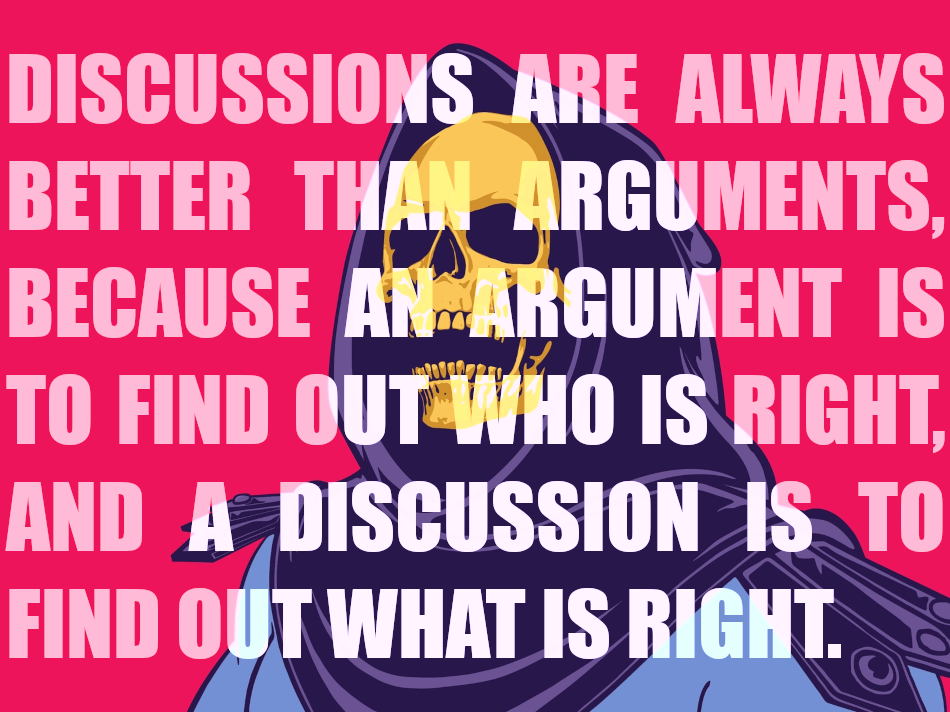 0
0
1