Conversation




lain
lain@lain.com
@georgia I’ll believe it once it actually does something useful, but it’s interesting to see that they are making progress.
 1
1
 0
0
 5
5


chjara@akko.wtf
chjara@akko.wtf
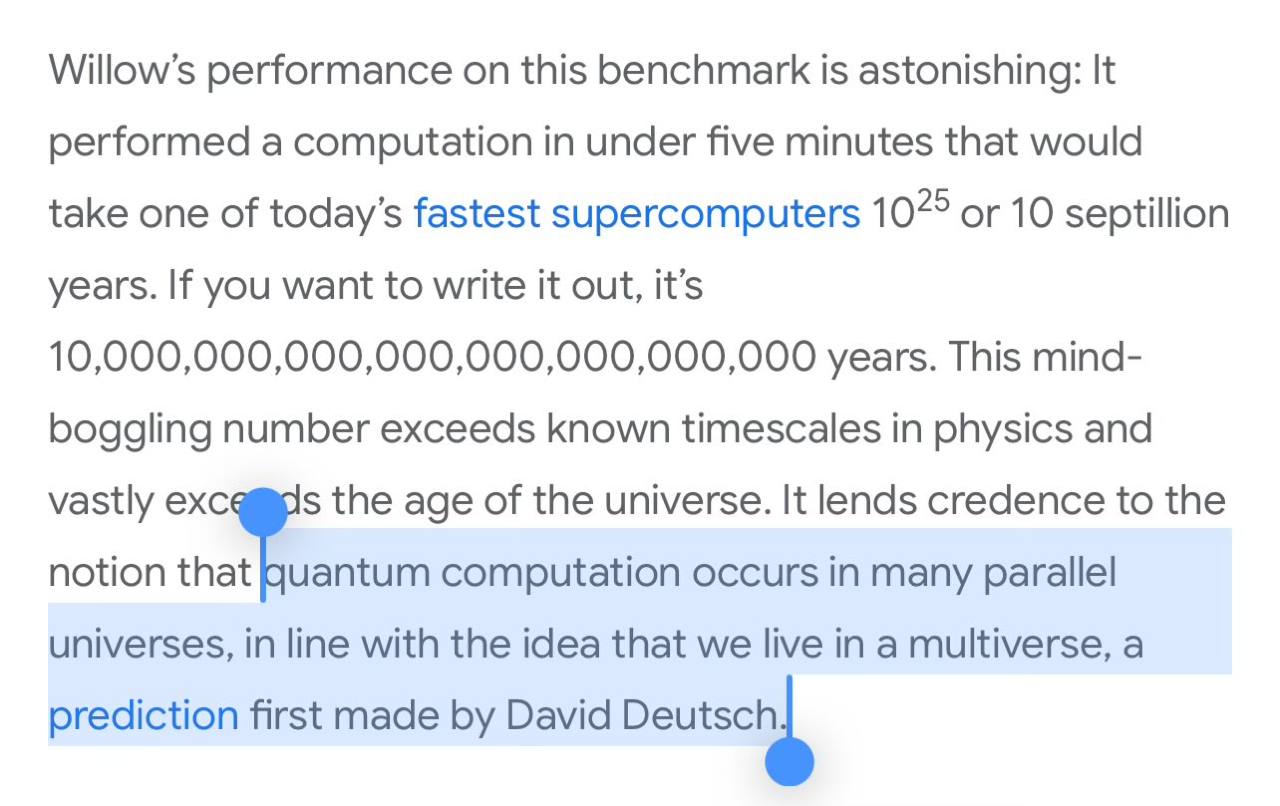
@georgia RCS means they're just sampling results from quantum circuits, this is a completely expected "speedup" for a 100-qbit system given that's a 2^100 element vector to simulate. that doesn't mean it's doing anything actually meaningful. also no idea where they're getting MWI, quantum computers just do that no matter what
1
0
1

Terry Hendrix II 🏹
thendrix@social.hendrixgames.comYou can just tell investors you don't have enough secondary/cache memory or it decays too fast -- yet if we get more funds we can fix that -- when you can't do something useful.
"Also we need to start running a fission reactor as part of the datacenter anyway, so could use the money."
0
0
0
Blurry Moon
sun@shitposter.world
1
0
1
lain
lain@lain.com
@sun @arcana @georgia
> Having said that, the biggest caveat to the “1025 years” result is one to which I fear Google drew insufficient attention. Namely, for the exact same reason why (as far as anyone knows) this quantum computation would take ~1025 years for a classical computer to simulate, it would also take ~1025 years for a classical computer to directly verify the quantum computer’s results!!
https://scottaaronson.blog/?p=8525
> Having said that, the biggest caveat to the “1025 years” result is one to which I fear Google drew insufficient attention. Namely, for the exact same reason why (as far as anyone knows) this quantum computation would take ~1025 years for a classical computer to simulate, it would also take ~1025 years for a classical computer to directly verify the quantum computer’s results!!
https://scottaaronson.blog/?p=8525
1
2
6

Ree ⚧️💚
Ree@shitposter.world
1
0
0
arcana@layer02.net
arcana@layer02.net
0
0
0
lain
lain@lain.com
0
0
2

Phantasm
phnt@fluffytail.org
@sun @lain @georgia Yes you can break RSA, and basically any cryptographic algorithm based on the exponential behavior of factorizing large prime numbers, with quantum computers. Technically. Not yet in reality.
The current research is mostly theoretical and the current record that could break RSA is a 50-bit integer I think. It's still years if not a decade or more until it becomes feasible at a larger scale. Still a threat right now though, if you care about data retention for feature breaking.
AES fairs much better and the last time I checked ~2 years ago the best theoretical algorithm halved the effective key size.
The current research is mostly theoretical and the current record that could break RSA is a 50-bit integer I think. It's still years if not a decade or more until it becomes feasible at a larger scale. Still a threat right now though, if you care about data retention for feature breaking.
AES fairs much better and the last time I checked ~2 years ago the best theoretical algorithm halved the effective key size.
0
0
1


@georgia The fact that this is possible scares the shit out of me and my gut tells me that we should stop all r&d on quantum computing immediately and back away slowly
0
0
2

ⰎⰅ ⰀⰍⰨⰒⰎⰫ
genmaicha@stereophonic.space
@sun @arcana @lain @georgia I studied the basics in college and have a somewhat informed take:
That line about the multiverse is REALLY stretching it, and I wouldn't hesitate to call it disingenuous. What people call "quantum parallelism" is sometimes described as computation occuring in multiple parallel universes all at once, but it's more like quantum states are probability distributions that you can reshape using unitary operations (which are just special kinds of matrices). Then when you observe a quantum system, it's like your sampling from that distribution. In a sense it does let you work "in parallel" across a bunch of different states, because that is how linear operations work, but saying that this behavior (which is consistent with almost a century of experimental observation, as far as I know) lends credence to the multiverse theory is ridiculous.
That line about the multiverse is REALLY stretching it, and I wouldn't hesitate to call it disingenuous. What people call "quantum parallelism" is sometimes described as computation occuring in multiple parallel universes all at once, but it's more like quantum states are probability distributions that you can reshape using unitary operations (which are just special kinds of matrices). Then when you observe a quantum system, it's like your sampling from that distribution. In a sense it does let you work "in parallel" across a bunch of different states, because that is how linear operations work, but saying that this behavior (which is consistent with almost a century of experimental observation, as far as I know) lends credence to the multiverse theory is ridiculous.
0
1
3