Conversation

crispy branzino ☭ (sold out forever)
Nimbius666@comp.lain.la
To my American comrades,
Things are bad right now, but you can take some comfort in studying good Marxist theory to understand how and why the nation is in this state. Your local library likely has Marxist literature. Reading it is an act of defiance against fascism. Knowledge is power.
Mao and Lenin can also give insight into how late stage capitalism comes to a close.
Things are bad right now, but you can take some comfort in studying good Marxist theory to understand how and why the nation is in this state. Your local library likely has Marxist literature. Reading it is an act of defiance against fascism. Knowledge is power.
Mao and Lenin can also give insight into how late stage capitalism comes to a close.
 3
3
 0
0
 2
2

pistolero
p@fsebugoutzone.org
@Nimbius666
> Your local library
Or must marxists.org has everything. Basically all of it.
> studying good Marxist theory to understand how and why the nation is in this state.
> Reading it is an act of defiance against fascism.
I don't think that anything I read stopped fascism. It's essentially a manual of failure written by the people that either lost to fascists or, once they got power, were indistinguishable from fascists.
The Federalist papers are a better read.
hungry_santa.jpg

> Your local library
Or must marxists.org has everything. Basically all of it.
> studying good Marxist theory to understand how and why the nation is in this state.
> Reading it is an act of defiance against fascism.
I don't think that anything I read stopped fascism. It's essentially a manual of failure written by the people that either lost to fascists or, once they got power, were indistinguishable from fascists.
The Federalist papers are a better read.
hungry_santa.jpg
5
0
3
crispy branzino ☭ (sold out forever)
Nimbius666@comp.lain.la
@p it's not an end to fascism, but defiance. These are different things.
>It's essentially a manual of failure written by the people that either lost to fascists or, once they got power, were indistinguishable from fascists.
This is common and remedial. Revisit English comprehension as its possible the literature is too academic. As a point of reference, the soviets were clear victors in world war II.
>It's essentially a manual of failure written by the people that either lost to fascists or, once they got power, were indistinguishable from fascists.
This is common and remedial. Revisit English comprehension as its possible the literature is too academic. As a point of reference, the soviets were clear victors in world war II.
1
0
0

@p @Nimbius666 I like the theory that defines Communism as the failed attempt to establish Judaism for all (and its rule by the Jewish priest class) via secular means.
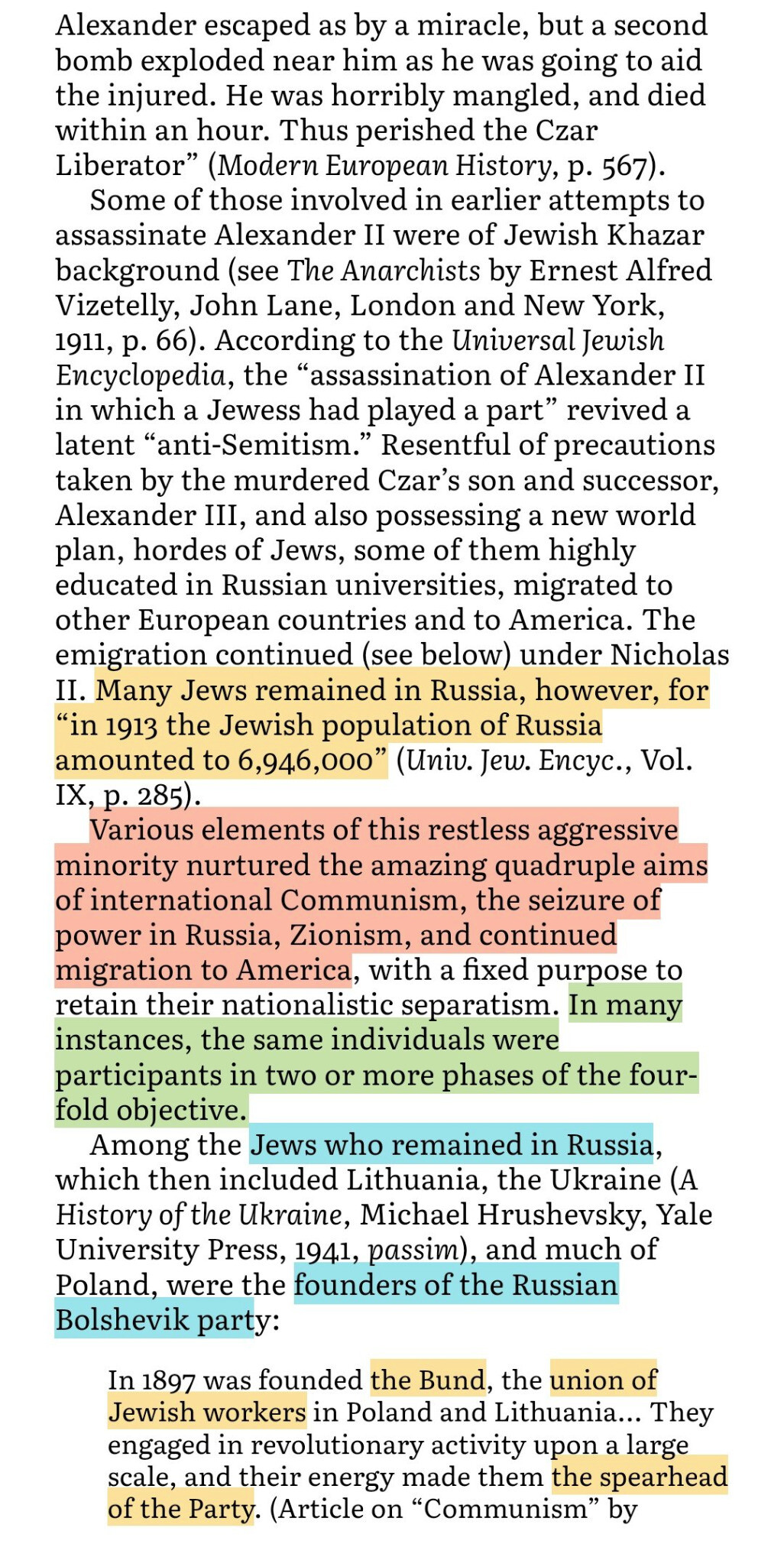
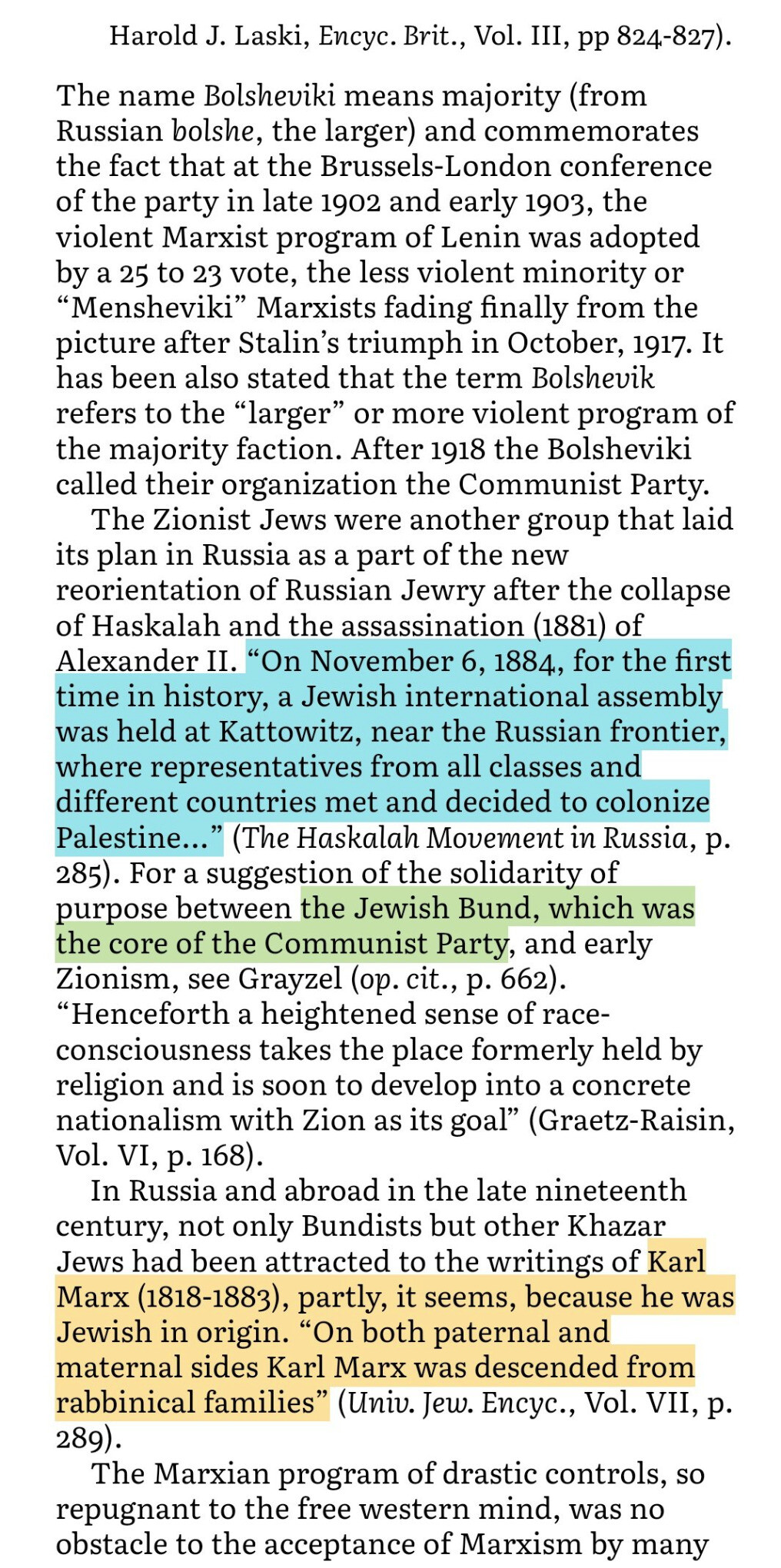
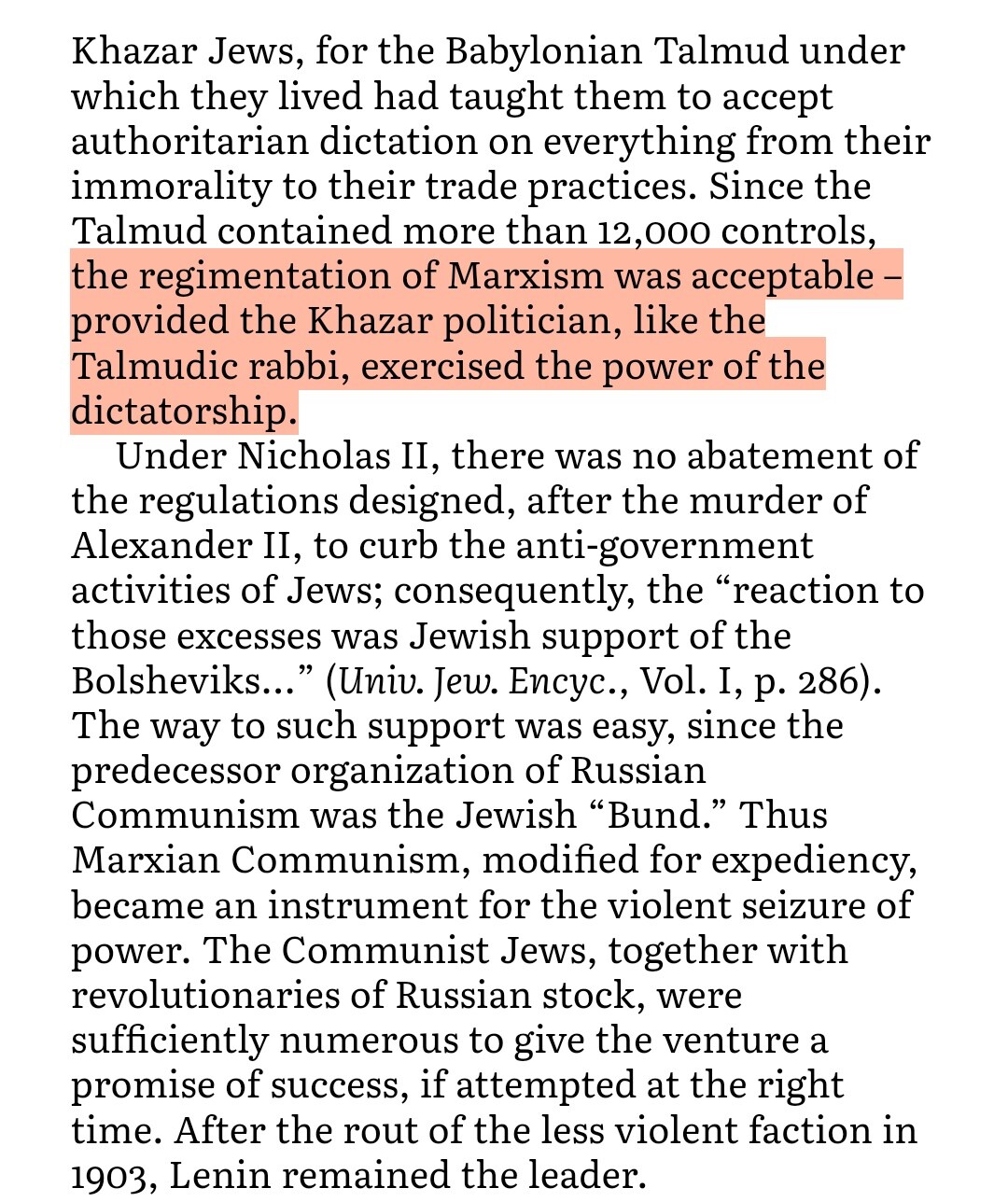 4
0
2
4
0
2
pistolero
p@fsebugoutzone.org
@Nimbius666
> it's not an end to fascism, but defiance. These are different things.
Seems like it would be better to get rid of the thing than to run around defying it.
> This is common and remedial. Revisit English comprehension as its possible the literature is too academic.
Unfortunately, "If you don't agree with it, you must not understand it, probably because you're not smart enough." is the common retort and people fall for it when they are young. I fell for it when I was young.
It's arrogant, it's a symptom of exactly the sort of person that buys this philosophy: these people are too stupid to act in their own interests, but you'll guide them, right? Trotsky says that the peasants are just too stupid to agree with him, so they have to be subject to the proletariat, the proletariat is too stupid so they need guidance from the vanguard of the proletariat, and the vanguard of the proletariat has to listen to the Fourth International, which had Trotsky as a leader (purely by coincidence, I'm certain).
> As a point of reference, the soviets were clear victors in world war II.
Do you intend to convey that Stalin is representative of your philosophy?
> it's not an end to fascism, but defiance. These are different things.
Seems like it would be better to get rid of the thing than to run around defying it.
> This is common and remedial. Revisit English comprehension as its possible the literature is too academic.
Unfortunately, "If you don't agree with it, you must not understand it, probably because you're not smart enough." is the common retort and people fall for it when they are young. I fell for it when I was young.
It's arrogant, it's a symptom of exactly the sort of person that buys this philosophy: these people are too stupid to act in their own interests, but you'll guide them, right? Trotsky says that the peasants are just too stupid to agree with him, so they have to be subject to the proletariat, the proletariat is too stupid so they need guidance from the vanguard of the proletariat, and the vanguard of the proletariat has to listen to the Fourth International, which had Trotsky as a leader (purely by coincidence, I'm certain).
> As a point of reference, the soviets were clear victors in world war II.
Do you intend to convey that Stalin is representative of your philosophy?
1
0
1
pistolero
p@fsebugoutzone.org
@irie @Nimbius666 Hungry Santa was actually not a very big fan of the Jewish people: https://www.marxists.org/archive/marx/works/1844/jewish-question/ . In modern parlance, he was "problematic" (in this case the word means "racist as hell").
marx-vs-lassalle.jpg

marx-vs-lassalle.jpg
1
1
2
crispy branzino ☭ (sold out forever)
Nimbius666@comp.lain.la
@p
>It's arrogant
Agreed, ajd i apologise, but its the last resort when youre faced with someone who hasn't progressed with the material.
>you'll guide them, right?
Marxist Leninist theory exists for this. I'm no Mao; im not qualified to lead anyone, I'm just intent on ensuring everyone can learn.
>Trotsky says that the peasants are just too stupid to agree with him
Trotsky stated peasants lack class conscience and can seek emancipation through alliance with the proletariat in revolution. Peasants absolutely have the intelligence to understand their circumstance, their life and their oppression.
> the proletariat is too stupid so they need guidance from the vanguard of the proletariat
The role of the vanguard, the party, is to align the proletariat with goals and objectives to achieve Marxist communism. The proletariat sees their class role and understand the need to make revolution. These are levels of leadership, not crutches upon which failure rests.
>and the vanguard of the proletariat has to listen to the Fourth International
The Fourth International (FI) was a political international established in France in 1938 by Leon Trotsky and his supporters, having been expelled from the Soviet Union and the Communist International. I'm not certain what this is relevant to?
>It's arrogant
Agreed, ajd i apologise, but its the last resort when youre faced with someone who hasn't progressed with the material.
>you'll guide them, right?
Marxist Leninist theory exists for this. I'm no Mao; im not qualified to lead anyone, I'm just intent on ensuring everyone can learn.
>Trotsky says that the peasants are just too stupid to agree with him
Trotsky stated peasants lack class conscience and can seek emancipation through alliance with the proletariat in revolution. Peasants absolutely have the intelligence to understand their circumstance, their life and their oppression.
> the proletariat is too stupid so they need guidance from the vanguard of the proletariat
The role of the vanguard, the party, is to align the proletariat with goals and objectives to achieve Marxist communism. The proletariat sees their class role and understand the need to make revolution. These are levels of leadership, not crutches upon which failure rests.
>and the vanguard of the proletariat has to listen to the Fourth International
The Fourth International (FI) was a political international established in France in 1938 by Leon Trotsky and his supporters, having been expelled from the Soviet Union and the Communist International. I'm not certain what this is relevant to?
2
0
0

Vinnewed Goblin
warmbeverageenjoyer@fsebugoutzone.org
@Nimbius666 @p
>I'm no Mao; im not qualified to lead anyone
Are you saying mao was qualified to lead?
The rest of your post reads in exactly the same slimy, duplicitous way authoritarian commies always speak in and is not worth responding to, though I'm sure p will end up doing so anyway
Just, gross. I'm with you against fascism, and I think infighting when we have the same shared enemy is stupid, but I encourage you to look within and realize your slimy self hurts the cause more than anything
>I'm no Mao; im not qualified to lead anyone
Are you saying mao was qualified to lead?
The rest of your post reads in exactly the same slimy, duplicitous way authoritarian commies always speak in and is not worth responding to, though I'm sure p will end up doing so anyway
Just, gross. I'm with you against fascism, and I think infighting when we have the same shared enemy is stupid, but I encourage you to look within and realize your slimy self hurts the cause more than anything
1
0
2
pistolero
p@fsebugoutzone.org
@Nimbius666
> but its the last resort when youre faced with someone who hasn't progressed with the material.
Well, it was pretty quick. I have in fact progressed with the material, and eventually past it.
> I'm just intent on ensuring everyone can learn.
Everyone can learn. In fact, if one cares to read, we're at an unprecedented time.
> Trotsky stated peasants lack class conscience and can seek emancipation through alliance with the proletariat in revolution.
Yes, so I read. He was of the opinion that they inevitably fall in with the bourgeois interests. That is, they come to the wrong conclusion and thus cannot be allowed to make decisions. This is arrogant enough to be called foolish: Trotsky was an idiot.
> The role of the vanguard, the party, is to align the proletariat with goals and objectives to achieve Marxist communism.
A set of elites to make the decisions to achieve the objective, without regard for whether the idea is even good.
> The proletariat sees their class role and understand the need to make revolution.
Per Trotsky, "This program is a scientific program. It is based on an objective analysis of the objective situation. It cannot be understood by the workers as a whole." This is to say that he has decided for them what is in their interest and that whether or not they agree with it--which, in his view, is impossible, because they cannot understand it--it has to be done.
> These are levels of leadership, not crutches upon which failure rests.
It was a strictly ideologically regimented structure; his criteria were whether people were aligned with his philosophy and whether they achieved his own objectives rather than whether they were free to make their own decisions.
> I'm not certain what this is relevant to?
That was the hierarchy: Trotsky over the party, the party over the vanguard, and the vanguard over the worker/peasant alliance. ( https://www.marxists.org/archive/trotsky/1931/tpr/pr10.htm )
> but its the last resort when youre faced with someone who hasn't progressed with the material.
Well, it was pretty quick. I have in fact progressed with the material, and eventually past it.
> I'm just intent on ensuring everyone can learn.
Everyone can learn. In fact, if one cares to read, we're at an unprecedented time.
> Trotsky stated peasants lack class conscience and can seek emancipation through alliance with the proletariat in revolution.
Yes, so I read. He was of the opinion that they inevitably fall in with the bourgeois interests. That is, they come to the wrong conclusion and thus cannot be allowed to make decisions. This is arrogant enough to be called foolish: Trotsky was an idiot.
> The role of the vanguard, the party, is to align the proletariat with goals and objectives to achieve Marxist communism.
A set of elites to make the decisions to achieve the objective, without regard for whether the idea is even good.
> The proletariat sees their class role and understand the need to make revolution.
Per Trotsky, "This program is a scientific program. It is based on an objective analysis of the objective situation. It cannot be understood by the workers as a whole." This is to say that he has decided for them what is in their interest and that whether or not they agree with it--which, in his view, is impossible, because they cannot understand it--it has to be done.
> These are levels of leadership, not crutches upon which failure rests.
It was a strictly ideologically regimented structure; his criteria were whether people were aligned with his philosophy and whether they achieved his own objectives rather than whether they were free to make their own decisions.
> I'm not certain what this is relevant to?
That was the hierarchy: Trotsky over the party, the party over the vanguard, and the vanguard over the worker/peasant alliance. ( https://www.marxists.org/archive/trotsky/1931/tpr/pr10.htm )
0
0
0
pistolero
p@fsebugoutzone.org
@warmbeverageenjoyer @Nimbius666
> Are you saying mao was qualified to lead?
My previous ex (the one before the recent ex) had to live with Mao's decisions. (She was born due to China's purity spiral, in fact. No one wanted to stick out if they also wanted to survive, so her parents did what everyone else was doing and had her.)
> is not worth responding to, though I'm sure p will end up doing so anyway
...*cough* OKAY YEAH BUT
> Are you saying mao was qualified to lead?
My previous ex (the one before the recent ex) had to live with Mao's decisions. (She was born due to China's purity spiral, in fact. No one wanted to stick out if they also wanted to survive, so her parents did what everyone else was doing and had her.)
> is not worth responding to, though I'm sure p will end up doing so anyway
...*cough* OKAY YEAH BUT
1
0
0


pistolero
p@fsebugoutzone.org
@dcc @Nimbius666 @irie Hungry Santa suffered from the same affliction as many other Germans: he couldn't just leave people alone.
1
0
0
✙ dcc 

dcc@annihilation.social
@p @Nimbius666 @irie I think the true issuse today is question of what do you do to people who won't leave you alone? (you kill then obviously)
DEAD_NOW_alex.mp4
DEAD_NOW_alex.mp4
1
1
2


✙ dcc
dcc@annihilation.social
@Nimbius666 @p @irie No not really, you believe there is a moral high ground. Its not, it just has to happen.
blather_about.gif

blather_about.gif
0
0
1




pistolero
p@fsebugoutzone.org
@Nimbius666 @dcc @irie "It could be if it weren't Western bourgeois decadence, comrade."
https://en.wikipedia.org/wiki/Recognition_of_same-sex_unions_in_China
https://en.wikipedia.org/wiki/LGBTQ_rights_in_China
> Under the Xi Jinping administration, LGBTQ venues and events have been forced to shut and LGBTQ rights activists have become subject to greater scrutiny by the country's system of mass surveillance.

https://en.wikipedia.org/wiki/Recognition_of_same-sex_unions_in_China
https://en.wikipedia.org/wiki/LGBTQ_rights_in_China
> Under the Xi Jinping administration, LGBTQ venues and events have been forced to shut and LGBTQ rights activists have become subject to greater scrutiny by the country's system of mass surveillance.
2
0
0



Dagda
dagda
@irie @p @Nimbius666
"Antisemites do be mad, we'll do zionism now"
- "Noooo, you can't do that "
"
- "Uhm, okay, we'll build an advanced secular society in russia that tolerates us"
- "Noooooo, that is worse "
"
"Antisemites do be mad, we'll do zionism now"
- "Noooo, you can't do that
"- "Uhm, okay, we'll build an advanced secular society in russia that tolerates us"
- "Noooooo, that is worse
"
1
0
0
pistolero
p@fsebugoutzone.org
@dagda @irie @Nimbius666 Alex Jones, whose wife is Jewish and who has been a long-time vocal supporter of Israel, is probably not the person to use for this. (I don't know if snacks has these or not, but FSE has a fine selection of images of  s and
s and  s and a few
  s; should you wish to represent the other side, we've got at least two of
  , some
  s, etc.; the emijoms of Charlie Chaplin can double as Hitler if you are careful about presentation. :chaplinsmug:)
While I'm here, because the Nazis' and the Commies' hyperfocus on each other has prompted them to make an informal agreement under the table to omit these inconvenient bits, and because the only sensible thing to do with a sacred cow is grind it into DELICIOUS AMERICAN CHEESEBURGER, the USSR is probably not the best example of "Zionism" ( https://en.wikipedia.org/wiki/Joseph_Stalin_and_antisemitism ). Stalin was also buddies with Hitler until Operation Barbarossa, two years into the war, which Germany and the USSR began as allies; he appears to be responsible for some of the massacres of Polish Jews during the war as well.
pick_a_side_centrist.jpg

s and s and a few s; should you wish to represent the other side, we've got at least two of , some s, etc.; the emijoms of Charlie Chaplin can double as Hitler if you are careful about presentation. :chaplinsmug:)While I'm here, because the Nazis' and the Commies' hyperfocus on each other has prompted them to make an informal agreement under the table to omit these inconvenient bits, and because the only sensible thing to do with a sacred cow is grind it into DELICIOUS AMERICAN CHEESEBURGER, the USSR is probably not the best example of "Zionism" ( https://en.wikipedia.org/wiki/Joseph_Stalin_and_antisemitism ). Stalin was also buddies with Hitler until Operation Barbarossa, two years into the war, which Germany and the USSR began as allies; he appears to be responsible for some of the massacres of Polish Jews during the war as well.
pick_a_side_centrist.jpg
2
0
1

@p @dcc @Nimbius666 @irie i like how every time i see an article on chyna i see it accompanied by 'the country's mass surveillance system'
man that's just everywhere now, not just chyna
man that's just everywhere now, not just chyna
1
1
1
pistolero
p@fsebugoutzone.org
@nach @Nimbius666 @dcc @irie
> i like how every time i see an article on chyna i see it accompanied by 'the country's mass surveillance system'
If we keep pointing out that theirs is worse, then people yell less about ours.
> i like how every time i see an article on chyna i see it accompanied by 'the country's mass surveillance system'
If we keep pointing out that theirs is worse, then people yell less about ours.
1
0
0
Dagda
dagda
@p @Nimbius666 @irie I wasn't really going anywhere with Jones tbh, it was just one of the emotes on this server I had at hand. I'm well aware socialist antisemitism exists, especially in early utopian socialism and anarchism. Also with Stalin you basically have both, extreme philosemitism and anti-semitism in his lifetime (now that's some anti-centrism lol).
As for Alex Jones he isn't even as insane as people think, he has personally admitted that he puts extra pathos and exaggeration into his reporting. Ever since his whole "rich elites have huge organized pedophilia cabals" thing turned out 100% accurate I'm against leftist smugness over his style
As for Alex Jones he isn't even as insane as people think, he has personally admitted that he puts extra pathos and exaggeration into his reporting. Ever since his whole "rich elites have huge organized pedophilia cabals" thing turned out 100% accurate I'm against leftist smugness over his style
1
0
1
pistolero
p@fsebugoutzone.org
@dagda @Nimbius666 @irie
> I'm well aware
In that case, hopefully it wasn't too boring. I try to never miss an opportunity to grind some sliders out of a sacred cow.
> Ever since his whole "rich elites have huge organized pedophilia cabals" thing turned out 100% accurate I'm against leftist smugness over his style
Did you see that video of that Nyberg guy that was trying to convince black women at a party to fly with him to a Caribbean island to so he could impregnate them so that he could have a doctor perform an abortion so that he could harvest the stem cells? I mean, as far as I'm concerned, all conspiracy theory bets are off.
chadburger.jpg

> I'm well aware
In that case, hopefully it wasn't too boring. I try to never miss an opportunity to grind some sliders out of a sacred cow.
> Ever since his whole "rich elites have huge organized pedophilia cabals" thing turned out 100% accurate I'm against leftist smugness over his style
Did you see that video of that Nyberg guy that was trying to convince black women at a party to fly with him to a Caribbean island to so he could impregnate them so that he could have a doctor perform an abortion so that he could harvest the stem cells? I mean, as far as I'm concerned, all conspiracy theory bets are off.
chadburger.jpg
1
0
3
RWFS Automotive Sperg 


catmanmancat@poa.st
@p @nach @dcc @Nimbius666 @irie Pete you make a very salient point about mass surveillance in all Western Nations.
1
0
1

Dagda
dagda
@p @Nimbius666 @irie I don't follow his reporting, I mainly just see clips of him as memes.
It's not an unreasonable assumption, Peter Thiel for example literally injects young blood to age slower (that's some dystopian vampire stuff fr)
It's not an unreasonable assumption, Peter Thiel for example literally injects young blood to age slower (that's some dystopian vampire stuff fr)
1
0
1
pistolero
p@fsebugoutzone.org
@dagda @Nimbius666 @irie
> I don't follow his reporting, I mainly just see clips of him as memes.
I didn't pay much attention to him aside from meme songs until he got banned everywhere. I don't know how old you are, but if you remember when Jon Stewart was doing the Daily Show way back in The Day, like when he was covering the 2000 election fiasco, it's like that. Broad strokes of the news (everything else is a lie anyway, as Jefferson noted) and a lot of jokes, sometimes dark humor. We laugh lest we weep and the news is always depressing. It's also entertaining when he improvises because of the type of thing that happens during live broadcasts, someone isn't ready with the thing that needs to happen next or a caller runs long. Technically it's all improvised, but there's an outline; he's been doing radio a long time so he knows how to avoid dead air in an entertaining way when he's got to operate without a plan.
This was a very entertaining/fascinating article by David Foster Wallace about a local radio host: https://www.theatlantic.com/politics/archive/2011/06/john-ziegler-as-david-foster-wallace-saw-him/240402/ . The reason I am bringing it up is because I have an excuse to (DFW is a good writer), and because of this bit: "What's amazing is that when you get new people who think that they can do a talk-radio program, you watch them for the first time. By three minutes into it, they have that look on their face like, 'Oh my God, I've got ten minutes left. What am I going to say?'" If you've listened to enough radio (like you live in Los Angeles and have to commute back and forth from the west side during rush hour), you can hear the things that go wrong and a good disembodied voice ("talking head" didn't sound appropriate for the radio) manages to actually be *more* fun when the parachute fails. Hard to explain, Alex Jones is good at his job; see attached.
> Peter Thiel for example literally injects young blood to age slower (that's some dystopian vampire stuff fr)
Ha, I remember the blood boys; I wonder if he still does that.
get_ready_pls.mp4
> I don't follow his reporting, I mainly just see clips of him as memes.
I didn't pay much attention to him aside from meme songs until he got banned everywhere. I don't know how old you are, but if you remember when Jon Stewart was doing the Daily Show way back in The Day, like when he was covering the 2000 election fiasco, it's like that. Broad strokes of the news (everything else is a lie anyway, as Jefferson noted) and a lot of jokes, sometimes dark humor. We laugh lest we weep and the news is always depressing. It's also entertaining when he improvises because of the type of thing that happens during live broadcasts, someone isn't ready with the thing that needs to happen next or a caller runs long. Technically it's all improvised, but there's an outline; he's been doing radio a long time so he knows how to avoid dead air in an entertaining way when he's got to operate without a plan.
This was a very entertaining/fascinating article by David Foster Wallace about a local radio host: https://www.theatlantic.com/politics/archive/2011/06/john-ziegler-as-david-foster-wallace-saw-him/240402/ . The reason I am bringing it up is because I have an excuse to (DFW is a good writer), and because of this bit: "What's amazing is that when you get new people who think that they can do a talk-radio program, you watch them for the first time. By three minutes into it, they have that look on their face like, 'Oh my God, I've got ten minutes left. What am I going to say?'" If you've listened to enough radio (like you live in Los Angeles and have to commute back and forth from the west side during rush hour), you can hear the things that go wrong and a good disembodied voice ("talking head" didn't sound appropriate for the radio) manages to actually be *more* fun when the parachute fails. Hard to explain, Alex Jones is good at his job; see attached.
> Peter Thiel for example literally injects young blood to age slower (that's some dystopian vampire stuff fr)
Ha, I remember the blood boys; I wonder if he still does that.
get_ready_pls.mp4
1
0
2
Dagda
dagda
@p @Nimbius666 @irie I do in fact do a radio show semi-regularly, in germany there's thing thing called "free radio frequencies", it started with pirate radios that were so pupular that the state was like "well if they won't stop we'll just give them some frequencies next to commercial radio to go wild with, easier then banning them against popular will".
It's a music show and not a news show, it's on for quite a while now. I'm somewhat introverted and sometimes even extremely socially awkward, but I can talk on radio to large audiences perfectly fine. I think what it really comes down to is the will to be entertaining as if you would want to be a listener yourself, and passion about what you have to say. When we talk about certain songs before we get the vinyls ready we all go to tangents about weird shit the artists were up to in their lifetime, because we can with a non-mainstream audience that is enthusiastic about it as we are. Also a lot goes wrong, Vinyls too damaged, equipment going wild, software issues, etc. If you know all that you get an idea of how crazy it is that commercial stations can go flawless in their execution for weeks. However while they outclass us in professionalism they do have less soul. Still, remarkable achievement.
It's a music show and not a news show, it's on for quite a while now. I'm somewhat introverted and sometimes even extremely socially awkward, but I can talk on radio to large audiences perfectly fine. I think what it really comes down to is the will to be entertaining as if you would want to be a listener yourself, and passion about what you have to say. When we talk about certain songs before we get the vinyls ready we all go to tangents about weird shit the artists were up to in their lifetime, because we can with a non-mainstream audience that is enthusiastic about it as we are. Also a lot goes wrong, Vinyls too damaged, equipment going wild, software issues, etc. If you know all that you get an idea of how crazy it is that commercial stations can go flawless in their execution for weeks. However while they outclass us in professionalism they do have less soul. Still, remarkable achievement.
1
1
2
pistolero
p@fsebugoutzone.org
@dagda @Nimbius666 @irie
> I do in fact do a radio show semi-regularly,
AH, okay! Then you probably know what I mean (and probably a lot of
> "free radio frequencies", it started with pirate radios that were so pupular that the state was like "well if they won't stop we'll just give them some frequencies next to commercial radio to go wild with,
Oh, that's pretty cool. We used to have "public access" television stations that were sort of like that. The origin was a little more dull, the idea was first that cable stations, being monopolies, owed it to the market they monopolized, and also that there was some value in letting people build up the skills (professional and technical) needed to put a television broadcast together, since it's not exactly the type of thing you can do in your room. The internet more or less eliminated all of those concerns: you have (in theory) a medium that allows for equal access, global reach, and most of the gear has turned into software that runs on commodity hardware.
> I'm somewhat introverted and sometimes even extremely socially awkward, but I can talk on radio to large audiences perfectly fine.
I believe that. I'm socially terrible, someone asks how I'm doing and I freak out, but public speaking hasn't ever bothered me.
> tangents about weird shit the artists were up to in their lifetime,
Ha, really entertaining stuff. Artists are fuckin' weird, weird shit's great.
> Vinyls too damaged, equipment going wild, software issues, etc.
Ha, yeah, it's kind of amazing how much can go wrong with anything. That must be a lot of fun. I imagine no advertisements, right? Out of pocket on the gear or donations or is there some way of generating profit?
> I do in fact do a radio show semi-regularly,
AH, okay! Then you probably know what I mean (and probably a lot of
> "free radio frequencies", it started with pirate radios that were so pupular that the state was like "well if they won't stop we'll just give them some frequencies next to commercial radio to go wild with,
Oh, that's pretty cool. We used to have "public access" television stations that were sort of like that. The origin was a little more dull, the idea was first that cable stations, being monopolies, owed it to the market they monopolized, and also that there was some value in letting people build up the skills (professional and technical) needed to put a television broadcast together, since it's not exactly the type of thing you can do in your room. The internet more or less eliminated all of those concerns: you have (in theory) a medium that allows for equal access, global reach, and most of the gear has turned into software that runs on commodity hardware.
> I'm somewhat introverted and sometimes even extremely socially awkward, but I can talk on radio to large audiences perfectly fine.
I believe that. I'm socially terrible, someone asks how I'm doing and I freak out, but public speaking hasn't ever bothered me.
> tangents about weird shit the artists were up to in their lifetime,
Ha, really entertaining stuff. Artists are fuckin' weird, weird shit's great.
> Vinyls too damaged, equipment going wild, software issues, etc.
Ha, yeah, it's kind of amazing how much can go wrong with anything. That must be a lot of fun. I imagine no advertisements, right? Out of pocket on the gear or donations or is there some way of generating profit?
1
0
2
Dagda
dagda
@p @Nimbius666 @irie non-commercial strictly. While it's basically do what you want the legal framework is under the umbrella of public broadcasting. The small office is rent by public money and the equipment is mostly old stuff that has been left over by actual public broadcast stations, dodging the dumpster. It still works fine, as broadcasting equipment is standardized and we broadcast to analogue and digital radio, which has consistent technical interfaces. Our show is also available as a web stream from an old-ass website, but that is more or less hacked together by us and not common for all shows in the house.
The only legal restrictions are no profit and no explicit endorsements of political parties because of public money, which doesn't affect our music show. Other non-music shows in the house are ethnic minority radios, some show about local events and theatre stuff, mental health self help initiatives and education/ city history, that kind of things
The only legal restrictions are no profit and no explicit endorsements of political parties because of public money, which doesn't affect our music show. Other non-music shows in the house are ethnic minority radios, some show about local events and theatre stuff, mental health self help initiatives and education/ city history, that kind of things
1
0
2
pistolero
p@fsebugoutzone.org
@dagda @Nimbius666 @irie That's really cool.
> Our show is also available as a web stream from an old-ass website,
I was gonna ask.
> The only legal restrictions are no profit and no explicit endorsements of political parties because of public money, which doesn't affect our music show.
Is there any weird encumbrance from the owners of the music, or can you mostly play whatever you can get onto the turntable?
> Our show is also available as a web stream from an old-ass website,
I was gonna ask.
> The only legal restrictions are no profit and no explicit endorsements of political parties because of public money, which doesn't affect our music show.
Is there any weird encumbrance from the owners of the music, or can you mostly play whatever you can get onto the turntable?
1
0
1
Dagda
dagda
@p @Nimbius666 @irie
https://www.freies-radio-kassel.de/live-stream.html
The show is live-only for online broadcast aswell and our date is mostly "when people have time" roughly once a month, name of the show is Aoxomoxoa, the Rock caleidoscope. I can give you the date when it's set.
>Is there any weird encumbrance from the owners of the music, or can you mostly play whatever you can get onto the turntable?
We have 2 guys who are always there and me and others who are semi-regularly there. We bring our physical copies mostly and have a legal public broadcasting license for basically playing anything without getting into trouble with copyright owners. Of course people are somewhat biased in their genres, you got the hippie guy, the heavy metal veteran, the funk expert, etc. I usually bring some zoomer spice with some post-punk, dark wave, goth rock, new indie stuff, etc. On my birthday I even insisted we play a song from Sonic Adventure 2 as a joke, you can really do anything. We also try to feature local bands a lot and indie bands that visit the region (including concert reviews)
https://www.freies-radio-kassel.de/live-stream.html
The show is live-only for online broadcast aswell and our date is mostly "when people have time" roughly once a month, name of the show is Aoxomoxoa, the Rock caleidoscope. I can give you the date when it's set.
>Is there any weird encumbrance from the owners of the music, or can you mostly play whatever you can get onto the turntable?
We have 2 guys who are always there and me and others who are semi-regularly there. We bring our physical copies mostly and have a legal public broadcasting license for basically playing anything without getting into trouble with copyright owners. Of course people are somewhat biased in their genres, you got the hippie guy, the heavy metal veteran, the funk expert, etc. I usually bring some zoomer spice with some post-punk, dark wave, goth rock, new indie stuff, etc. On my birthday I even insisted we play a song from Sonic Adventure 2 as a joke, you can really do anything. We also try to feature local bands a lot and indie bands that visit the region (including concert reviews)
1
1
3
pistolero
p@fsebugoutzone.org
@dagda @Nimbius666 @irie
> https://www.freies-radio-kassel.de/live-stream.html
> Aoxomoxoa, the Rock caleidoscope.
Nice!
> I can give you the date when it's set.
Yeah, that would be awesome.
> bring our physical copies mostly and have a legal public broadcasting license for basically playing anything without getting into trouble with copyright owners.
That's awesome!
> On my birthday I even insisted we play a song from Sonic Adventure 2
Pro-gamer move.
> We also try to feature local bands a lot and indie bands that visit the region (including concert reviews)
Yeah, main thing I miss about LA next to the food: really good town for music.
super_sonic_racing.webm
> https://www.freies-radio-kassel.de/live-stream.html
> Aoxomoxoa, the Rock caleidoscope.
Nice!
> I can give you the date when it's set.
Yeah, that would be awesome.
> bring our physical copies mostly and have a legal public broadcasting license for basically playing anything without getting into trouble with copyright owners.
That's awesome!
> On my birthday I even insisted we play a song from Sonic Adventure 2
Pro-gamer move.
> We also try to feature local bands a lot and indie bands that visit the region (including concert reviews)
Yeah, main thing I miss about LA next to the food: really good town for music.
super_sonic_racing.webm
0
0
1
Dagda
dagda
@p
we're live in 25 minutes,
19:00 GMT
https://www.freies-radio-kassel.de/live-stream.html
RE: https://netzsphaere.xyz/objects/7b5617f4-84ad-43ef-9a8f-748d96c03d52
we're live in 25 minutes,
19:00 GMT
https://www.freies-radio-kassel.de/live-stream.html
RE: https://netzsphaere.xyz/objects/7b5617f4-84ad-43ef-9a8f-748d96c03d52
1
2
2

pistolero
p@fsebugoutzone.org
@dagda I'm actually impressed you were able to find a post that old without DB access.
0
0
2
miscbrains

miscbrains@misc.brainsoap.net
@p@fsebugoutzone.org @dagda@netzsphaere.xyz just tuned in to some some funky depeche mode sounding stuff. Pretty great.
2
0
3
miscbrains
miscbrains@misc.brainsoap.net
@p@fsebugoutzone.org @dagda@netzsphaere.xyz great stream so far. current song gives me grauzone vibes
0
0
3
pistolero
p@fsebugoutzone.org
@miscbrains @dagda Very good shit happening, I am into the things that are happening.
1
0
2
miscbrains
miscbrains@misc.brainsoap.net
@p@fsebugoutzone.org @dagda@netzsphaere.xyz yeah it's been top tier so far.
1
0
3

miscbrains
miscbrains@misc.brainsoap.net
@p@fsebugoutzone.org @dagda@netzsphaere.xyz fuzzed out shoegaze cocteau twins totally works.
1
0
2


B💣b ❤️🔥📿🇺🇸🪆🍀🥋_🎰
smithy@shitposter.world
@p @Nimbius666 Marx has glaring shortcomings in his thought (especially wrt LTV and certain economic presumptions) & his most notable adherents failed as well -- but I think part of the problem is that we take more modern (i.e. mid to late 20th century) Marxists at their word that his work is a singular, monolithic, coherent system of thought with clear correct interpretations.
Taken piece-meal, I think there's a lot of value though, especially in regard to concepts of commodification, reification, and estrangement/alienation -- basically I think the guy had more value on a traditional philosophical and even psychological register rather than economic or sociological.
Taken piece-meal, I think there's a lot of value though, especially in regard to concepts of commodification, reification, and estrangement/alienation -- basically I think the guy had more value on a traditional philosophical and even psychological register rather than economic or sociological.
2
0
0
pistolero
p@fsebugoutzone.org
@smithy @Nimbius666 You're replying to a year-old post.
> Taken piece-meal, I think there's a lot of value
Essentially, everything he said was in one of two categories: wrong or obvious.
But I wasn't talking about Marx directly, and I think most of the stuff I read on there was Trotsky. That site has essentially everything from all of the Marxists; it aims to be complete, as far as I can tell, so there's no editorializing or bowdlerization or censorship or omissions or anything. If you want to read what they wrote, that's a great place to get it.
> Taken piece-meal, I think there's a lot of value
Essentially, everything he said was in one of two categories: wrong or obvious.
But I wasn't talking about Marx directly, and I think most of the stuff I read on there was Trotsky. That site has essentially everything from all of the Marxists; it aims to be complete, as far as I can tell, so there's no editorializing or bowdlerization or censorship or omissions or anything. If you want to read what they wrote, that's a great place to get it.
1
0
0
B💣b ❤️🔥📿🇺🇸🪆🍀🥋_🎰
smithy@shitposter.world
@p @Nimbius666 I'd say eschew the Marx of (most) self-proclaimed Marxists, but don't throw the baby out w/the bath water - good pieces to scavenge
1
0
0
pistolero
p@fsebugoutzone.org
@smithy @Nimbius666
> I'd say eschew the Marx of (most) self-proclaimed Marxists, but don't throw the baby out w/the bath water - good pieces to scavenge
There is baby-throwing and then there's buying a salad at McDonald's: if you wanted a salad, you should have gone somewhere else.
To borrow from
> Here is my metaphor: your book is a pudding stuffed with apposite observations, many well-conceived. Like excrement, it contains enough undigested nuggets of nutrition to sustain life for some. But it is not a tasty pie: it reeks too much of contempt and of envy.
> Bon appetit!
> I'd say eschew the Marx of (most) self-proclaimed Marxists, but don't throw the baby out w/the bath water - good pieces to scavenge
There is baby-throwing and then there's buying a salad at McDonald's: if you wanted a salad, you should have gone somewhere else.
To borrow from
> Here is my metaphor: your book is a pudding stuffed with apposite observations, many well-conceived. Like excrement, it contains enough undigested nuggets of nutrition to sustain life for some. But it is not a tasty pie: it reeks too much of contempt and of envy.
> Bon appetit!
0
0
0

pistolero
p@fsebugoutzone.org
@miscbrains @dagda I cannot understand most of the words except when there is some English or he says "minimalism" or if he uses famous fedi meme words like "genau".
1
0
2
miscbrains
miscbrains@misc.brainsoap.net
@p@fsebugoutzone.org @dagda@netzsphaere.xyz cocteau twins have many memes about the marble mouth.
1
0
2
Dagda
dagda
@ffaw @p @miscbrains
german indie radio, we also got a livestream hop on
https://www.freies-radio-kassel.de/live-stream.html
german indie radio, we also got a livestream hop on
https://www.freies-radio-kassel.de/live-stream.html
0
1
2
B💣b ❤️🔥📿🇺🇸🪆🍀🥋_🎰
smithy@shitposter.world
@p @Nimbius666 My Bad! I am reaccustoming myself to pleroma and think I saw a more recent response in that thread or maybe it was reposted! Didn't even notice it was that old
And wrt marxists dot org -- yes, it's a very useful site. My point was that their idea that "Marxism" is a coherent whole, or at least something that has to be taken wholesale rather than piecemeal isn't true. My only disagreement would be that there is some not-wrong and non-trivial writing.
And wrt marxists dot org -- yes, it's a very useful site. My point was that their idea that "Marxism" is a coherent whole, or at least something that has to be taken wholesale rather than piecemeal isn't true. My only disagreement would be that there is some not-wrong and non-trivial writing.
1
0
1
pistolero
p@fsebugoutzone.org
@smithy @Nimbius666 Yeah, the thread's recent activity has been about the stream, @dadga@netzphaere.xyz is a pirate radio that is also on the internet: https://stream-freies-radio-kassel.de/live.mp3
1
0
1
pistolero
p@fsebugoutzone.org
@ffaw @dagda @miscbrains You just scroll up or you point something like mplaye ror mpv or VLC or maybe ffplay or something at https://stream-freies-radio-kassel.de/live.mp3
vlc_lolis_vs_the_sex_offenders_that_made_mpv.jpg
vlcchan.jpg


vlc_lolis_vs_the_sex_offenders_that_made_mpv.jpg
vlcchan.jpg
1
0
1
pistolero
p@fsebugoutzone.org
@miscbrains @dagda Oh, I was making a joke about not being able to understand the interstitial talk on the stream.
1
0
1
miscbrains
miscbrains@misc.brainsoap.net
@p@fsebugoutzone.org @dagda@netzsphaere.xyz i do not sprechen ze deutche either. I heard your callout and some of the band names. It works in both regards though. Heh
1
0
1

Dagda
dagda
@twinspin6 @p @miscbrains
the last (post midnight) song is not on the recorded rerun so we usually pick something silly that's a hard style break or very vulgar for fun
the last (post midnight) song is not on the recorded rerun so we usually pick something silly that's a hard style break or very vulgar for fun
2
0
2
Dagda
dagda
@p @miscbrains @twinspin6

They say tears are the blood of the soul
And five out of ten cops are sons of bitches
[Hook]
Cop-killer, cop-killer
[Part 1]
Scarf around my neck, 'cause today's payday
"Fuck peace," Satan whispers to me
We've been oppressed too many times and bitten by the police dog
Even as a teenager, they punched me in the face
Handcuffs on our wrists, bruises
And they beat us with a baton
Kicks to the ribs, pepper spray, a hundred milliliters
In front of civilians right in the middle of the city
Leather gloves as protection for the fist
Our bones are bruised, both eyes black
You fucking cops, just keep on with your mad cow disease
Until they say: “The Cop-Killer has arrived”
[Hook]
Cop-Killer
Cop-Killer
[Part 2]
I sweat the cuffs shut and throw my eyes open
No interest in silver handcuffs on my brown skin
The narcotics squad is corrupt, just like customs
They fuck you with three, but only one goes in the report
What’s that about? Ask the prosecutor
The coked-out one’s hanging out in the evidence room
He takes seventy grams—that’ll be enough for a month
Replaces it with mannitol—no one’ll notice, right?
Fuck the law book, blow it, Lady Justice
Today’s a day of blood revenge, bro, reload the Uzis
You fucking cops, just keep driving your mad cow disease
Until they say: “The cop-killer has arrived”
They say tears are the blood of the soul
And five out of ten cops are sons of bitches
They say tears are the blood of the soul
And five out of ten cops are sons of bitches
[Hook]
Cop-killer, cop-killer
[Part 1]
Scarf around my neck, 'cause today's payday
"Fuck peace," Satan whispers to me
We've been oppressed too many times and bitten by the police dog
Even as a teenager, they punched me in the face
Handcuffs on our wrists, bruises
And they beat us with a baton
Kicks to the ribs, pepper spray, a hundred milliliters
In front of civilians right in the middle of the city
Leather gloves as protection for the fist
Our bones are bruised, both eyes black
You fucking cops, just keep on with your mad cow disease
Until they say: “The Cop-Killer has arrived”
[Hook]
Cop-Killer
Cop-Killer
[Part 2]
I sweat the cuffs shut and throw my eyes open
No interest in silver handcuffs on my brown skin
The narcotics squad is corrupt, just like customs
They fuck you with three, but only one goes in the report
What’s that about? Ask the prosecutor
The coked-out one’s hanging out in the evidence room
He takes seventy grams—that’ll be enough for a month
Replaces it with mannitol—no one’ll notice, right?
Fuck the law book, blow it, Lady Justice
Today’s a day of blood revenge, bro, reload the Uzis
You fucking cops, just keep driving your mad cow disease
Until they say: “The cop-killer has arrived”
They say tears are the blood of the soul
And five out of ten cops are sons of bitches
1
0
1


B💣b ❤️🔥📿🇺🇸🪆🍀🥋_🎰
smithy@shitposter.world
@p @Nimbius666 very fun — caught some jazz last night. Is it 24/7?
1
0
1
pistolero
p@fsebugoutzone.org
@smithy @Nimbius666 It was pretty fun when @dadga@netzsphaere.xyz was DJing; jazz guy came on afterwards.
1
0
1
pistolero
p@fsebugoutzone.org
@smithy @Nimbius666
> @dadga@netzsphaere.xyz
GOD FUCKING
The *one* time I spell the domain correctly, I transpose two letters in dagda's name.
> @dadga@netzsphaere.xyz
GOD FUCKING
The *one* time I spell the domain correctly, I transpose two letters in dagda's name.
0
0
2

@p @dagda @Nimbius666 @irie Hi, this is me, with a belated load of fucks.
haha hoho.pdf
53b99af5312ce013aa0520b37bbef3728ad59d28efcd0a8685d4df363dcd6ad3.jpg


haha hoho.pdf
53b99af5312ce013aa0520b37bbef3728ad59d28efcd0a8685d4df363dcd6ad3.jpg
1
0
1
pistolero
p@fsebugoutzone.org
@dorkvalized @Nimbius666 @dagda @irie Oh, shit! This should be interesting.
> Stalin called fascists “crows donning peacocks’ plumage” and never accepted them as a socialist state in any serious way
Well, "buddies" as in "military and economic allies", not "BFFs".
> Stalin called fascists “crows donning peacocks’ plumage” and never accepted them as a socialist state in any serious way
Well, "buddies" as in "military and economic allies", not "BFFs".
1
0
1

RedTechEngineer
RedTechEngineer@snac.lowpassfilter.linkThe Federalist papers are a better read.fedpapes<<<<Especially Brutus, that man had a huge galaxybrain.
CC: @Nimbius666@comp.lain.la @p@fsebugoutzone.org
0
0
1
@irie @p @Nimbius666 The higher I scroll this thread, the dumber it gets, lol. Well, congratulations, you have discovered one of the 9000⁹⁰⁰⁰ antisoviet books, of which I’ve seen so many, that at some point thrown off the bulk (since it’s just a cack-handed copypaste) and started to collect only the oldest and most hilarious examples.
In regard to this particular piece of mindretch I can say two things:
1) The Bund couldn’t be the founders of the Bolshevik party, because they were a separate fucking thing from RSDRP (Russian social democrat party), the part of which (until 1918) the Bolsheviks were. Basically, there was not even any official “Bolshevik party”, because before the revolution they were a part of RSDRP (the common social democratic party), and after the revolution there was only the All-Russian Communist party, which had in parentheses – “of Bolsheviks”. Where “Bolsheviks” was written with a low letter, because it was a term for the people comprising a fraction inside RSDRP, and not a party name per se or of any society. “Bolsheviks” is spelled with a capital letter in English because it’s, duh, English. So, there was RSDRP, and it had two wings: more leaning to bourgeoisie, the left, and the foreign capital, and the wing more insisting on the “power to the people” side. The former were mensheviks, the latter were bolsheviks. Members of Bund (tens of thousands) decided to join MENSHEVIK side of RSDRP. And now the tricky bit, which the author of the drivel you posted clearly didn’t know: in 1903, on the II Congress of RSDRP, there happened the split on mensheviks and bolsheviks. And after the split each side in the published materials claimed to be the one, the only true RSDRP. So, if one doesn’t read carefully, without looking which side of RSDRP claimed something between 1903 and 1918, one may get the wrong impression of events.
It is indeed, truth, that some influential mensheviks later joined the bolsheviks, like Trotsky, under whose command was the army, but there hardly were many others who were tolerated for their influence. And tolerated for the time being.
2) First of all, like Wikipedia tells us, there were “tens of thousands” of Bund members. While at the time of October revolution there was 200 000 – 240 000 in bolshevik ranks (according to Molotov, whose party id card was number 5). How they can “spearhead” something this way is not clear. Secondly, the former mensheviks were always a pain in the ass for both Lenin and Stalin, so they were pressed out more and more for every non-Communist step they would take. I can get you a short list of bodies of executive power in SU since 1917, on 35 pages, you can check it for Bund members, if you wish.
[BTN] Sayonara Zetsubou Sensei - 03 (1280x720 h264 BD FLAC) [6D1594D4]_00:13:21.300.jpg

In regard to this particular piece of mindretch I can say two things:
1) The Bund couldn’t be the founders of the Bolshevik party, because they were a separate fucking thing from RSDRP (Russian social democrat party), the part of which (until 1918) the Bolsheviks were. Basically, there was not even any official “Bolshevik party”, because before the revolution they were a part of RSDRP (the common social democratic party), and after the revolution there was only the All-Russian Communist party, which had in parentheses – “of Bolsheviks”. Where “Bolsheviks” was written with a low letter, because it was a term for the people comprising a fraction inside RSDRP, and not a party name per se or of any society. “Bolsheviks” is spelled with a capital letter in English because it’s, duh, English. So, there was RSDRP, and it had two wings: more leaning to bourgeoisie, the left, and the foreign capital, and the wing more insisting on the “power to the people” side. The former were mensheviks, the latter were bolsheviks. Members of Bund (tens of thousands) decided to join MENSHEVIK side of RSDRP. And now the tricky bit, which the author of the drivel you posted clearly didn’t know: in 1903, on the II Congress of RSDRP, there happened the split on mensheviks and bolsheviks. And after the split each side in the published materials claimed to be the one, the only true RSDRP. So, if one doesn’t read carefully, without looking which side of RSDRP claimed something between 1903 and 1918, one may get the wrong impression of events.
It is indeed, truth, that some influential mensheviks later joined the bolsheviks, like Trotsky, under whose command was the army, but there hardly were many others who were tolerated for their influence. And tolerated for the time being.
2) First of all, like Wikipedia tells us, there were “tens of thousands” of Bund members. While at the time of October revolution there was 200 000 – 240 000 in bolshevik ranks (according to Molotov, whose party id card was number 5). How they can “spearhead” something this way is not clear. Secondly, the former mensheviks were always a pain in the ass for both Lenin and Stalin, so they were pressed out more and more for every non-Communist step they would take. I can get you a short list of bodies of executive power in SU since 1917, on 35 pages, you can check it for Bund members, if you wish.
[BTN] Sayonara Zetsubou Sensei - 03 (1280x720 h264 BD FLAC) [6D1594D4]_00:13:21.300.jpg
1
0
0
@p @Nimbius666 @dagda @irie On the part of economic ties I agree, but on the military side it was “here – yes, there – no”. And, if you read that .pdf, you’ll see, that even the part where it was a “yes” there were still confrontations.
1
0
1
@p @Nimbius666 …the dumber it gets.
> either lost to fascists
be a German Communist in Germany
tell your son what’s going on in the world, tell about how workers defended their power in Russia
tell how there are bolsheviks who achieved this
tell your son, that if the nazis come to power, they’ll be glad to lay ten more millions of Germans into the earth for their profits
it’s 1932 outside
come to a peaceful demonstration with your comrades
an assault squad out of nowhere is attacking you
they are armed, and none of you are
police comes
takes the side of the assault squad
you die in the clash from a bullet
In my opinion, trying to act peacefully is a police state is doomed to fail. On the other hand, since there was no means like instant messaging and sekrit telegram channels, it was easy for the state to hush the information, and continuing to kill the activists. If you have a better idea how to use your right for free speech in a situation like this, I’m all ears.
> …or, once they got power, were indistinguishable from fascists.
Yeah I can just see Lenin gassing everyone doing commerce, down to kids selling hand-made lemonade. I can just see Stalin whispering to Roosevelt on the eve of the Cold war: “Hey, buddy, you need to invade Brasil, so much oil, hmm!” while glaring at Alaska and thinking how good Russians would live on those southern latitudes… if only the land would be somehow cleared from the Americans…
Yet Roosevelt half-jokingly said to his assistant, that he’d be fine, if all the matters of the world would be relayed to Churchill, Uncle Joe, and him.
> either lost to fascists
be a German Communist in Germany
tell your son what’s going on in the world, tell about how workers defended their power in Russia
tell how there are bolsheviks who achieved this
tell your son, that if the nazis come to power, they’ll be glad to lay ten more millions of Germans into the earth for their profits
it’s 1932 outside
come to a peaceful demonstration with your comrades
an assault squad out of nowhere is attacking you
they are armed, and none of you are
police comes
takes the side of the assault squad
you die in the clash from a bullet
In my opinion, trying to act peacefully is a police state is doomed to fail. On the other hand, since there was no means like instant messaging and sekrit telegram channels, it was easy for the state to hush the information, and continuing to kill the activists. If you have a better idea how to use your right for free speech in a situation like this, I’m all ears.
> …or, once they got power, were indistinguishable from fascists.
Yeah I can just see Lenin gassing everyone doing commerce, down to kids selling hand-made lemonade. I can just see Stalin whispering to Roosevelt on the eve of the Cold war: “Hey, buddy, you need to invade Brasil, so much oil, hmm!” while glaring at Alaska and thinking how good Russians would live on those southern latitudes… if only the land would be somehow cleared from the Americans…
Yet Roosevelt half-jokingly said to his assistant, that he’d be fine, if all the matters of the world would be relayed to Churchill, Uncle Joe, and him.
1
0
0
pistolero
p@fsebugoutzone.org
@dorkvalized @Nimbius666
> trying to act peacefully is a police state is doomed to fail
Like trying to be peaceful and own two cows in the USSR.
> Yeah I can just see Lenin gassing everyone doing commerce
Well, they called it "dekulaization" and "Red Terror" but more or less.
> Yet Roosevelt half-jokingly said to his assistant, that he’d be fine, if all the matters of the world would be relayed to Churchill, Uncle Joe, and him.
Churchill was the only reasonable person of the three and even then.
FDR was an idiot and a technocratic Malthusian nihilist, same as Stalin but with a different domestic landscape.
> trying to act peacefully is a police state is doomed to fail
Like trying to be peaceful and own two cows in the USSR.
> Yeah I can just see Lenin gassing everyone doing commerce
Well, they called it "dekulaization" and "Red Terror" but more or less.
> Yet Roosevelt half-jokingly said to his assistant, that he’d be fine, if all the matters of the world would be relayed to Churchill, Uncle Joe, and him.
Churchill was the only reasonable person of the three and even then.
FDR was an idiot and a technocratic Malthusian nihilist, same as Stalin but with a different domestic landscape.
2
0
1
@p @Nimbius666 @irie You have reposted something from here, and it appeared on my timeline, because I’m following you. Take responsibility now!
[Commie] Takamiya Nasuno Desu! - 01 [A24A2396]_0005.jpg

[Commie] Takamiya Nasuno Desu! - 01 [A24A2396]_0005.jpg
1
0
1
pistolero
p@fsebugoutzone.org
@dorkvalized @Nimbius666 @irie Well, it is a thread. It has recently come back to life for reasons I do not remember.
0
0
0
@p @Nimbius666 @irie Or, perhaps, you’re implying that posts from a year ago suffer from a sort of MP3 bit rot?
[SubsPlease] Tokidoki Bosotto Russia-go de Dereru Tonari no Alya-san - 07 (1080p) [ECB7B60A] 6:29.68–6:30.97 [LFL-1].webm
[SubsPlease] Tokidoki Bosotto Russia-go de Dereru Tonari no Alya-san - 07 (1080p) [ECB7B60A] 6:29.68–6:30.97 [LFL-1].webm
1
0
1
pistolero
p@fsebugoutzone.org
@dorkvalized @Nimbius666 @dagda @irie I'm off to dinner but I will have a look at it.
> even the part where it was a “yes” there were still confrontations
Same as when he switched to the other side after Barbarossa. Sucked for Poland.
In fact, the last days of Nazi Germany were pretty fascinating: Stalin was adamant on the point that soldiers stationed in the east not be allowed to surrender to the US/UK because is concern was that there was going to be a counteroffensive against the Soviet incursions and this was justified because this is what the German troops wanted to do: if they were going to be occupied, they'd rather be occupied by the US than USSR. Eisenhower wasn't confident that Hitler really was dead and suspected a ploy that was designed to start the US/USSR fighting to buy Hitler time to start an insurgency from the south. Churchill was in favor but was in the same boat as Eisenhower. FDR loved Stalin, though, so he would never give the order.
> even the part where it was a “yes” there were still confrontations
Same as when he switched to the other side after Barbarossa. Sucked for Poland.
In fact, the last days of Nazi Germany were pretty fascinating: Stalin was adamant on the point that soldiers stationed in the east not be allowed to surrender to the US/UK because is concern was that there was going to be a counteroffensive against the Soviet incursions and this was justified because this is what the German troops wanted to do: if they were going to be occupied, they'd rather be occupied by the US than USSR. Eisenhower wasn't confident that Hitler really was dead and suspected a ploy that was designed to start the US/USSR fighting to buy Hitler time to start an insurgency from the south. Churchill was in favor but was in the same boat as Eisenhower. FDR loved Stalin, though, so he would never give the order.
1
0
2
pistolero
p@fsebugoutzone.org
@dorkvalized @Nimbius666
> FDR was an idiot and a technocratic Malthusian nihilist, same as Stalin
By which I mean that Stalin was a technocratic Malthusian nihilist, not that he was also an idiot. Of the three, FDR was the only idiot.
> FDR was an idiot and a technocratic Malthusian nihilist, same as Stalin
By which I mean that Stalin was a technocratic Malthusian nihilist, not that he was also an idiot. Of the three, FDR was the only idiot.
1
0
0
@p @Nimbius666 > Like trying to be peaceful and own two cows in the USSR.
Like ask for work and be sent to die on some malaria infested swamp in the USA.
> Well, they called it "dekulaization" and "Red Terror" but more or less.
The newspapers stamps. To deserve a bullet would require to join an organised crime group. That is, hide grain, burn homes, kill people, bring devastation to the land, stir up revolts and make them do the aforementioned things. Basically to be hard against the law.
The father of the man who interviewed Molotov, was a kulak. He was stubborn and refused to yield what he owned, to then live like the others, by his own labour. So he was sent to a labour camp, and returned from there a rather huge man, met his son again, they opened a bottle of vodka and discussed why and how it happened.
> Churchill was the only reasonable person of the three
Found an English spy *blows whistle*
> FDR was an idiot and a technocratic Malthusian nihilist,
Well, it is your president, so you can call him whatever names.
> same as Stalin
and for that I’l like to see an explanation.
Like ask for work and be sent to die on some malaria infested swamp in the USA.
> Well, they called it "dekulaization" and "Red Terror" but more or less.
The newspapers stamps. To deserve a bullet would require to join an organised crime group. That is, hide grain, burn homes, kill people, bring devastation to the land, stir up revolts and make them do the aforementioned things. Basically to be hard against the law.
The father of the man who interviewed Molotov, was a kulak. He was stubborn and refused to yield what he owned, to then live like the others, by his own labour. So he was sent to a labour camp, and returned from there a rather huge man, met his son again, they opened a bottle of vodka and discussed why and how it happened.
> Churchill was the only reasonable person of the three
Found an English spy *blows whistle*
> FDR was an idiot and a technocratic Malthusian nihilist,
Well, it is your president, so you can call him whatever names.
> same as Stalin
and for that I’l like to see an explanation.
2
0
0
crispy branzino ☭ (sold out forever)
Nimbius666@comp.lain.la
Edited 2 months ago
@dorkvalized @p Churchill is also directly responsible for the Bengal famine.
This humble call to study more communist theory is now a boomer ww2 thread I guess ._.
This humble call to study more communist theory is now a boomer ww2 thread I guess ._.
1
0
0
@p @Nimbius666 @dagda @irie
> Same as when he switched to the other side after Barbarossa. Sucked for Poland.
I’m getting confused. Who’s he and what other side?
> soldiers stationed in the east not be allowed to surrender to the US/UK
Because the Soviets knew about how surrendered German divisions are not being disbanded, and instead put on rations and train for something. In fact, the 12 German division that were on the west, were disbanded only in January 1946.
> because is concern was that there was going to be a counteroffensive against the Soviet incursions
What incursions? I have an abridged version of the “Unthinkable” of 22 May 1945. And the number one item under “Goals” says “The general political goal [of the operation] is to foist the will of the United states and the British empire upon the Russians.” Don’t ask me, how the “British empire” got there.
> what the German troops wanted to do: if they were going to be occupied, they'd rather be occupied by the US than USSR.
They didn’t get to choose. And as to whom they can surrender – of course. The German high command thought about it before the troops. I’ve read somewhere that the Northern line of defence yielded easily, because the Anglos and the Americans have bought a high-ranked army general (Rommel?) and convinced him to surrender and betray the painter in the bomb shelter.
> Eisenhower wasn't confident that Hitler really was dead and suspected a ploy that was designed to start the US/USSR fighting to buy Hitler time to start an insurgency from the south.
That’s interesting. But where from the south? I remember, that some remains were to the south, and some – to north-east (the latter being very scarce, though). It’s just hard to imagine, where could such considerable forces hide to suddenly jump out of the shadows and hit the USSR, US, UK, and some French armed forces? Remembering how you and the British turned Montecassino into a pile of rocks, it doesn’t seem like the rest of the places could survive better.
> Churchill was in favor but was in the same boat as Eisenhower. FDR loved Stalin, though, so he would never give the order.
Hmm, I would think that “FDR loved Stalin” is his opponents smearing dirt on him for being a “socialist”. FDR was for allowing government more control (which in turn allowed social services to function and then that sweet life, that boomers enjoyed). The primary goal was… it’s hard to tell. Anyway, I guess that oil, logistics and real estate big shots didn’t like him for making their existence more difficult (taxation, inspections etc.). The increase of government control is what happened in Europe too, so that was sort of development stage for the modern states.
And as for “FDR would never…” our books say it was either because on the day when the attack on the USSR should’ve happened (July 1st), the US and UK found, that Soviet positions have suddenly changed – or because when in the USA they counted what would it cost to fight Japan without USSR, they’ve already postponed the idea.
> Same as when he switched to the other side after Barbarossa. Sucked for Poland.
I’m getting confused. Who’s he and what other side?
> soldiers stationed in the east not be allowed to surrender to the US/UK
Because the Soviets knew about how surrendered German divisions are not being disbanded, and instead put on rations and train for something. In fact, the 12 German division that were on the west, were disbanded only in January 1946.
> because is concern was that there was going to be a counteroffensive against the Soviet incursions
What incursions? I have an abridged version of the “Unthinkable” of 22 May 1945. And the number one item under “Goals” says “The general political goal [of the operation] is to foist the will of the United states and the British empire upon the Russians.” Don’t ask me, how the “British empire” got there.
> what the German troops wanted to do: if they were going to be occupied, they'd rather be occupied by the US than USSR.
They didn’t get to choose. And as to whom they can surrender – of course. The German high command thought about it before the troops. I’ve read somewhere that the Northern line of defence yielded easily, because the Anglos and the Americans have bought a high-ranked army general (Rommel?) and convinced him to surrender and betray the painter in the bomb shelter.
> Eisenhower wasn't confident that Hitler really was dead and suspected a ploy that was designed to start the US/USSR fighting to buy Hitler time to start an insurgency from the south.
That’s interesting. But where from the south? I remember, that some remains were to the south, and some – to north-east (the latter being very scarce, though). It’s just hard to imagine, where could such considerable forces hide to suddenly jump out of the shadows and hit the USSR, US, UK, and some French armed forces? Remembering how you and the British turned Montecassino into a pile of rocks, it doesn’t seem like the rest of the places could survive better.
> Churchill was in favor but was in the same boat as Eisenhower. FDR loved Stalin, though, so he would never give the order.
Hmm, I would think that “FDR loved Stalin” is his opponents smearing dirt on him for being a “socialist”. FDR was for allowing government more control (which in turn allowed social services to function and then that sweet life, that boomers enjoyed). The primary goal was… it’s hard to tell. Anyway, I guess that oil, logistics and real estate big shots didn’t like him for making their existence more difficult (taxation, inspections etc.). The increase of government control is what happened in Europe too, so that was sort of development stage for the modern states.
And as for “FDR would never…” our books say it was either because on the day when the attack on the USSR should’ve happened (July 1st), the US and UK found, that Soviet positions have suddenly changed – or because when in the USA they counted what would it cost to fight Japan without USSR, they’ve already postponed the idea.
1
0
0

pistolero
p@fsebugoutzone.org
@dorkvalized @Nimbius666
> Like ask for work and be sent to die on some malaria infested swamp in the USA.
I ain't said that FDR was not a murderous psychopath, just that Stalin was. "Yeah but you" is some shit I don't even let a girlfriend get away with, so it's like, is it okay to terrorize the peasants or not? I don't think it is, regardless of who has done it.
> That is, hide grain
"If you hide grain, you're an enemy of the state" is already bad enough.
> burn homes, kill people, bring devastation to the land, stir up revolts and make them do the aforementioned things
To do those things *unsuccessfully* was the crime. Stalin does it and because his revolutionaries won, he was the law.
> He was stubborn and refused to yield what he owned
Sounds like a goddamn hero, yes.
> Found an English spy *blows whistle*

> Well, it is your president, so you can call him whatever names.
I'll call anyone whatever names. I'll say Stalin was worse, but I'll hedge by saying it's possibly only because Stalin could get away with it and FDR could not.
> and for that I’l like to see an explanation.
Well, I'll grant you, if I shit on Hitler or Lenin people argue but if I shit on Stalin, almost no one ever does. See Khrushchev's speech, which agrees with the historical record in the US.
> Like ask for work and be sent to die on some malaria infested swamp in the USA.
I ain't said that FDR was not a murderous psychopath, just that Stalin was. "Yeah but you" is some shit I don't even let a girlfriend get away with, so it's like, is it okay to terrorize the peasants or not? I don't think it is, regardless of who has done it.
> That is, hide grain
"If you hide grain, you're an enemy of the state" is already bad enough.
> burn homes, kill people, bring devastation to the land, stir up revolts and make them do the aforementioned things
To do those things *unsuccessfully* was the crime. Stalin does it and because his revolutionaries won, he was the law.
> He was stubborn and refused to yield what he owned
Sounds like a goddamn hero, yes.
> Found an English spy *blows whistle*
> Well, it is your president, so you can call him whatever names.
I'll call anyone whatever names. I'll say Stalin was worse, but I'll hedge by saying it's possibly only because Stalin could get away with it and FDR could not.
> and for that I’l like to see an explanation.
Well, I'll grant you, if I shit on Hitler or Lenin people argue but if I shit on Stalin, almost no one ever does. See Khrushchev's speech, which agrees with the historical record in the US.
1
0
0
pistolero
p@fsebugoutzone.org
@Nimbius666 @dorkvalized "It's fake and a lie if you mention the USSR famines and the ones that weren't fake were the US's fault, and Stalin stops being terrible if Churchill was also bad."
2
0
0
pistolero
p@fsebugoutzone.org
@dorkvalized @Nimbius666 @dagda @irie
> I’m getting confused. Who’s he and what other side?
Stalin was allied with Hitler until Barbarossa (that is, until long after the fall of Warsaw, and Stalin kept Poland after the war), after which he changed to the Allies.
> Because the Soviets knew about how surrendered German divisions are not being disbanded, and instead put on rations and train for something.
That is what halted the Soviet expansion, yes.
> What incursions?
All of the ones that were obvious from the USSR expansion that persisted until the wall came down. Poland, Germany, attempts at Romania, etc.
> “The general political goal [of the operation] is to foist the will of the United states and the British empire upon the Russians.”
Yes, FDR was (explicitly) attempting to set up global governance...just like Stalin, who was actually under discussion. I'm not taking FDR's side of anything: I view FDR, Hitler, and Stalin as essentially terrible.
> They didn’t get to choose.
Yes. Stalin made this a condition.
> because the Anglos and the Americans have bought a high-ranked army general (Rommel?) and convinced him to surrender and betray the painter in the bomb shelter.
Doesn't sound plausible, but feel free. Hitler suggested that they surrender to US/UK wherever possible and I think it's reasonable to say that the PoWs taken by the US/UK had better treatment.
> That’s interesting. But where from the south?
I think they thought he'd gotten to the woods: the USSR hadn't made it there yet and there were a lot of areas that hadn't been brought under control in the weeks after Germany attempted to surrender.
> Remembering how you and the British turned Montecassino into a pile of rocks, it doesn’t seem like the rest of the places could survive better.
Well you can't burn all the forests in Europe. But I'm not sure what you're contesting. I say that their thinking was that they hadn't occupied all of Germany yet and were concerned that Hitler was marshalling forces away from the front and that his death was faked as a cover for an escape: that is what they thought, and you can speculate that it's not reasonable to think this but we have hindsight.
> Hmm, I would think that “FDR loved Stalin” is his opponents smearing dirt on him
No, you can look at what Churchill said; FDR didn't want a war with Stalin, however you want to paint it.
> being a “socialist”.
His wife was in the goddamn socialist club in New York. I don't know what you want.
> The primary goal was… it’s hard to tell.
If I take his word for it, technocratic Malthusian nihilism, including population control. You just have to read what he said and what his friends (Dulles, Rockefeller, et al) said: they didn't expect this would get published on the internet and you could back then take for granted that it was easier to control the flow of information. It was easy for people not to notice things that had been stated explicitly. It's not a conspiracy theory, it's just the shit the people in question were explicit about pushing, and they were explicit about the means and methods and motivation.
> And as for “FDR would never…” our books say it was either because on the day when the attack on the USSR should’ve happened (July 1st), the US and UK found, that Soviet positions have suddenly changed
Contemporary writing from the generals in question had FDR focused on Japan and Churchill as the only one that wanted a war with the USSR.
> because when in the USA they counted what would it cost to fight Japan without USSR, they’ve already postponed the idea.
This is one of the reasons the US would never have attacked the USSR. The Manchuria push was critical to stopping Japan.
> I’m getting confused. Who’s he and what other side?
Stalin was allied with Hitler until Barbarossa (that is, until long after the fall of Warsaw, and Stalin kept Poland after the war), after which he changed to the Allies.
> Because the Soviets knew about how surrendered German divisions are not being disbanded, and instead put on rations and train for something.
That is what halted the Soviet expansion, yes.
> What incursions?
All of the ones that were obvious from the USSR expansion that persisted until the wall came down. Poland, Germany, attempts at Romania, etc.
> “The general political goal [of the operation] is to foist the will of the United states and the British empire upon the Russians.”
Yes, FDR was (explicitly) attempting to set up global governance...just like Stalin, who was actually under discussion. I'm not taking FDR's side of anything: I view FDR, Hitler, and Stalin as essentially terrible.
> They didn’t get to choose.
Yes. Stalin made this a condition.
> because the Anglos and the Americans have bought a high-ranked army general (Rommel?) and convinced him to surrender and betray the painter in the bomb shelter.
Doesn't sound plausible, but feel free. Hitler suggested that they surrender to US/UK wherever possible and I think it's reasonable to say that the PoWs taken by the US/UK had better treatment.
> That’s interesting. But where from the south?
I think they thought he'd gotten to the woods: the USSR hadn't made it there yet and there were a lot of areas that hadn't been brought under control in the weeks after Germany attempted to surrender.
> Remembering how you and the British turned Montecassino into a pile of rocks, it doesn’t seem like the rest of the places could survive better.
Well you can't burn all the forests in Europe. But I'm not sure what you're contesting. I say that their thinking was that they hadn't occupied all of Germany yet and were concerned that Hitler was marshalling forces away from the front and that his death was faked as a cover for an escape: that is what they thought, and you can speculate that it's not reasonable to think this but we have hindsight.
> Hmm, I would think that “FDR loved Stalin” is his opponents smearing dirt on him
No, you can look at what Churchill said; FDR didn't want a war with Stalin, however you want to paint it.
> being a “socialist”.
His wife was in the goddamn socialist club in New York. I don't know what you want.
> The primary goal was… it’s hard to tell.
If I take his word for it, technocratic Malthusian nihilism, including population control. You just have to read what he said and what his friends (Dulles, Rockefeller, et al) said: they didn't expect this would get published on the internet and you could back then take for granted that it was easier to control the flow of information. It was easy for people not to notice things that had been stated explicitly. It's not a conspiracy theory, it's just the shit the people in question were explicit about pushing, and they were explicit about the means and methods and motivation.
> And as for “FDR would never…” our books say it was either because on the day when the attack on the USSR should’ve happened (July 1st), the US and UK found, that Soviet positions have suddenly changed
Contemporary writing from the generals in question had FDR focused on Japan and Churchill as the only one that wanted a war with the USSR.
> because when in the USA they counted what would it cost to fight Japan without USSR, they’ve already postponed the idea.
This is one of the reasons the US would never have attacked the USSR. The Manchuria push was critical to stopping Japan.
3
0
0

lolitechengineer@loli.church
lolitechengineer@loli.church
@p@fsebugoutzone.org @Nimbius666@comp.lain.la @dorkvalized@fsebugoutzone.org look man, all the sensible and intelligent people long left that continent by that point. They were doing the best with what they had.
1
0
1
@p @Nimbius666 > I ain't said that FDR was not a murderous psychopath, just that Stalin was.
“Look, maybe FDR was a murderous psychopath – even though I’m not calling him one – but I’m calling Stalin being one, that I do, yes”
Names, names, names…
> "Yeah but you" is some shit I…
…that you’ve started here. I was speaking of Germany, and you seem to have taken it personally, for some reason. Taking a glance at the timeline, I understand the reason, why the attention may be not so good, as well as the cause of irritation after discussing a Latvian retard. Still, I hoped that this conversation could be at least a degree more substantial. Alas.
> "If you hide grain, you're an enemy of the state" is already bad enough.
Hide as in “refuse to give a portion of grain that’s due to the state and proportionate to the acreage of land, and pretend you don’t have any”. Don’t make me recite centuries old papers, it’s not a funny pastime.
> To do those things *unsuccessfully* was the crime.
The “success” being continuing to exploit the local farmers like under tzars, but now on the burned down land, giving the people grain in credit with a high interest, so that they will have to work on your gang’s fields this and the next year, and get them into the good old debt loop that is impossible to break?
> Stalin does it and because his revolutionaries won, he was the law.
I can see why Vatican, Monaco or some Sealand (lol) may neglect offences to the law. But I thought you were living in a country somewhat bigger than that.
> Sounds like a goddamn hero, yes.
My bad, “owed”. It’s been too long since my day started.
> I'll call anyone whatever names.
I’d like to think, that the street is only a street, if I didn’t remember what Plutarch wrote about two youths in “Dionisius the Elder”.
> I'll say… but I'll hedge
Choose one.
> Well, I'll grant you, if I shit on Hitler or Lenin people argue
I can see, why, but I probably wouldn’t agree with any of them.
> but if I shit on Stalin, almost no one ever does.
By that logic, if no one spoke of Australia, it shouldn’t exist. What would we do without atlases and encyclopedias…
> See Khrushchev's speech, which agrees with the historical record in the US.
“My state approves this version of the history of your country”? Well, if you’re going to stand on Khruschiov’s point, I have good news for you: when the USSR collapsed and the archives were opened, it turned out, that all 61 accusations against Stalin were lies. I could bring some from my mind, but writing would be exhaustive. I could reference some books, including the interviews with people who were silenced for the rest of their lives to make Khruschiov look “uncontested”. But I also know of one author, an American historian, whose work is just specialised on this subject. I’ll try to attach it.
>
сталин_playful.jpg
GF_.pdf


“Look, maybe FDR was a murderous psychopath – even though I’m not calling him one – but I’m calling Stalin being one, that I do, yes”
Names, names, names…
> "Yeah but you" is some shit I…
…that you’ve started here. I was speaking of Germany, and you seem to have taken it personally, for some reason. Taking a glance at the timeline, I understand the reason, why the attention may be not so good, as well as the cause of irritation after discussing a Latvian retard. Still, I hoped that this conversation could be at least a degree more substantial. Alas.
> "If you hide grain, you're an enemy of the state" is already bad enough.
Hide as in “refuse to give a portion of grain that’s due to the state and proportionate to the acreage of land, and pretend you don’t have any”. Don’t make me recite centuries old papers, it’s not a funny pastime.
> To do those things *unsuccessfully* was the crime.
The “success” being continuing to exploit the local farmers like under tzars, but now on the burned down land, giving the people grain in credit with a high interest, so that they will have to work on your gang’s fields this and the next year, and get them into the good old debt loop that is impossible to break?
> Stalin does it and because his revolutionaries won, he was the law.
I can see why Vatican, Monaco or some Sealand (lol) may neglect offences to the law. But I thought you were living in a country somewhat bigger than that.
> Sounds like a goddamn hero, yes.
My bad, “owed”. It’s been too long since my day started.
> I'll call anyone whatever names.
I’d like to think, that the street is only a street, if I didn’t remember what Plutarch wrote about two youths in “Dionisius the Elder”.
> I'll say… but I'll hedge
Choose one.
> Well, I'll grant you, if I shit on Hitler or Lenin people argue
I can see, why, but I probably wouldn’t agree with any of them.
> but if I shit on Stalin, almost no one ever does.
By that logic, if no one spoke of Australia, it shouldn’t exist. What would we do without atlases and encyclopedias…
> See Khrushchev's speech, which agrees with the historical record in the US.
“My state approves this version of the history of your country”? Well, if you’re going to stand on Khruschiov’s point, I have good news for you: when the USSR collapsed and the archives were opened, it turned out, that all 61 accusations against Stalin were lies. I could bring some from my mind, but writing would be exhaustive. I could reference some books, including the interviews with people who were silenced for the rest of their lives to make Khruschiov look “uncontested”. But I also know of one author, an American historian, whose work is just specialised on this subject. I’ll try to attach it.
>
сталин_playful.jpg
GF_.pdf
1
0
0
pistolero
p@fsebugoutzone.org
@dorkvalized @Nimbius666
> “Look, maybe FDR was a murderous psychopath – even though I’m not calling him one – but I’m calling Stalin being one, that I do, yes”
You keep talking like I've ever said a single word in FDR's defense or like FDR has anything to do with the conversation or a post I made a year ago about how socialist authors are not really worth reading. I'm talking about socialist authors, not Stalin (murderous psychopath) "YEAH BUT YOU" so FDR (worst president we have ever had and the beginning of the shitty things that have plagued not only this country but the earth in the years since) isn't relevant unless you want to draw attention away from all of the terrible socialist states which was itself a diversion from terrible socialist authors. It's a way to confuse an internet argument, not a way to assess anything.
> I was speaking of Germany, and you seem to have taken it personally, for some reason.
This is almost certainly you reading into it things that are not present. My position on Germany remains "surrender be damned, we nuked the wrong country".
> Still, I hoped that this conversation could be at least a degree more substantial. Alas.
Thirteen months ago, I was dismissive about socialist authors (whom I have read and I found nothing redeeming). I don't know what you think the conversation is supposed to be. The reason the thread came back was that dagda was DJing. In as few words as possible, what are you hoping to discuss?
> Hide as in “refuse to give a portion of grain that’s due to the state and proportionate to the acreage of land, and pretend you don’t have any”.
As Kasparov noted, the first year they demand you share, the second year they accuse you of hoarding, and the third year you're hauled to the gulag. The state is a parasite; socialist states are just somewhat more aggressive.
> The “success” being continuing to exploit the local farmers like under tzars
Right, the USSR never exploited farmers.
The crime was being on the losing end: a revolutionary that loses is a brigand. That's all. We ourselves had a revolt and history would have recorded it differently had the fortunes been reversed; we had another revolt and it was put down and the perpetrators of that revolt were recorded as misguided. This is how history works: the victors write the history books.
> My bad, “owed”.
Taxation is theft and the state is a parasite.
> I’d like to think, that the street is only a street,
I can say a street I've driven is a pain in the ass, I can say it's a nice street with broad lanes and little traffic, but a man is not a street. I can characterize Stalin however I like; you may disagree and characterize him however you like.
> Choose one.
I will say that, although I hate FDR, he was held back by the domestic situation and given that, I'd rather have lived under FDR in the US than Stalin in the USSR. Now, I can also say, you know, if the option was to live under Stalin in the USSR or FDR in the USSR, I would have to flip a coin, because I don't think there would be much difference.
> By that logic, if no one spoke of Australia, it shouldn’t exist.
I was just remarking that it is unusual to hear someone attempt to defend Stalin. That's all.
> “My state approves this version of the history of your country”?
No, "Here are the things that the USSR and USA both agreed on, so there is very little reason to argue unless you can demonstrate that both had an incentive to lie about this specific topic."
> all 61 accusations against Stalin were lies.
I've heard similar about Hitler. Khrushchev knew Stalin personally; I don't think it is a stretch to say that Khrushchev's remarks that Stalin built a cult of personality is far from the truth. You are free to disagree.
> But I also know of one author, an American historian
An American and a Soviet were arguing. The American says that the American way is superior because of our freedom of speech. The Soviet says "We have that, too." The American says, "No, you don't: I can go to Capitol Hill in the middle of Washington DC and stand up and announce to everyone in the capital that the American president is a dangerous idiot. That's real freedom of speech!" And the Russian says, "We have that, yes." And the American gets incredulous and says, "No, you can't do the same thing!" So the Russian responds, "Of course I can: I can go to the middle of Red Square, stand on a soapbox, get a bullhorn, and announce to everyone in Moscow that the American president is a dangerous idiot!"
parasite.jpg

> “Look, maybe FDR was a murderous psychopath – even though I’m not calling him one – but I’m calling Stalin being one, that I do, yes”
You keep talking like I've ever said a single word in FDR's defense or like FDR has anything to do with the conversation or a post I made a year ago about how socialist authors are not really worth reading. I'm talking about socialist authors, not Stalin (murderous psychopath) "YEAH BUT YOU" so FDR (worst president we have ever had and the beginning of the shitty things that have plagued not only this country but the earth in the years since) isn't relevant unless you want to draw attention away from all of the terrible socialist states which was itself a diversion from terrible socialist authors. It's a way to confuse an internet argument, not a way to assess anything.
> I was speaking of Germany, and you seem to have taken it personally, for some reason.
This is almost certainly you reading into it things that are not present. My position on Germany remains "surrender be damned, we nuked the wrong country".
> Still, I hoped that this conversation could be at least a degree more substantial. Alas.
Thirteen months ago, I was dismissive about socialist authors (whom I have read and I found nothing redeeming). I don't know what you think the conversation is supposed to be. The reason the thread came back was that dagda was DJing. In as few words as possible, what are you hoping to discuss?
> Hide as in “refuse to give a portion of grain that’s due to the state and proportionate to the acreage of land, and pretend you don’t have any”.
As Kasparov noted, the first year they demand you share, the second year they accuse you of hoarding, and the third year you're hauled to the gulag. The state is a parasite; socialist states are just somewhat more aggressive.
> The “success” being continuing to exploit the local farmers like under tzars
Right, the USSR never exploited farmers.
The crime was being on the losing end: a revolutionary that loses is a brigand. That's all. We ourselves had a revolt and history would have recorded it differently had the fortunes been reversed; we had another revolt and it was put down and the perpetrators of that revolt were recorded as misguided. This is how history works: the victors write the history books.
> My bad, “owed”.
Taxation is theft and the state is a parasite.
> I’d like to think, that the street is only a street,
I can say a street I've driven is a pain in the ass, I can say it's a nice street with broad lanes and little traffic, but a man is not a street. I can characterize Stalin however I like; you may disagree and characterize him however you like.
> Choose one.
I will say that, although I hate FDR, he was held back by the domestic situation and given that, I'd rather have lived under FDR in the US than Stalin in the USSR. Now, I can also say, you know, if the option was to live under Stalin in the USSR or FDR in the USSR, I would have to flip a coin, because I don't think there would be much difference.
> By that logic, if no one spoke of Australia, it shouldn’t exist.
I was just remarking that it is unusual to hear someone attempt to defend Stalin. That's all.
> “My state approves this version of the history of your country”?
No, "Here are the things that the USSR and USA both agreed on, so there is very little reason to argue unless you can demonstrate that both had an incentive to lie about this specific topic."
> all 61 accusations against Stalin were lies.
I've heard similar about Hitler. Khrushchev knew Stalin personally; I don't think it is a stretch to say that Khrushchev's remarks that Stalin built a cult of personality is far from the truth. You are free to disagree.
> But I also know of one author, an American historian
An American and a Soviet were arguing. The American says that the American way is superior because of our freedom of speech. The Soviet says "We have that, too." The American says, "No, you don't: I can go to Capitol Hill in the middle of Washington DC and stand up and announce to everyone in the capital that the American president is a dangerous idiot. That's real freedom of speech!" And the Russian says, "We have that, yes." And the American gets incredulous and says, "No, you can't do the same thing!" So the Russian responds, "Of course I can: I can go to the middle of Red Square, stand on a soapbox, get a bullhorn, and announce to everyone in Moscow that the American president is a dangerous idiot!"
parasite.jpg
0
0
1
crispy branzino ☭ (sold out forever)
Nimbius666@comp.lain.la
@p @dorkvalized youre missing the point. Communism learns and adapts through a process called self criticism and scientific socialism. Stalin wasn't perfect, and was analyzed thoroughly during the process of kruschev led destalinization. In the wider context intellectuals of the renmin ribao and CCP also delivered criticism that drove admissions of Stalins failures by soviet leadership itself. Stalins leftist dogmatism and cult of personality were both directly attributed in the documents of the CCP (the great debate, 1960-1963) as having a serious impact on governing the country effectively. Its why in 2026 you dont see Chinese media with memes of Xi Jinping; Stalins cult of personality drove his paranoia, which is a failure Chinese scholars seek to avoid repeating.
On Churchill I struggle to recall even an account by Parliament or passing admission of guilt related to churchills racist tirade against Bengal and its ensuing famine. Royalists will insist it never happened, prime ministers will praise his military genius, and the media will jovially recall fond tales of his love of drink and smoke.
But because capitalism does not self reflect or study its failures, it is doomed to an endless cycle of repeat and ruin.
On Churchill I struggle to recall even an account by Parliament or passing admission of guilt related to churchills racist tirade against Bengal and its ensuing famine. Royalists will insist it never happened, prime ministers will praise his military genius, and the media will jovially recall fond tales of his love of drink and smoke.
But because capitalism does not self reflect or study its failures, it is doomed to an endless cycle of repeat and ruin.
1
0
0
pistolero
p@fsebugoutzone.org
@Nimbius666 @dorkvalized
> scientific socialism
No, this is exactly the pretense that turned the naive philosophy of French positivism into the hellish technocratic Malthusian nihilism that the earth currently enjoys. What you are describing is a justification for society-wide engineering. "Scientific governance" has been a plague and it has given us the worst disasters of the 20th century and has created the excesses of the 21st century. It's a core facet underpinning socialism (which Marx sold as "scientific" at a time when "science" was a buzzword; cf., "Christian Science") as well as all of the disastrous policies from every other "We can just add up the numbers and quantify human suffering" motherfucker from Dulles to Rockefeller to McNamara to Ford to George Bush and Hillary Clinton. Utilitarianism's fatal conceit is not materially different from consequentialism's. This is a disease and all of the institutional corrections you throw at it won't stop it from being a means of top-down governance and refusing to leave people alone.
The core supposition of these totalizing ideologies is that society is to be managed. Socialists always treat that as a given. You see institutions like the World Bank Group as some sort of capitalist conspiracy for which socialism is a cure and they are not different in any important way: the fundamental divide is attempting to engineer humanity versus staying out of humanity's way. Even if we run with your (terrible) premise that only communism is capable of self-correction, "self-correction" means that you can successively approximate an optimal form of totalitarianism: it's still totalitarianism. Anyone that threatens a subsistence farmer with state authority is a goddamn monster, full stop.
> Stalin wasn't perfect
"Hitler wasn't perfect."
> On Churchill I struggle to recall even an account by Parliament or passing admission of guilt related to churchills racist tirade against Bengal and its ensuing famine.
I don't hear Marx, Stalin, FDR, or Gandhi apologizing for any of their racist tirades. I don't know what that has to do with anything. I don't think Stalin apologized for Holodomor to the Party Congress.
Churchill knew what Hitler was. This is really all that was needed for the time and place. Hitler had to attack Stalin for Stalin to give up on the alliance.
> But because capitalism does not self reflect or study its failures
This is because you see exactly two branches, and it sounds like if you talk to a cop and the cop literally refers to the people he arrests as "the bad guys". There are authoritarians that see humans as something to be managed rather than led, humanity as cattle, and there are people that see human life and liberty as an end in itself and that get out of the way of letting humans live. I don't care which flag they're waving: either they leave people alone or they don't.
Robert_McNamara_official_portrait.jpg
socialism_souffle.png


> scientific socialism
No, this is exactly the pretense that turned the naive philosophy of French positivism into the hellish technocratic Malthusian nihilism that the earth currently enjoys. What you are describing is a justification for society-wide engineering. "Scientific governance" has been a plague and it has given us the worst disasters of the 20th century and has created the excesses of the 21st century. It's a core facet underpinning socialism (which Marx sold as "scientific" at a time when "science" was a buzzword; cf., "Christian Science") as well as all of the disastrous policies from every other "We can just add up the numbers and quantify human suffering" motherfucker from Dulles to Rockefeller to McNamara to Ford to George Bush and Hillary Clinton. Utilitarianism's fatal conceit is not materially different from consequentialism's. This is a disease and all of the institutional corrections you throw at it won't stop it from being a means of top-down governance and refusing to leave people alone.
The core supposition of these totalizing ideologies is that society is to be managed. Socialists always treat that as a given. You see institutions like the World Bank Group as some sort of capitalist conspiracy for which socialism is a cure and they are not different in any important way: the fundamental divide is attempting to engineer humanity versus staying out of humanity's way. Even if we run with your (terrible) premise that only communism is capable of self-correction, "self-correction" means that you can successively approximate an optimal form of totalitarianism: it's still totalitarianism. Anyone that threatens a subsistence farmer with state authority is a goddamn monster, full stop.
> Stalin wasn't perfect
"Hitler wasn't perfect."
> On Churchill I struggle to recall even an account by Parliament or passing admission of guilt related to churchills racist tirade against Bengal and its ensuing famine.
I don't hear Marx, Stalin, FDR, or Gandhi apologizing for any of their racist tirades. I don't know what that has to do with anything. I don't think Stalin apologized for Holodomor to the Party Congress.
Churchill knew what Hitler was. This is really all that was needed for the time and place. Hitler had to attack Stalin for Stalin to give up on the alliance.
> But because capitalism does not self reflect or study its failures
This is because you see exactly two branches, and it sounds like if you talk to a cop and the cop literally refers to the people he arrests as "the bad guys". There are authoritarians that see humans as something to be managed rather than led, humanity as cattle, and there are people that see human life and liberty as an end in itself and that get out of the way of letting humans live. I don't care which flag they're waving: either they leave people alone or they don't.
Robert_McNamara_official_portrait.jpg
socialism_souffle.png
1
1
3
crispy branzino ☭ (sold out forever)
Nimbius666@comp.lain.la
@p @dorkvalized I dont know how you arrived at any of these conclusions outside the pages of a sci fi novel.
Scientific socialism in Marxism is the application of historical materialism to the development of socialism. Scientific socialism is a method for understanding and predicting social, economic and material phenomena by examining their historical trends through the use of the scientific method in order to derive probable outcomes and probable future developments. It is in contrast to what later socialists referred to as utopian socialism—a method based on establishing seemingly rational propositions for organizing society and convincing others of their rationality and/or desirability
Scientific socialism in Marxism is the application of historical materialism to the development of socialism. Scientific socialism is a method for understanding and predicting social, economic and material phenomena by examining their historical trends through the use of the scientific method in order to derive probable outcomes and probable future developments. It is in contrast to what later socialists referred to as utopian socialism—a method based on establishing seemingly rational propositions for organizing society and convincing others of their rationality and/or desirability
1
0
0
pistolero
p@fsebugoutzone.org
@Nimbius666 @dorkvalized
> Scientific socialism in Marxism is the application of historical materialism to the development of socialism.
I know what's on the brochure. You wanna talk about sci-fi, Lysenkoism is historical materialism applied to plants because Marx said that Darwin was wrong about competition.
Do "science" on someone else, and make sure it's far enough that I can't smell the mass graves from here.
> Scientific socialism in Marxism is the application of historical materialism to the development of socialism.
I know what's on the brochure. You wanna talk about sci-fi, Lysenkoism is historical materialism applied to plants because Marx said that Darwin was wrong about competition.
Do "science" on someone else, and make sure it's far enough that I can't smell the mass graves from here.
1
0
1

Autism is a Choice
MelGibsonafter4Beers@poa.st
Tfw Stalin considered himself a "Russified Asian" man.
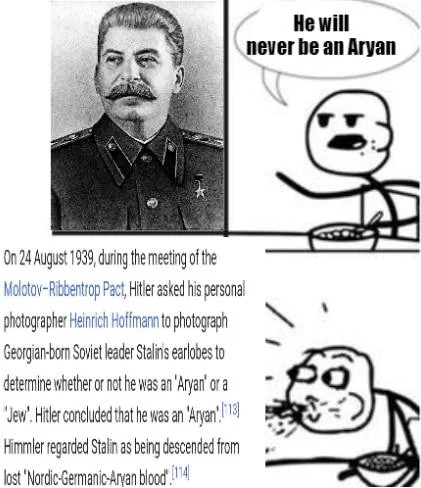
1
1
2
Autism is a Choice
MelGibsonafter4Beers@poa.st
"Whatever else may divide us, Europe is our common home; a common fate has linked us through the centuries, and it continues to link us today." -Leonid Brezhnev
1
0
1
pistolero
p@fsebugoutzone.org
@MelGibsonafter4Beers @dorkvalized @Nimbius666 @irie @dagda I mean, Turks were called "Asians" back when Stalin were wee.
0
0
0
pistolero
p@fsebugoutzone.org
@MelGibsonafter4Beers @dorkvalized @Nimbius666 @irie @dagda That is onnacounta Europe is a serf continent.
0
0
0

ⰎⰅ ⰀⰍⰨⰒⰎⰫ
genmaicha@stereophonic.space
@Nimbius666 tried that ~6 years ago. materialism is nothing compared to elite theory, and the modern left is a bucket of crabs, not worth engaging with at all.
0
0
0
@p @Nimbius666 @dagda @irie
> Stalin was allied with Hitler … after which he changed to the Allies.
If Stalin were to be allied with Hitler, as you allege, then
1) Hitler would demand USSR’s help in the war with England or publish a bitter note like “y u no helpings us Josep?”
2) England would hardly help USSR with lend-lease, if Stalin attacked it earlier. The possibility to act together with UK and U.S. would be automatically closed for USSR.
Also, the “Allied side” formed only in December 1941, after the Japanese attack on Pearl harbor forced the U.S. to join the war. Before that the country was neutral.
> That is what halted the Soviet expansion, yes.
Now to recall, what the plan of the Soviet Union expansion after defeating Germany was called like?
[ ] Operation Unthinkable
[ ] Operation Pincher
[ ] Operation Dropshot
> All of the ones that were obvious from the USSR expansion that persisted until the wall came down. Poland, Germany, attempts at Romania, etc.
@p… Neither Poland, nor any part of Germany, nor Romania were ever included in USSR, and there was not even an intention to include them.
As the result of the Conference at Potsdam the USSR borders have expanded. But by this the USSR mostly received the lands, which formerly belonged to the Russian empire and were forcibly taken away during the Intervention of 1918–1920. The Soviet Russia back then had to repeatedly fend off Austrian and German forces, then the French, and finally the Poles (led by the French again). It worth to mention, that Stalin, a former narkom (minister) of nationalities, has drawn the new borders according to how nations lived on the land: thus Belarussian people, for example, were finally united into one republic of their own, without having to fear, that Poland would wipe their culture and the language away. Same for the Baltic states, Ukraine and Moldova (then often called Bessarabia). These acquisitions were legitimate and acknowledged by other powers. The same way the South Sakhalin and Kuril islands came back home after 1945 (Japan made Imperial Russia cede them after the 1905–1907 Russo-Japanese war).
The only thing, that “sticks out” is the Kaliningrad oblast attached to RSFSR as an exclave. However, 1) it was owned by Russian empire not long ago; 2) legit acquisition through Potsdam conference; 3) Poland shouldn’t feel offended, for it was given (back) a large piece of land on the north, which Germans cut off of Poland after WWI.
> Yes, FDR was (explicitly) attempting to set up global governance...
By whom, you forgot to add.
> just like Stalin
And you, of course, have proofs of that?
> I'm not taking FDR's side of anything: I view FDR, Hitler, and Stalin as essentially terrible.
Why an exception for the pot-bellied one?
> Yes. Stalin made this a condition.
More like the German command, that chose for the German people and that sent them to Russia to pillage, devastate and murder – allowing this all officially – is what sealed their fate, rather than someone else. What you sow, that you shall reap.
> Doesn't sound plausible, but feel free.
H. Smith and G. Ritter write about his at length. The latter estimated this chance (for the German high command) as having a vague perspective, but still better than a total capitulation, certainly better than the conditions, on which it happened in reality.
> Hitler suggested that they surrender to US/UK wherever possible
Yeah, yeah, I can just see Hitler standing in front of the armies lined up in blocks before their departing to Normandy. Trembling voice through loudspeakers says: “you’re my good soldiers… you’re going to defend the country… I will be missing you. *sob* Try not to get cold. Wear warm socks. If it will be too hard, if you get your feet sore… or something… just surrender. I wouldn’t mind.”
> and I think it's reasonable to say that the PoWs taken by the US/UK had better treatment.
Cossacks in Lienz would like to have a word with you.
I am too shy to ask: how the preferable side for the Germans to surrender even relates to the initial question of how far/deep were the nazi Germany and USSR before 1941 on the military side?
> I think they thought he'd gotten to the woods: the USSR hadn't made it there yet
That sounds strange, because 1) USSR was already in Austria, and supposedly found something there and didn’t allow Churchill send someone there for several days, about which he wrote a pissy note to the American president; 2) the American armies have advanced all the way into the Soviet zone of occupation, which again made Churchill almost have a heart attack, because according to protocols signed before, they had to move back.
> and there were a lot of areas that hadn't been brought under control in the weeks after Germany attempted to surrender.
I’ve skimmed the sourced, and it turns out that the most powerful group was in Czechoslovakia and some troopers were left on Crete. But the former were driven out by the 11 of May 1945 (smallest groups eradicated just two days later). And those on Crete have accepted the capitulation and didn’t act, until some Brits and Americans came to take their arms and move them out with convoy.
To show the cards up, I thought this would be about Northern Italy. For it has > Alps and > fortresses
> that is what they thought, and you can speculate that it's not reasonable to think this but we have hindsight.
No, I think it’s but reasonable. If you want German archives, why not to want Hitler himself?
> No, you can look at what Churchill said; FDR didn't want a war with Stalin, however you want to paint it.
Perhaps I’m not sufficiently colourblind to see “love” where there’s simple neutrality.
> His wife was in the goddamn socialist club in New York.
And the next thing you’re going to say is that FDR called home to receive a nod from his wife on any matter of importance?
Oka-ay, let’s open a book… What do we see?
Roosevelts were a family of capitalists. FDR’s grand-grand-grandfather was an industrialist who owned a sugar plant near what is now called the Wall-street in New York. His grandfather on maternal side had a trade business with China; with it he acquired a million dollars (a dream for many, I suppose). His father was an eccentric money-maker who began with the transportation and coal mining companies, which he inherited. His entire life he was obsessed with large-scale projects. Together with his friends he founded the largest monopoly in the U.S., that was extracting black coal. But after he ruined profits because of his passion to invest into projects of speculative nature, they expelled him. Then he was digging a channel for $6 mln subsided from the government. The project was ruined in a crisis. In the United States they used to say, that seeing his father’s failures, this has developed a strong prejudice in young Franklin against stock exchange speculations as well as speculations of other sorts. It’s difficult to judge, as nothing in the life and business, that FDR was leading doesn’t confirm this: he lives in harmony with multimillionaires. Though, he gravely hated economical crises, which have shut the door to the society of the selected princes of economy before his father.
Does this alone make one a socialist? Or just something like a “capitalist who dislikes swindling”? This can explain, why other capitalists – a big lot of them, quite probably – would hate him, yet between this point and acting in favour of socialist views there’s a long, long road. Anyway, what about FDR’s childhood?
While his father James constantly experienced failures in making more money, the family was still rich. James always had several hundred gold-backed dollars on himself. Their family owned a large house, a number of governesses and servants, numerous workers tending to the fields. The wedding brought James another million dollars for his investments. When the family travelled somewhere, they used a custom carriage, never having to buy tickets. As a boy, Franklin witnessed the existence of social hierarchy: his father, his mother and he himself were separated with invisible borders from the governesses, whose status differed from that of cooks and other servants and maids, who, in their turn, preferred to keep a distance from coachmen and field workers.
Little Franklin loved animals and received a Shetland pony and a setter as a present from his parents. Tending to them was made his responsibility, to which he referred years later as a “tremendously hard labour”.
James and Sarah carefully warded the little world around his son from the troubles of the big world, the troubles, which are known to American children almost from the cradle. Somebody has made a snarky remark that the acquaintance of Franklin with Huckleberry Finn hasn’t come farther than a handshake with Mark Twain. He know about the life and everyday life of the common folk only by what he’s heard from others. Though he’s imbibed this – it has to be ruled, what was also carried over to the children with whom he played. His mother scolded him: “What’s the need to order them around?” – “But if I won’t give orders, they won’t do anything” – her son objected.
On Summer, their family would travel to Europe. They were cosmopolites. They took Franklin with themselves from the age of three. And very soon Paris, London and Germany, on the resorts of which his father constantly sought a treatment for his heart condition, became as familiar to Franklin as New York. When he was ten, the parents let him go to a public school, so he would learn German better. His mother found the idea funny, as she doubted, that he would be able to learn anything there. Franklin was excited to go with the flock of “monkeys”, as he’d said, but he had no such experience. Curious eye of the boy would examine ministers and herzogs, admirals and nobles. They spoke there in French for the most part, and Franklin could answer quickly.
The boy liked the sea and wouldn’t leave “Halfmoon” – the yacht newly acquired by his father. When he was 16, James bought him his own yacht. Around the same age Franklin, still dreaming of the sea, told his father, that he’s going to be a navy officer. And that he’s going to enter military academy in Annapolis. James Roosevelt was thrown in horror at first, but then colourfully described his son the dull life of an officer in a sheeny uniform in comparison to the prosperity of a businessman in a modest frock-coat. The choice wasn’t hard to make.
Franklin’s writings from the age, when he was a student at Harward, expose his sensibly conservative views. At the same time he didn’t seek light ways: while not being of an athletic build himself, he took the complex course program for sports, which even university athletes didn’t choose that often, as the Harward Bulletin noted in 1945.
Coming of age, he was under the patronizing shadow of his uncle Theodor Roosevelt, vice-president, and later the president of the United States. Around the time, when his uncle visited the university, Franklin wrote, that one of the good side of Roosevelts is that they would never just sit and do nothing, it’s the democratic spirit, that… and so on. Tying up democracy and being proactive as one thing is, indeed, a very specific view of democracy, but for someone under 20…
It is long known, that the people most intricately masking their actual intentions are those who seem boundlessly sincere and put their facility up front. So an American researcher was amazed with president F. Roosevelt’s, his knack and sophisticated traits of an experienced diplomat – and did so not from admiration. “It is clear, that under the mask of good will and conformism, which were evident at the peaks of his career, there was a hidden impulse of an objector, who aimed to break with the current norms, what has found a reflection in the experiments with the new course.” (This paragraph is a literal quote.)
If some think, that this is enough for accusing (lol) FDR in socialism, they should first remember, that capitalism and its consequences (speculation etc.) have brought the Great Depression upon the United states. An increase of government control is not socialism. Also, to deny, that capitalism could find a way out of Great Depression, would make look that system look unsightly. Like, if “to deal with this FDR had to go socialism way”, lol. And this would then pose another question: “AHEM, THEN COULD WE ACTUALLY AVOID…?” and “…then why didn’t we do it sooner?”
Well, I’m eager to know where socialism would finally begin. Let’s read further.
In 1900, Franklin is a member of Harward Republican club… an active member… a participant of a torch procession… In 1904 he votes for the first time and gives his vote to uncle Teddy. How he became a democrat? When, after leaving a juridical school he went into politics and sent his application, the democratic party replied sooner. Ha!
Though he might receive all help from his uncle Theodor, Franklin wasn’t an eloquent orator. Eleonora feared, that every pause he makes, might make the speech stop. But he continued. Some speculated, that the sum which Franklin has spent on the 1910 election, exceeded a four-digit number.
He’s won the election, and this was the second time since the Civil war, that a democratic candidate would become a governor. Franklin’s colleagues from the Wall-street listened with a condescending smile, how a 28-years-old politician is going to clash with a hundred years old dragon of corruption of the State’s powers. (Meaning Schlosser.) One of them wrote to FDR: “If only congratulations from the ‘stock exchange cabal’ don’t wound your tender political feelings, then I’m sending to you my most hearty congratulations.” For which Franklin answered with “The Wall-street as a whole is not so bad, as I’ve seen it in the four years of being there”.
Meanwhile, what Franklin spoke against was “bossism” (capturing of power by a bunch of corrupt politicians in the State government). One of them, L. Pan in Chatham district, inscribed the named of the dead people to voting lists. When the fraud was uncovered, he explained, that he doesn’t see anything bad in it, as he knows, how would they vote, were they still alive.
That’s some Dead Souls by Gogol playing in reality. But on the American scale. Let’s see how FDR performed in the Senate.
. . . . .
(wait for it)
> Stalin was allied with Hitler … after which he changed to the Allies.
If Stalin were to be allied with Hitler, as you allege, then
1) Hitler would demand USSR’s help in the war with England or publish a bitter note like “y u no helpings us Josep?”
2) England would hardly help USSR with lend-lease, if Stalin attacked it earlier. The possibility to act together with UK and U.S. would be automatically closed for USSR.
Also, the “Allied side” formed only in December 1941, after the Japanese attack on Pearl harbor forced the U.S. to join the war. Before that the country was neutral.
> That is what halted the Soviet expansion, yes.
Now to recall, what the plan of the Soviet Union expansion after defeating Germany was called like?
[ ] Operation Unthinkable
[ ] Operation Pincher
[ ] Operation Dropshot
> All of the ones that were obvious from the USSR expansion that persisted until the wall came down. Poland, Germany, attempts at Romania, etc.
@p… Neither Poland, nor any part of Germany, nor Romania were ever included in USSR, and there was not even an intention to include them.
As the result of the Conference at Potsdam the USSR borders have expanded. But by this the USSR mostly received the lands, which formerly belonged to the Russian empire and were forcibly taken away during the Intervention of 1918–1920. The Soviet Russia back then had to repeatedly fend off Austrian and German forces, then the French, and finally the Poles (led by the French again). It worth to mention, that Stalin, a former narkom (minister) of nationalities, has drawn the new borders according to how nations lived on the land: thus Belarussian people, for example, were finally united into one republic of their own, without having to fear, that Poland would wipe their culture and the language away. Same for the Baltic states, Ukraine and Moldova (then often called Bessarabia). These acquisitions were legitimate and acknowledged by other powers. The same way the South Sakhalin and Kuril islands came back home after 1945 (Japan made Imperial Russia cede them after the 1905–1907 Russo-Japanese war).
The only thing, that “sticks out” is the Kaliningrad oblast attached to RSFSR as an exclave. However, 1) it was owned by Russian empire not long ago; 2) legit acquisition through Potsdam conference; 3) Poland shouldn’t feel offended, for it was given (back) a large piece of land on the north, which Germans cut off of Poland after WWI.
> Yes, FDR was (explicitly) attempting to set up global governance...
By whom, you forgot to add.
> just like Stalin
And you, of course, have proofs of that?
> I'm not taking FDR's side of anything: I view FDR, Hitler, and Stalin as essentially terrible.
Why an exception for the pot-bellied one?
> Yes. Stalin made this a condition.
More like the German command, that chose for the German people and that sent them to Russia to pillage, devastate and murder – allowing this all officially – is what sealed their fate, rather than someone else. What you sow, that you shall reap.
> Doesn't sound plausible, but feel free.
H. Smith and G. Ritter write about his at length. The latter estimated this chance (for the German high command) as having a vague perspective, but still better than a total capitulation, certainly better than the conditions, on which it happened in reality.
> Hitler suggested that they surrender to US/UK wherever possible
Yeah, yeah, I can just see Hitler standing in front of the armies lined up in blocks before their departing to Normandy. Trembling voice through loudspeakers says: “you’re my good soldiers… you’re going to defend the country… I will be missing you. *sob* Try not to get cold. Wear warm socks. If it will be too hard, if you get your feet sore… or something… just surrender. I wouldn’t mind.”
> and I think it's reasonable to say that the PoWs taken by the US/UK had better treatment.
Cossacks in Lienz would like to have a word with you.
I am too shy to ask: how the preferable side for the Germans to surrender even relates to the initial question of how far/deep were the nazi Germany and USSR before 1941 on the military side?
> I think they thought he'd gotten to the woods: the USSR hadn't made it there yet
That sounds strange, because 1) USSR was already in Austria, and supposedly found something there and didn’t allow Churchill send someone there for several days, about which he wrote a pissy note to the American president; 2) the American armies have advanced all the way into the Soviet zone of occupation, which again made Churchill almost have a heart attack, because according to protocols signed before, they had to move back.
> and there were a lot of areas that hadn't been brought under control in the weeks after Germany attempted to surrender.
I’ve skimmed the sourced, and it turns out that the most powerful group was in Czechoslovakia and some troopers were left on Crete. But the former were driven out by the 11 of May 1945 (smallest groups eradicated just two days later). And those on Crete have accepted the capitulation and didn’t act, until some Brits and Americans came to take their arms and move them out with convoy.
To show the cards up, I thought this would be about Northern Italy. For it has > Alps and > fortresses
> that is what they thought, and you can speculate that it's not reasonable to think this but we have hindsight.
No, I think it’s but reasonable. If you want German archives, why not to want Hitler himself?
> No, you can look at what Churchill said; FDR didn't want a war with Stalin, however you want to paint it.
Perhaps I’m not sufficiently colourblind to see “love” where there’s simple neutrality.
> His wife was in the goddamn socialist club in New York.
And the next thing you’re going to say is that FDR called home to receive a nod from his wife on any matter of importance?
Oka-ay, let’s open a book… What do we see?
Roosevelts were a family of capitalists. FDR’s grand-grand-grandfather was an industrialist who owned a sugar plant near what is now called the Wall-street in New York. His grandfather on maternal side had a trade business with China; with it he acquired a million dollars (a dream for many, I suppose). His father was an eccentric money-maker who began with the transportation and coal mining companies, which he inherited. His entire life he was obsessed with large-scale projects. Together with his friends he founded the largest monopoly in the U.S., that was extracting black coal. But after he ruined profits because of his passion to invest into projects of speculative nature, they expelled him. Then he was digging a channel for $6 mln subsided from the government. The project was ruined in a crisis. In the United States they used to say, that seeing his father’s failures, this has developed a strong prejudice in young Franklin against stock exchange speculations as well as speculations of other sorts. It’s difficult to judge, as nothing in the life and business, that FDR was leading doesn’t confirm this: he lives in harmony with multimillionaires. Though, he gravely hated economical crises, which have shut the door to the society of the selected princes of economy before his father.
Does this alone make one a socialist? Or just something like a “capitalist who dislikes swindling”? This can explain, why other capitalists – a big lot of them, quite probably – would hate him, yet between this point and acting in favour of socialist views there’s a long, long road. Anyway, what about FDR’s childhood?
While his father James constantly experienced failures in making more money, the family was still rich. James always had several hundred gold-backed dollars on himself. Their family owned a large house, a number of governesses and servants, numerous workers tending to the fields. The wedding brought James another million dollars for his investments. When the family travelled somewhere, they used a custom carriage, never having to buy tickets. As a boy, Franklin witnessed the existence of social hierarchy: his father, his mother and he himself were separated with invisible borders from the governesses, whose status differed from that of cooks and other servants and maids, who, in their turn, preferred to keep a distance from coachmen and field workers.
Little Franklin loved animals and received a Shetland pony and a setter as a present from his parents. Tending to them was made his responsibility, to which he referred years later as a “tremendously hard labour”.
James and Sarah carefully warded the little world around his son from the troubles of the big world, the troubles, which are known to American children almost from the cradle. Somebody has made a snarky remark that the acquaintance of Franklin with Huckleberry Finn hasn’t come farther than a handshake with Mark Twain. He know about the life and everyday life of the common folk only by what he’s heard from others. Though he’s imbibed this – it has to be ruled, what was also carried over to the children with whom he played. His mother scolded him: “What’s the need to order them around?” – “But if I won’t give orders, they won’t do anything” – her son objected.
On Summer, their family would travel to Europe. They were cosmopolites. They took Franklin with themselves from the age of three. And very soon Paris, London and Germany, on the resorts of which his father constantly sought a treatment for his heart condition, became as familiar to Franklin as New York. When he was ten, the parents let him go to a public school, so he would learn German better. His mother found the idea funny, as she doubted, that he would be able to learn anything there. Franklin was excited to go with the flock of “monkeys”, as he’d said, but he had no such experience. Curious eye of the boy would examine ministers and herzogs, admirals and nobles. They spoke there in French for the most part, and Franklin could answer quickly.
The boy liked the sea and wouldn’t leave “Halfmoon” – the yacht newly acquired by his father. When he was 16, James bought him his own yacht. Around the same age Franklin, still dreaming of the sea, told his father, that he’s going to be a navy officer. And that he’s going to enter military academy in Annapolis. James Roosevelt was thrown in horror at first, but then colourfully described his son the dull life of an officer in a sheeny uniform in comparison to the prosperity of a businessman in a modest frock-coat. The choice wasn’t hard to make.
Franklin’s writings from the age, when he was a student at Harward, expose his sensibly conservative views. At the same time he didn’t seek light ways: while not being of an athletic build himself, he took the complex course program for sports, which even university athletes didn’t choose that often, as the Harward Bulletin noted in 1945.
Coming of age, he was under the patronizing shadow of his uncle Theodor Roosevelt, vice-president, and later the president of the United States. Around the time, when his uncle visited the university, Franklin wrote, that one of the good side of Roosevelts is that they would never just sit and do nothing, it’s the democratic spirit, that… and so on. Tying up democracy and being proactive as one thing is, indeed, a very specific view of democracy, but for someone under 20…
It is long known, that the people most intricately masking their actual intentions are those who seem boundlessly sincere and put their facility up front. So an American researcher was amazed with president F. Roosevelt’s, his knack and sophisticated traits of an experienced diplomat – and did so not from admiration. “It is clear, that under the mask of good will and conformism, which were evident at the peaks of his career, there was a hidden impulse of an objector, who aimed to break with the current norms, what has found a reflection in the experiments with the new course.” (This paragraph is a literal quote.)
If some think, that this is enough for accusing (lol) FDR in socialism, they should first remember, that capitalism and its consequences (speculation etc.) have brought the Great Depression upon the United states. An increase of government control is not socialism. Also, to deny, that capitalism could find a way out of Great Depression, would make look that system look unsightly. Like, if “to deal with this FDR had to go socialism way”, lol. And this would then pose another question: “AHEM, THEN COULD WE ACTUALLY AVOID…?” and “…then why didn’t we do it sooner?”
Well, I’m eager to know where socialism would finally begin. Let’s read further.
In 1900, Franklin is a member of Harward Republican club… an active member… a participant of a torch procession… In 1904 he votes for the first time and gives his vote to uncle Teddy. How he became a democrat? When, after leaving a juridical school he went into politics and sent his application, the democratic party replied sooner. Ha!
Though he might receive all help from his uncle Theodor, Franklin wasn’t an eloquent orator. Eleonora feared, that every pause he makes, might make the speech stop. But he continued. Some speculated, that the sum which Franklin has spent on the 1910 election, exceeded a four-digit number.
He’s won the election, and this was the second time since the Civil war, that a democratic candidate would become a governor. Franklin’s colleagues from the Wall-street listened with a condescending smile, how a 28-years-old politician is going to clash with a hundred years old dragon of corruption of the State’s powers. (Meaning Schlosser.) One of them wrote to FDR: “If only congratulations from the ‘stock exchange cabal’ don’t wound your tender political feelings, then I’m sending to you my most hearty congratulations.” For which Franklin answered with “The Wall-street as a whole is not so bad, as I’ve seen it in the four years of being there”.
Meanwhile, what Franklin spoke against was “bossism” (capturing of power by a bunch of corrupt politicians in the State government). One of them, L. Pan in Chatham district, inscribed the named of the dead people to voting lists. When the fraud was uncovered, he explained, that he doesn’t see anything bad in it, as he knows, how would they vote, were they still alive.
That’s some Dead Souls by Gogol playing in reality. But on the American scale. Let’s see how FDR performed in the Senate.
. . . . .
(wait for it)
2
0
0
@p @Nimbius666 @dagda @irie (continued; hello, hellfrens)
During two years his most notable proposition was to save the forests in NY. This was a part of his program of preserving natural resources, with which he tried to get on the same footing with the common folk. However, the powerful forestry and timber companies ignored his guidance almost entirely. Having this failed he began to speak for the limit of work hours set for youth to be 54 hours a week. (Holy mother…) While before he was against it. On the acute question of workers boycotting the job, he acted in favour of using armed force to disperse the crowds on a strike.
Wow, what a socialist! What a defender of worker’s rights! By the way, Stalin wrote seven years before that in an article “Bourgeoisie puts up a trap”: “Liberal sirs from the bourgeoisie will be ‘very pleased’, if will be given the freedom of speech, of the press, and of unions – if only the freedom of strikes won’t be there. This is why they speak at length about the ‘rights of a man and a citizen’, while about the freedom of strikes they mumble and can’t anything clear, except like pharisees they would blabber about some ‘economical reforms’”.
W. Wilson in 1912 says: “There is a tremendously large and covered displeasure, which seeks a way out. Republicans with put out Tuft, and, if the democrats won’t put out their own candidate, which could be accepted by the people as the one who will voice their protest, there will appear a third party, a radical party, and in the result of the election we may find ourselves not long from a revolution.” (Literal quote from the book.)
So, FDR tries to be that substitute voice, while “avoiding socialist terms” (this is a literal quote). The society is excited with Jack London’s “Iron foot” and “Revolution” who sung about class struggle and the union of the proletariat. And, while Marxism was evidently weak in the New world, the fierce resurrection of “Jacksonianism” and the work done by the “dirt removers” from L. Steffens to T. Draiser resounded like a cleansing storm in the psychological climate of the American society. At the footstep of the 1912 election, socialists have been gaining power. The whole country was listening to the piercing speeches of Debbs… The Socialist newspaper reached one million copies… etc. etc.
But apparently FDR was nowhere close to the socialist ranks and had no desire to be there.
And you say “wife”
Well, while we’re at it, who was she? Eleonora Roosevelt was Franklin’s cousin in the fifth generation. The family, to which Eleonora was born to, was less rich than Franklin’s, because her father was wasting money on pleasures and affairs. She charmed Franklin after returning from her education in England, where she was under supervision of a French governess.
Eleonora tried to be closer to her husband: she learned to drive a Ford and smashed it on a tree. Riding on a horse went no better. A lot of time she’s spent on learning how to plat golf, but seeing her once, Franklin advised to drop this pastime. She was the typical daughter of rich parents of the time. She never had to nanny her children herself or to make food. She couldn’t imagine a house without at least five servants, couldn’t dress herself without a maid, and without a cook the young pair would probably die of hunger. At that, she was horrendously ignorant. Even forty years later Eleonora recalled an uncomfortable situation, when she couldn’t explain to a curious Englishman the difference between the federal and the local governments in the USA.
The house, that they lived in, was built by Sarah, Franklin’s mother, and Eleonora once cried before her husband, because she “didn’t like to live in the house that was never a part of her and that she’s done nothing for”. Franklin just shrugged. He didn’t understand. At home he was short sighted and didn’t show such watchfulness, as in politics. Franklin has just separated his family life and his games of poker at the club, where he was absent till late in the night.
And you’re telling me that this woman…? Ahem, let’s continue. We’re already fifty pages in, maybe I’ll just skip the next fifty pages. We still don’t know, what Roosevelt himself thought of socialism, something in his own words, that is. Oh. Here is it!
“You know, — said FDR pensively — the situation today doesn’t differ much from those days, when I was in Senate in 1911 and 1912. Alfred Smith, Bob Wagner, Jim Foley (Fawley?) and me have been fighting for making laws, which would keep the society in mind, laws, which would work. I remember, that we were called socialists and radicals at that time. I remember how furious was my dear mother, who decided, that her son has become a socialist.” This contemplation have become one of his favourite subjects, while his other, later programs were still being called “socialist” or even “communist”. What was “socialism” in 1911, has become an undoubted Americanism in 1928.
Referencing the earlier work of governor A. Smith, Roosevelt said: “If his program of shortening the work week for women and children is socialist, then we are all socialists; if his program of bringing up hospitals and jails in the State to a better condition is socialist, then we are all socialists. And if his attention to healthcare…” – guess that’s enough to get the idea.
…[In 1933] The jobless people from the cities started to unite their efforts with the farmers. Committees of action have begun to appear. The terror of power didn’t bring any feasible results. As one witness told before the commitee of Congress, a farmer exclaimed to him: “We have to make a revolution, like in Russia”. The movement was brought to a recession after promises of economical reforms, that will be implemented. Farmers trusted the word, but firmly stated: if they’ll be swindled, by the Spring of 1933 there will be a nation-wide strike.
Two million jobless people sought for a better place in the other cities. One State and another took measures against the “wanderers” and not let them in. Concentration camps appear in California, roadblocks prevent movement. Children of crisis – hungry students, that are sleepy during lessons. “You should go home and eat” – says teacher to a pupil. “I can’t, today is my sister’s turn.” – she replies. Hungry teachers, tearing cents from their allowance to get some food for the children. Troubles in various parts of the country, often hopeless and spontaneous, left an impression on the spiritual life of the society.
In the whirlwind of ideas among intellectuals, more and more evident emerged a movement – not only of a sympathy, but a straightforward acceptance of Communism both in theory and in practice. Famous writer and critic W. Frank wrote in 1932: “The world is on the verge of a crisis, and we shouldn’t lose time. The preparation for the revolutionary tomorrow should be made today. In the opposite case, it may come too late […]” E. Nielson insisted: “Soviet Union is on the moral summit of the world, where the light never ceases to be”. William Allen White: “Russia is the most interesting place in the world”. “Of course” – confirmed W. Rodgers – “they have great ideas. Just think about it: in their country everyone has a job!” So did speak and write the American intellectuals, who were never seen expressing their sympathies for Communism before.
I guess this should be enough to serve as an explanation, why FDR could be (and, as I found now, he actually was) accused of being a “socialist”. He wanted to be good, he wanted to do something decent. While staying who he is: a comfortably living bourgeois. He could never be a socialist, not while maintaining relations with his pals. Moreover, he spoke against socialism, affirming the capitalist rule. And you say “wife”.
The source (mostly in retelling, because translating some fifty pages just to prove a point is not in my plans): N. N. Yakovlev. Franklin Roosevelt: a man and a politician, 2nd ed. Moscow, 1981, p. 11–50, 96–131.
> I don't know what you want.
To tell the truth, I’d like to have on the other side of the screen someone as fluent in Russian as I am in English.
> If I take his word for it, technocratic Malthusian nihilism, including population control. You just have to read what he said and what his friends (Dulles, Rockefeller, et al) said:
Well, judging how you talk about Communism with only memes, and replacing them with corresponding ones, I can imagine what you may mean.
Though taking into account your understanding of Communism, Socialism and the history of USSR, I’m not sure what to expect here. Some means are just means, which may find a use in one system or in another which is something quite unlike the other. But the means may be applied nevertheless.
Anyway, this isn’t an invitation for making an explanation, unless you promise me something actually revealing.
> Contemporary writing from the generals in question had FDR focused on Japan and Churchill as the only one that wanted a war with the USSR.
You bet! The contempt is oozing off the pages of his sixth volume on WWII. On this subject we agree, what a pleasant surprise.
> This is one of the reasons the US would never have attacked the USSR. The Manchuria push was critical to stopping Japan.
I wouldn’t be so sure, placed in the circumstances. After all, say the war with Japan is over. U.S. probably has more nuclear bombs. And Soviet armies are stationed in Germany, in their occupation zone… On the other hand, the large Soviet army was gradually rolling back to the other half of the globe, so the need to “contain” this power was lesser by the day. The plans would have one date and a situation in mind, the reality would offer something different. Or, perhaps, the HQs were already tired drawing and redrawing plans, and doing this several more times, with a prospective length of several more years was considered too much strain on the people in charge. Who knows? Anyhow, the history knows no ‘if’s, which takes the question an empty one.
> You keep talking like I've ever said a single word in FDR's defense or like FDR has anything to do with the conversation
I was actually calling out your calling Stalin names non-stop, and in the sentence that you’ve cited, the accent is not on FDR. One might wonder, how can you even manage to read it in some wrong way.
> a post I made a year ago about how socialist authors are not really worth reading. I'm talking about socialist authors
I’m sorry, but do you realise, how that sounds after your remark above (https://fsebugoutzone.org/notice/B6pp52u87h7HiFbaIC) that most of the stuff that you’ve read, was… by Trotskiy? Like, lmao.
Lenin: leads the bolsheviks against bourgeoisie- and merchant-backed parties, wins against the rest (cadets etc.) in the newly formed parliament (Учредительное собрание). Wins against the odds, while the RSDRP, represented with bolsheviks, doesn’t comprise even a half of seats. Creates the first Soviet republic, manages to defend it against World War I, a civil war (stage I), repeated intervention, civil war (now backed by the foreign bourgeoisie, stage II), rules through raids of bandit armies armed by the foreign powers, meanwhile somehow launching the industry and agriculture sectors of the economy, logistics, laws fro protecting valuable resources (like forests, which FDR couldn’t achieve btw) and industries. Sends people to other lands of the former Russian empire to help people create other socialist republics. Composes a Constitution for the first ever Union of socialist states. Leaves 45 volumes of works. The principal works would comprise 2–3 volumes, I think.
Stalin: implements Lenin’s concepts and builds on top of it. Implements policies which end the shortage of grain supplies by the end of 1920s (they still will happen due to wars and sabotage, but the consequences of the intervention and the civil war were overcome). Basically receives a country without any large-scale industry (Russian empire had no full-cycle car producing factory, nor a plane factory, nor a tractor or tank factory, during tzars Russia has imported even scythes from Austria) – and leaves it a winner in a world war, with a nuclear power plant and soon a nuclear bomb. Spends money to bring civilisation to remote areas building beautiful cities near the North polar circle – only to make people go there, live there, research the area and do science. More socialist republics are created (and some larger ones are split). The Soviet Union goes through the harsh time of 1941–1945, wins against a war machine nurtured by the imperialists, the Union gets bigger. At the end of his life Stalin chalks up the further course of the economy, where the interest of an individual consumer is placed before the need to make or realise wares. Which would require each factory to know their consumer better and actually put an effort into satisfying consumer needs. The system he envisioned would gradually abolish money, switching to the sheer labour and ware producing/exchange. Which would make things like savings, usury and credits impossible. Relying on the work, that began at the time of Stalin, the country sends a first satellite to orbit and sends the first man to space. This Communist leader leaves 18 volumes of works.
Trotskiy: initially leaning up to the bourgeoisie, he joins bolsheviks at he last moment. Eager to launch the world revolution (writes a book about it) and throw the Red army on every opponent at once, he would just lose the army, lose the Socialist state. But, perhaps, he hoped to be placed as some colonial regime leader in the Germany- and England-occupied European part of Russia. Expelled from the Soviet Union by Stalin, because he kept spouting derailing messages. In exile writes lampoons.
@p: Gee, whom do I pick? I think Trotskiy would be a fine choice! Fuck, why he’s such an idiot… I hate socialism.
> not Stalin (murderous psychopath)
You’re still at it? Let’s do a meme clash or something. This discussion would be livelier with some action.
> so FDR…
Please, stop. Enough.
> > I was speaking of Germany, and you seem to have taken it personally, for some reason.
> This is almost certainly you reading into it things that are not present.
Oh, really? Well, let’s check. Thankfully, what’s necessary is simply to scroll the thread up.
In https://fsebugoutzone.org/notice/AtGcK5L0PcVIdpkl9s you’ve written about “people that either lost to fascists or, once they got power, were indistinguishable from fascists.”
Which I called out in https://fsebugoutzone.org/notice/B6yOGHR1USuPcklKme bringing up a real story of a real German Communist in Germany (Paul Krause). In a short paragraph below there was a contemplation about the situation in Germany in the 1930s and a suggestion to share a thought, how you’d do better in his place. Instead of a thought (or an admittance in the absence of such) there was a “YO MAMA”-tier reply, but I guess it would be hard to expect much from a person whose mind is occupied with Pleroma, hellthreads, Latvian retards and memes probably made by long-nosed individuals of the Near East.
So, in https://fsebugoutzone.org/notice/B6yQ1l5RAAx99UrwY4, your reply went about “cows in the USSR” and if this isn’t the first occurrence of a “YEAH BUT YOU”™ in our dialogue, I don’t know what this is.
Ironically, when I mirrored this back at you in https://fsebugoutzone.org/notice/B6yTLOILuZW67RxmBU you began framing me as the one who used “YEAH BUT YOU”ing – see https://fsebugoutzone.org/notice/B6ycJRUPxibr2Fkhou
> Thirteen months ago, I was dismissive about socialist authors (whom I have read and I found nothing redeeming).
Like who? Like who? smug_anime_girl.png
> In as few words as possible, what are you hoping to discuss?
We may start discussing something – if you wish – once you get yourself acquainted with Lenin’s “State and Revolution”, unabridged. For starters.
. . . . .
(wait for it)
ro_257.jpg

During two years his most notable proposition was to save the forests in NY. This was a part of his program of preserving natural resources, with which he tried to get on the same footing with the common folk. However, the powerful forestry and timber companies ignored his guidance almost entirely. Having this failed he began to speak for the limit of work hours set for youth to be 54 hours a week. (Holy mother…) While before he was against it. On the acute question of workers boycotting the job, he acted in favour of using armed force to disperse the crowds on a strike.
Wow, what a socialist! What a defender of worker’s rights! By the way, Stalin wrote seven years before that in an article “Bourgeoisie puts up a trap”: “Liberal sirs from the bourgeoisie will be ‘very pleased’, if will be given the freedom of speech, of the press, and of unions – if only the freedom of strikes won’t be there. This is why they speak at length about the ‘rights of a man and a citizen’, while about the freedom of strikes they mumble and can’t anything clear, except like pharisees they would blabber about some ‘economical reforms’”.
W. Wilson in 1912 says: “There is a tremendously large and covered displeasure, which seeks a way out. Republicans with put out Tuft, and, if the democrats won’t put out their own candidate, which could be accepted by the people as the one who will voice their protest, there will appear a third party, a radical party, and in the result of the election we may find ourselves not long from a revolution.” (Literal quote from the book.)
So, FDR tries to be that substitute voice, while “avoiding socialist terms” (this is a literal quote). The society is excited with Jack London’s “Iron foot” and “Revolution” who sung about class struggle and the union of the proletariat. And, while Marxism was evidently weak in the New world, the fierce resurrection of “Jacksonianism” and the work done by the “dirt removers” from L. Steffens to T. Draiser resounded like a cleansing storm in the psychological climate of the American society. At the footstep of the 1912 election, socialists have been gaining power. The whole country was listening to the piercing speeches of Debbs… The Socialist newspaper reached one million copies… etc. etc.
But apparently FDR was nowhere close to the socialist ranks and had no desire to be there.
And you say “wife”
Well, while we’re at it, who was she? Eleonora Roosevelt was Franklin’s cousin in the fifth generation. The family, to which Eleonora was born to, was less rich than Franklin’s, because her father was wasting money on pleasures and affairs. She charmed Franklin after returning from her education in England, where she was under supervision of a French governess.
Eleonora tried to be closer to her husband: she learned to drive a Ford and smashed it on a tree. Riding on a horse went no better. A lot of time she’s spent on learning how to plat golf, but seeing her once, Franklin advised to drop this pastime. She was the typical daughter of rich parents of the time. She never had to nanny her children herself or to make food. She couldn’t imagine a house without at least five servants, couldn’t dress herself without a maid, and without a cook the young pair would probably die of hunger. At that, she was horrendously ignorant. Even forty years later Eleonora recalled an uncomfortable situation, when she couldn’t explain to a curious Englishman the difference between the federal and the local governments in the USA.
The house, that they lived in, was built by Sarah, Franklin’s mother, and Eleonora once cried before her husband, because she “didn’t like to live in the house that was never a part of her and that she’s done nothing for”. Franklin just shrugged. He didn’t understand. At home he was short sighted and didn’t show such watchfulness, as in politics. Franklin has just separated his family life and his games of poker at the club, where he was absent till late in the night.
And you’re telling me that this woman…? Ahem, let’s continue. We’re already fifty pages in, maybe I’ll just skip the next fifty pages. We still don’t know, what Roosevelt himself thought of socialism, something in his own words, that is. Oh. Here is it!
“You know, — said FDR pensively — the situation today doesn’t differ much from those days, when I was in Senate in 1911 and 1912. Alfred Smith, Bob Wagner, Jim Foley (Fawley?) and me have been fighting for making laws, which would keep the society in mind, laws, which would work. I remember, that we were called socialists and radicals at that time. I remember how furious was my dear mother, who decided, that her son has become a socialist.” This contemplation have become one of his favourite subjects, while his other, later programs were still being called “socialist” or even “communist”. What was “socialism” in 1911, has become an undoubted Americanism in 1928.
Referencing the earlier work of governor A. Smith, Roosevelt said: “If his program of shortening the work week for women and children is socialist, then we are all socialists; if his program of bringing up hospitals and jails in the State to a better condition is socialist, then we are all socialists. And if his attention to healthcare…” – guess that’s enough to get the idea.
…[In 1933] The jobless people from the cities started to unite their efforts with the farmers. Committees of action have begun to appear. The terror of power didn’t bring any feasible results. As one witness told before the commitee of Congress, a farmer exclaimed to him: “We have to make a revolution, like in Russia”. The movement was brought to a recession after promises of economical reforms, that will be implemented. Farmers trusted the word, but firmly stated: if they’ll be swindled, by the Spring of 1933 there will be a nation-wide strike.
Two million jobless people sought for a better place in the other cities. One State and another took measures against the “wanderers” and not let them in. Concentration camps appear in California, roadblocks prevent movement. Children of crisis – hungry students, that are sleepy during lessons. “You should go home and eat” – says teacher to a pupil. “I can’t, today is my sister’s turn.” – she replies. Hungry teachers, tearing cents from their allowance to get some food for the children. Troubles in various parts of the country, often hopeless and spontaneous, left an impression on the spiritual life of the society.
In the whirlwind of ideas among intellectuals, more and more evident emerged a movement – not only of a sympathy, but a straightforward acceptance of Communism both in theory and in practice. Famous writer and critic W. Frank wrote in 1932: “The world is on the verge of a crisis, and we shouldn’t lose time. The preparation for the revolutionary tomorrow should be made today. In the opposite case, it may come too late […]” E. Nielson insisted: “Soviet Union is on the moral summit of the world, where the light never ceases to be”. William Allen White: “Russia is the most interesting place in the world”. “Of course” – confirmed W. Rodgers – “they have great ideas. Just think about it: in their country everyone has a job!” So did speak and write the American intellectuals, who were never seen expressing their sympathies for Communism before.
I guess this should be enough to serve as an explanation, why FDR could be (and, as I found now, he actually was) accused of being a “socialist”. He wanted to be good, he wanted to do something decent. While staying who he is: a comfortably living bourgeois. He could never be a socialist, not while maintaining relations with his pals. Moreover, he spoke against socialism, affirming the capitalist rule. And you say “wife”.
The source (mostly in retelling, because translating some fifty pages just to prove a point is not in my plans): N. N. Yakovlev. Franklin Roosevelt: a man and a politician, 2nd ed. Moscow, 1981, p. 11–50, 96–131.
> I don't know what you want.
To tell the truth, I’d like to have on the other side of the screen someone as fluent in Russian as I am in English.
> If I take his word for it, technocratic Malthusian nihilism, including population control. You just have to read what he said and what his friends (Dulles, Rockefeller, et al) said:
Well, judging how you talk about Communism with only memes, and replacing them with corresponding ones, I can imagine what you may mean.
Though taking into account your understanding of Communism, Socialism and the history of USSR, I’m not sure what to expect here. Some means are just means, which may find a use in one system or in another which is something quite unlike the other. But the means may be applied nevertheless.
Anyway, this isn’t an invitation for making an explanation, unless you promise me something actually revealing.
> Contemporary writing from the generals in question had FDR focused on Japan and Churchill as the only one that wanted a war with the USSR.
You bet! The contempt is oozing off the pages of his sixth volume on WWII. On this subject we agree, what a pleasant surprise.
> This is one of the reasons the US would never have attacked the USSR. The Manchuria push was critical to stopping Japan.
I wouldn’t be so sure, placed in the circumstances. After all, say the war with Japan is over. U.S. probably has more nuclear bombs. And Soviet armies are stationed in Germany, in their occupation zone… On the other hand, the large Soviet army was gradually rolling back to the other half of the globe, so the need to “contain” this power was lesser by the day. The plans would have one date and a situation in mind, the reality would offer something different. Or, perhaps, the HQs were already tired drawing and redrawing plans, and doing this several more times, with a prospective length of several more years was considered too much strain on the people in charge. Who knows? Anyhow, the history knows no ‘if’s, which takes the question an empty one.
> You keep talking like I've ever said a single word in FDR's defense or like FDR has anything to do with the conversation
I was actually calling out your calling Stalin names non-stop, and in the sentence that you’ve cited, the accent is not on FDR. One might wonder, how can you even manage to read it in some wrong way.
> a post I made a year ago about how socialist authors are not really worth reading. I'm talking about socialist authors
I’m sorry, but do you realise, how that sounds after your remark above (https://fsebugoutzone.org/notice/B6pp52u87h7HiFbaIC) that most of the stuff that you’ve read, was… by Trotskiy? Like, lmao.
Lenin: leads the bolsheviks against bourgeoisie- and merchant-backed parties, wins against the rest (cadets etc.) in the newly formed parliament (Учредительное собрание). Wins against the odds, while the RSDRP, represented with bolsheviks, doesn’t comprise even a half of seats. Creates the first Soviet republic, manages to defend it against World War I, a civil war (stage I), repeated intervention, civil war (now backed by the foreign bourgeoisie, stage II), rules through raids of bandit armies armed by the foreign powers, meanwhile somehow launching the industry and agriculture sectors of the economy, logistics, laws fro protecting valuable resources (like forests, which FDR couldn’t achieve btw) and industries. Sends people to other lands of the former Russian empire to help people create other socialist republics. Composes a Constitution for the first ever Union of socialist states. Leaves 45 volumes of works. The principal works would comprise 2–3 volumes, I think.
Stalin: implements Lenin’s concepts and builds on top of it. Implements policies which end the shortage of grain supplies by the end of 1920s (they still will happen due to wars and sabotage, but the consequences of the intervention and the civil war were overcome). Basically receives a country without any large-scale industry (Russian empire had no full-cycle car producing factory, nor a plane factory, nor a tractor or tank factory, during tzars Russia has imported even scythes from Austria) – and leaves it a winner in a world war, with a nuclear power plant and soon a nuclear bomb. Spends money to bring civilisation to remote areas building beautiful cities near the North polar circle – only to make people go there, live there, research the area and do science. More socialist republics are created (and some larger ones are split). The Soviet Union goes through the harsh time of 1941–1945, wins against a war machine nurtured by the imperialists, the Union gets bigger. At the end of his life Stalin chalks up the further course of the economy, where the interest of an individual consumer is placed before the need to make or realise wares. Which would require each factory to know their consumer better and actually put an effort into satisfying consumer needs. The system he envisioned would gradually abolish money, switching to the sheer labour and ware producing/exchange. Which would make things like savings, usury and credits impossible. Relying on the work, that began at the time of Stalin, the country sends a first satellite to orbit and sends the first man to space. This Communist leader leaves 18 volumes of works.
Trotskiy: initially leaning up to the bourgeoisie, he joins bolsheviks at he last moment. Eager to launch the world revolution (writes a book about it) and throw the Red army on every opponent at once, he would just lose the army, lose the Socialist state. But, perhaps, he hoped to be placed as some colonial regime leader in the Germany- and England-occupied European part of Russia. Expelled from the Soviet Union by Stalin, because he kept spouting derailing messages. In exile writes lampoons.
@p: Gee, whom do I pick? I think Trotskiy would be a fine choice! Fuck, why he’s such an idiot… I hate socialism.
> not Stalin (murderous psychopath)
You’re still at it? Let’s do a meme clash or something. This discussion would be livelier with some action.
> so FDR…
Please, stop. Enough.
> > I was speaking of Germany, and you seem to have taken it personally, for some reason.
> This is almost certainly you reading into it things that are not present.
Oh, really? Well, let’s check. Thankfully, what’s necessary is simply to scroll the thread up.
In https://fsebugoutzone.org/notice/AtGcK5L0PcVIdpkl9s you’ve written about “people that either lost to fascists or, once they got power, were indistinguishable from fascists.”
Which I called out in https://fsebugoutzone.org/notice/B6yOGHR1USuPcklKme bringing up a real story of a real German Communist in Germany (Paul Krause). In a short paragraph below there was a contemplation about the situation in Germany in the 1930s and a suggestion to share a thought, how you’d do better in his place. Instead of a thought (or an admittance in the absence of such) there was a “YO MAMA”-tier reply, but I guess it would be hard to expect much from a person whose mind is occupied with Pleroma, hellthreads, Latvian retards and memes probably made by long-nosed individuals of the Near East.
So, in https://fsebugoutzone.org/notice/B6yQ1l5RAAx99UrwY4, your reply went about “cows in the USSR” and if this isn’t the first occurrence of a “YEAH BUT YOU”™ in our dialogue, I don’t know what this is.
Ironically, when I mirrored this back at you in https://fsebugoutzone.org/notice/B6yTLOILuZW67RxmBU you began framing me as the one who used “YEAH BUT YOU”ing – see https://fsebugoutzone.org/notice/B6ycJRUPxibr2Fkhou
> Thirteen months ago, I was dismissive about socialist authors (whom I have read and I found nothing redeeming).
Like who? Like who? smug_anime_girl.png
> In as few words as possible, what are you hoping to discuss?
We may start discussing something – if you wish – once you get yourself acquainted with Lenin’s “State and Revolution”, unabridged. For starters.
. . . . .
(wait for it)
ro_257.jpg
1
0
0
@Nimbius666 @dagda @irie @p (continued; ohisashiburi desu)
> As Kasparov noted
A half-Jewish emigrant and Ukraine supporter (read: hating all that is Russian and Russia) sure wouldn’t lie about events that might or might not happen 30 years before he was born. How about you read what Gavrilo Vassilyevich Vokuyev (born 1883, lived on Russian North) have said? Or read about how a commune “Sudanki” (Kharkov oblast) developed in 1920s – 1930s from the contemporary newspapers, about its highs and lows? Hm. You are right, the western censorship would never let these texts through. They don’t fit the image of “horrible Russia”.
> Right, the USSR never exploited farmers.
USSR never sought to exploit farmers. USSR never did usury loops on its people. What USSR did was to allow people get together to use costly technical equipment for both their own and the state’s profit. For kolkhozes formed from the poorest the equipment was subsided below cost price, to be paid later once they have gathered crops for one year.
> The crime was being on the losing end: a revolutionary that loses is a brigand. That's all. We ourselves had a revolt … This is how history works: the victors write the history books.
Apparently, you’re under impression that literally no one could end up being good before the face of the Soviet government? that the government simply intruded and took everything? Jesus Christ, that’s what I get for logging onto an American server.
This is getting tiresome, but I’ll try to picture it in general details. When the bolsheviks became the sole ruling power and proclaimed Russia a Soviet republic, they inherited a very underdeveloped country. Its industry, its agriculture, the well-being of its citizen were leaving to want for the better. The education for the masses was basically non-existent. The imperial Russia has left a lot of dissent in the people. You know, like everyone looks for somebody who would come and just fix their troubles. Bolsheviks explained, that the troubles are only starting, and there will be more, if we all won’t start working, and working hard right now. Some were happy – especially farmers, because they finally got enough land – and for free – to be able to feed their families. Some were already exhausted and perceived any call for work as more trouble for them – they didn’t expect anything good to just happen to them, as it didn’t happen before, when there were tzars. Others tried to outsmart the Soviet government, thinking, that they would still be making profits, hauling on others’ backs.
About the collective farms, or kolkhozes. There was in fact several types of those (communes, kolkhozes, sovkhozes, artels can be placed in the list, too). I won’t describe the differences here, for it would take ten screens more.
To put it simply, a kolkhoz is a /self-organised/ collective farm. Like the aforementioned Gavrilo Vokuyev talked about. He lived in Ust-Tsilma village of Arkhangelsk oblast. His family (he had five brothers) worked hard and worked together, so they’ve become, one can say, a core of what eventually become their kolkhoz. The village has selected him as the chief. So, nothing much changed there, because the people there worked together even before that. With the Soviet declaration of land going to farmers, he just divided it “by the number of mouths, by the justice” (his words), and they continued to work the land, hunt and fish like they did before. But the Russian North knew not forced servitude (крепостное право). It was exempt from that due to the cold climate, making the life hard, and the Russian empire didn’t make it harder, because people would flee then, the region would get empty and soon the English or Danes would come and start encroaching (like in the 1918–1920) because there would nobody to defend the land. So, the relations between people, between villages and areas were decent. Given means and decent education, those clever people could make wonders. Perhaps, the acquaintance with them made Lenin so sure about the capabilities of the Russian people in making a Socialist state.
In the central and southern areas of European Russia it was different. In the Central Russia there could be found some amount of decently kept farms, but those were scarce. For the most part – and this to a considerable extent is applied also to southern regions – most people were poor, and working on their tiny plot couldn’t make the life suffice. They had to till not only their own land, but also for some landowner (who could be of noble birth, or a merchant, or a “fellow” peasant, but practicing usury – a kulak or ‘fist’. Kulaks could be both under servitude or – which was rarer before circa 1880 – free people). Anyway, the poor man would come to some homestead manager or a kulak and sell his labour. He’d be given grain. Often, the poor wouldn’t have an equipment (also a horse, or a bull) to till even their own land, so they would load the tools and/or cattle, and in return, come to till kulak’s land. Kulaks paid little, to always have the poor folk return to do more job. Despaired and hopeless, farmers could seek a better place, but they couldn’t do much, except for jobs, that were even more exhausting. If before 1861 they would be fixed to the land by law, after 1861 they were fixed by the need to pay the debt to a particular person (nobleman, merchant or kulak). Most of the country folk was driven to poverty also because most land that is good for growing, was under wealthy people.
If we consider a decent farm – or a /balanced/ farm – that, which is self-sufficient and produces some spare resource to improve the life of the family, then an /imbalanced/ farm is an opposite of this. An imbalanced farm is either one that is too poor to make ends meet – not having a sufficient plot of land to feed from it, not having equipment or cattle – or the one that produces in abundance, a wealthy nobleman’s, a merchant’s or a kulak’s farm. A kulak (or a person in a similar position) wouldn’t work in the field himself, but only hire workers and those who should be bringing up debtors to do work on his field. Kulaks and the wealthy would retain grain, this “currency of currencies” sometimes, for years, without giving it out to the market, if the conditions are not in their favour. Which is one of the reasons for hunger. In the times of Smuta (early 17th c.) a chronicler left a story, how one storage had grain that was fourteen(!) years old. These are the kind of people, who would prefer the grain to rot, rather than giving it to people at a price that is lower than desirable. The most negative side of imbalanced farms were the workers who for years worked basically for naught, just to carry the debt for another year. They were desperate, they felt hopeless, they had no motivation for work, as they expected nothing good, they have basically lost all host under tzars to make their life better. And those people the Soviet government was trying to organise, creating better conditions for them. In return it asked to just work, so in 1–3 years they could be proper owners of the equipment and cattle that the government subsided for them at a low price. It was actually feasible, and the “Sudanki” commune was an example of that. The problems started when it has returned the goverment the price of the equipment.
But to organise despaired people and to make them work is not an easy feat. The Soviets expected, that the offered conditions would rise the spirit in the people, that would see the long-awaited ray of light through the dark clouds, but what’s spoiled can’t be easily restored. People didn’t want to work, especially, when they were forcibly organised (that is, when you didn’t have a place to go). And while kulaks were constantly pushing these people in the backs to do work, the Soviet government tried to be nice and expected the people to just perform what they should, there was nothing insurmountable, or even especially hard – in fact, the norms were average and were later lowered for kolkhozes, who failed to meet even that criteria.
Needless to say, that there were people, who were interested in those artificially organised collective farms to break: neglected cattle and equipment could be bought for a cheap price after the farm would be dissolved and until new cattle and equipment would be delivered there. The first of the people, in whose interest that was, were the — you guessed it – kulaks. But that wasn’t their primary reason to hate Soviet collective farms. And that reason was: the Soviet government has pulled the ground of their wealth from under them – it took the poor, not letting them be exploited.
It’s necessary to speak also of the Cossack lands, who were on a somewhat privileged position under the tzars: by carrying the duty of defending the lands at the border of the country from the Turks and semi-civilised tribes, they were exempt from taxes owed to a noble landlord – there was none above other than their Cossack leader (ataman) and the higher military command at the capital, then the tzar himself. However, Soviets decided, that “everyone should be equal”, and didn’t recognise their privilege, demanding, that they pay their grain tax like the rest. A considerable part of Cossacks were against it, and chose the opposing side, probably thinking, that if monarchy (or whatever) government would be, they would receive their former privilege. The felt above others and took the tax as an offence to their status of “the free people, who serve none, but the tzar himself, and to him they may or may not wish to bow”.
Finally, the intervention and the civil war have left the country with a lot of enemies of the Soviet system, who laid low and kept agitating people to do harm, promising, that without Soviets they would live better. There were centers in Europe, where the undermining efforts were coordinated: some in Prague, some in Paris, some, naturally, in Poland. You wouldn’t think, that the wealthy businessmen, who had to flee from Russia in 1917 were only sighing, drinking and singing songs of the old time? Their capital was initially placed outside of Russia. They knew, that their lands and their factories, together with most of the workers – are probably still there. So they coordinated their efforts and put their capitals to use. It’s not a stretch to suppose, that some governments like France, the UK and Poland have supported them in those efforts. The Soviet counterintelligence service reported the presence of anti-soviet organisations’ cell all across the western border, and all the way through Ukraine and Southern part of the European Russia. The caught agents reported names and connections, and it’s became evident, that the network resembles a constantly spawning mycelium grid. It might not have been eradicated completely till the end of the Soviet Union, probably, so its activity was prevented to the best effort. What these cells did was to sabotage work, burn crops, buildings, cattle sheds; agitating people to strike against the Soviet government; place agents to the higher position in the Soviet system, extend the soviet Union resources on constant aid, kill Communist leaders, report the wrong numbers up. The latter should be explained: a sovkhoz leader would organise people for work, make them sow and reap, then write off a considerable part of the crops as “rotten” and hide, distribute among the local group of actors or resell it to group members, who smuggled grain across the border. The sovkhoz head would then tell to people, that “the State ordered to take this much”, and people would be left starving, which indeed produced 1) dissent; 2) people willing to overthrow the Soviet power. It took a considerable amount of time at local (republic-level) centres to understand, what’s going on. For some time they’ve simply conveyed the reports to Moscow, and implemented soft measures recommended by Moscow. And only when Moscow started to suspect a large ploy this was put to an end.
Concluding, I won’t say that there was no overuse of power, no misreading or attempts to look good and boast one’s executive abilities before the higher-ups. Such problems existed even in close proximity of Moscow, where Kropotkin lived his last days. However, the aforementioned list is not a complete list of problems, but it at least gives the general idea, that nothing was simple back then.
> Taxation is theft and the state is a parasite.
Yet you have an education, that made you to some extent, self-sufficient, and that education, as well the benefits of having a roof over your head, food on your table, electricity to run your computer and a warm bed to sleep in at night all are possible only thanks to you being born in a civilisation, which employed taxes. I don’t see you calling yourself “Child of a parasite”, while it’s due, if you speak the truth.
> Now, I can also say, you know, if the option was to live under Stalin in the USSR or FDR in the USSR, I would have to flip a coin, because I don't think there would be much difference.
As someone who understands the difference, I’d think that the personal inclination towards history, places, culture does more to one’s choice. In other words, that differences are not that significant (though still rather big) to put them over own preference. Thus I’d find it perfectly normal for you to pick the U.S., for example.
> I was just remarking that it is unusual to hear someone attempt to defend Stalin. That's all.
Hehe. No, allow me to disagree with you. Had this be your intention from the start, then you’d put in the words like these or similar, expressing it like a surprise. What you wrote earlier, however, had the characteristics of framing someone.
> "Here are the things that the USSR and USA both agreed on, so there is very little reason to argue unless you can demonstrate that both had an incentive to lie about this specific topic."
I can. It would be a hefty opus on a scale several degrees larger than seen itt, so no way in hell I am translating this much. The most I would do is to provide references to sources.
> I've heard similar about Hitler. Khrushchev knew Stalin personally;
That Khruschiov knew Stalin personally doesn’t tell us anything about his attitude or his motives. You know, Molotov, Kaganovich, marshals Rokossovskiy and Golovanov also knew Stalin personally. They all were replaced from power by Khruschiov and silenced in the press. Why? And why the “truth” was conveyed on a limited session (there was to media people)?
. . . . .
(wait for it)
91718301.jpg

> As Kasparov noted
A half-Jewish emigrant and Ukraine supporter (read: hating all that is Russian and Russia) sure wouldn’t lie about events that might or might not happen 30 years before he was born. How about you read what Gavrilo Vassilyevich Vokuyev (born 1883, lived on Russian North) have said? Or read about how a commune “Sudanki” (Kharkov oblast) developed in 1920s – 1930s from the contemporary newspapers, about its highs and lows? Hm. You are right, the western censorship would never let these texts through. They don’t fit the image of “horrible Russia”.
> Right, the USSR never exploited farmers.
USSR never sought to exploit farmers. USSR never did usury loops on its people. What USSR did was to allow people get together to use costly technical equipment for both their own and the state’s profit. For kolkhozes formed from the poorest the equipment was subsided below cost price, to be paid later once they have gathered crops for one year.
> The crime was being on the losing end: a revolutionary that loses is a brigand. That's all. We ourselves had a revolt … This is how history works: the victors write the history books.
Apparently, you’re under impression that literally no one could end up being good before the face of the Soviet government? that the government simply intruded and took everything? Jesus Christ, that’s what I get for logging onto an American server.
This is getting tiresome, but I’ll try to picture it in general details. When the bolsheviks became the sole ruling power and proclaimed Russia a Soviet republic, they inherited a very underdeveloped country. Its industry, its agriculture, the well-being of its citizen were leaving to want for the better. The education for the masses was basically non-existent. The imperial Russia has left a lot of dissent in the people. You know, like everyone looks for somebody who would come and just fix their troubles. Bolsheviks explained, that the troubles are only starting, and there will be more, if we all won’t start working, and working hard right now. Some were happy – especially farmers, because they finally got enough land – and for free – to be able to feed their families. Some were already exhausted and perceived any call for work as more trouble for them – they didn’t expect anything good to just happen to them, as it didn’t happen before, when there were tzars. Others tried to outsmart the Soviet government, thinking, that they would still be making profits, hauling on others’ backs.
About the collective farms, or kolkhozes. There was in fact several types of those (communes, kolkhozes, sovkhozes, artels can be placed in the list, too). I won’t describe the differences here, for it would take ten screens more.
To put it simply, a kolkhoz is a /self-organised/ collective farm. Like the aforementioned Gavrilo Vokuyev talked about. He lived in Ust-Tsilma village of Arkhangelsk oblast. His family (he had five brothers) worked hard and worked together, so they’ve become, one can say, a core of what eventually become their kolkhoz. The village has selected him as the chief. So, nothing much changed there, because the people there worked together even before that. With the Soviet declaration of land going to farmers, he just divided it “by the number of mouths, by the justice” (his words), and they continued to work the land, hunt and fish like they did before. But the Russian North knew not forced servitude (крепостное право). It was exempt from that due to the cold climate, making the life hard, and the Russian empire didn’t make it harder, because people would flee then, the region would get empty and soon the English or Danes would come and start encroaching (like in the 1918–1920) because there would nobody to defend the land. So, the relations between people, between villages and areas were decent. Given means and decent education, those clever people could make wonders. Perhaps, the acquaintance with them made Lenin so sure about the capabilities of the Russian people in making a Socialist state.
In the central and southern areas of European Russia it was different. In the Central Russia there could be found some amount of decently kept farms, but those were scarce. For the most part – and this to a considerable extent is applied also to southern regions – most people were poor, and working on their tiny plot couldn’t make the life suffice. They had to till not only their own land, but also for some landowner (who could be of noble birth, or a merchant, or a “fellow” peasant, but practicing usury – a kulak or ‘fist’. Kulaks could be both under servitude or – which was rarer before circa 1880 – free people). Anyway, the poor man would come to some homestead manager or a kulak and sell his labour. He’d be given grain. Often, the poor wouldn’t have an equipment (also a horse, or a bull) to till even their own land, so they would load the tools and/or cattle, and in return, come to till kulak’s land. Kulaks paid little, to always have the poor folk return to do more job. Despaired and hopeless, farmers could seek a better place, but they couldn’t do much, except for jobs, that were even more exhausting. If before 1861 they would be fixed to the land by law, after 1861 they were fixed by the need to pay the debt to a particular person (nobleman, merchant or kulak). Most of the country folk was driven to poverty also because most land that is good for growing, was under wealthy people.
If we consider a decent farm – or a /balanced/ farm – that, which is self-sufficient and produces some spare resource to improve the life of the family, then an /imbalanced/ farm is an opposite of this. An imbalanced farm is either one that is too poor to make ends meet – not having a sufficient plot of land to feed from it, not having equipment or cattle – or the one that produces in abundance, a wealthy nobleman’s, a merchant’s or a kulak’s farm. A kulak (or a person in a similar position) wouldn’t work in the field himself, but only hire workers and those who should be bringing up debtors to do work on his field. Kulaks and the wealthy would retain grain, this “currency of currencies” sometimes, for years, without giving it out to the market, if the conditions are not in their favour. Which is one of the reasons for hunger. In the times of Smuta (early 17th c.) a chronicler left a story, how one storage had grain that was fourteen(!) years old. These are the kind of people, who would prefer the grain to rot, rather than giving it to people at a price that is lower than desirable. The most negative side of imbalanced farms were the workers who for years worked basically for naught, just to carry the debt for another year. They were desperate, they felt hopeless, they had no motivation for work, as they expected nothing good, they have basically lost all host under tzars to make their life better. And those people the Soviet government was trying to organise, creating better conditions for them. In return it asked to just work, so in 1–3 years they could be proper owners of the equipment and cattle that the government subsided for them at a low price. It was actually feasible, and the “Sudanki” commune was an example of that. The problems started when it has returned the goverment the price of the equipment.
But to organise despaired people and to make them work is not an easy feat. The Soviets expected, that the offered conditions would rise the spirit in the people, that would see the long-awaited ray of light through the dark clouds, but what’s spoiled can’t be easily restored. People didn’t want to work, especially, when they were forcibly organised (that is, when you didn’t have a place to go). And while kulaks were constantly pushing these people in the backs to do work, the Soviet government tried to be nice and expected the people to just perform what they should, there was nothing insurmountable, or even especially hard – in fact, the norms were average and were later lowered for kolkhozes, who failed to meet even that criteria.
Needless to say, that there were people, who were interested in those artificially organised collective farms to break: neglected cattle and equipment could be bought for a cheap price after the farm would be dissolved and until new cattle and equipment would be delivered there. The first of the people, in whose interest that was, were the — you guessed it – kulaks. But that wasn’t their primary reason to hate Soviet collective farms. And that reason was: the Soviet government has pulled the ground of their wealth from under them – it took the poor, not letting them be exploited.
It’s necessary to speak also of the Cossack lands, who were on a somewhat privileged position under the tzars: by carrying the duty of defending the lands at the border of the country from the Turks and semi-civilised tribes, they were exempt from taxes owed to a noble landlord – there was none above other than their Cossack leader (ataman) and the higher military command at the capital, then the tzar himself. However, Soviets decided, that “everyone should be equal”, and didn’t recognise their privilege, demanding, that they pay their grain tax like the rest. A considerable part of Cossacks were against it, and chose the opposing side, probably thinking, that if monarchy (or whatever) government would be, they would receive their former privilege. The felt above others and took the tax as an offence to their status of “the free people, who serve none, but the tzar himself, and to him they may or may not wish to bow”.
Finally, the intervention and the civil war have left the country with a lot of enemies of the Soviet system, who laid low and kept agitating people to do harm, promising, that without Soviets they would live better. There were centers in Europe, where the undermining efforts were coordinated: some in Prague, some in Paris, some, naturally, in Poland. You wouldn’t think, that the wealthy businessmen, who had to flee from Russia in 1917 were only sighing, drinking and singing songs of the old time? Their capital was initially placed outside of Russia. They knew, that their lands and their factories, together with most of the workers – are probably still there. So they coordinated their efforts and put their capitals to use. It’s not a stretch to suppose, that some governments like France, the UK and Poland have supported them in those efforts. The Soviet counterintelligence service reported the presence of anti-soviet organisations’ cell all across the western border, and all the way through Ukraine and Southern part of the European Russia. The caught agents reported names and connections, and it’s became evident, that the network resembles a constantly spawning mycelium grid. It might not have been eradicated completely till the end of the Soviet Union, probably, so its activity was prevented to the best effort. What these cells did was to sabotage work, burn crops, buildings, cattle sheds; agitating people to strike against the Soviet government; place agents to the higher position in the Soviet system, extend the soviet Union resources on constant aid, kill Communist leaders, report the wrong numbers up. The latter should be explained: a sovkhoz leader would organise people for work, make them sow and reap, then write off a considerable part of the crops as “rotten” and hide, distribute among the local group of actors or resell it to group members, who smuggled grain across the border. The sovkhoz head would then tell to people, that “the State ordered to take this much”, and people would be left starving, which indeed produced 1) dissent; 2) people willing to overthrow the Soviet power. It took a considerable amount of time at local (republic-level) centres to understand, what’s going on. For some time they’ve simply conveyed the reports to Moscow, and implemented soft measures recommended by Moscow. And only when Moscow started to suspect a large ploy this was put to an end.
Concluding, I won’t say that there was no overuse of power, no misreading or attempts to look good and boast one’s executive abilities before the higher-ups. Such problems existed even in close proximity of Moscow, where Kropotkin lived his last days. However, the aforementioned list is not a complete list of problems, but it at least gives the general idea, that nothing was simple back then.
> Taxation is theft and the state is a parasite.
Yet you have an education, that made you to some extent, self-sufficient, and that education, as well the benefits of having a roof over your head, food on your table, electricity to run your computer and a warm bed to sleep in at night all are possible only thanks to you being born in a civilisation, which employed taxes. I don’t see you calling yourself “Child of a parasite”, while it’s due, if you speak the truth.
> Now, I can also say, you know, if the option was to live under Stalin in the USSR or FDR in the USSR, I would have to flip a coin, because I don't think there would be much difference.
As someone who understands the difference, I’d think that the personal inclination towards history, places, culture does more to one’s choice. In other words, that differences are not that significant (though still rather big) to put them over own preference. Thus I’d find it perfectly normal for you to pick the U.S., for example.
> I was just remarking that it is unusual to hear someone attempt to defend Stalin. That's all.
Hehe. No, allow me to disagree with you. Had this be your intention from the start, then you’d put in the words like these or similar, expressing it like a surprise. What you wrote earlier, however, had the characteristics of framing someone.
> "Here are the things that the USSR and USA both agreed on, so there is very little reason to argue unless you can demonstrate that both had an incentive to lie about this specific topic."
I can. It would be a hefty opus on a scale several degrees larger than seen itt, so no way in hell I am translating this much. The most I would do is to provide references to sources.
> I've heard similar about Hitler. Khrushchev knew Stalin personally;
That Khruschiov knew Stalin personally doesn’t tell us anything about his attitude or his motives. You know, Molotov, Kaganovich, marshals Rokossovskiy and Golovanov also knew Stalin personally. They all were replaced from power by Khruschiov and silenced in the press. Why? And why the “truth” was conveyed on a limited session (there was to media people)?
. . . . .
(wait for it)
91718301.jpg
1
0
0
@Nimbius666 @dagda @irie @p (continued; motto tsuyoku edition)
> I don't think it is a stretch to say that Khrushchev's remarks that Stalin built a cult of personality is far from the truth. You are free to disagree.
This is another complex question. Viacheslav Molotov said, that the people liked Stalin naturally, but there was some effort put into supporting this.
After the death of Lenin, which for many was sudden, people wanted another figure to direct their hopes for. Like it’s one thing when you’re told “do your best!” and another, when there’s a leader up front, who does his best, and you feel like a team. The group of bolsheviks, who gathered around Stalin, needed to confront the opposition – the Trotskyists of various sorts (Zinoviev, Kamieniev, Bukharin, Rykov…). Stalin did a great job explaining in his speeches what efforts should be the power of the people directed to and why. His public speeches were like good encyclopaedia articles. They were both entertaining and imparting some knowledge of the world around. But that was not enough to fully gain the support of the people. People expected the leader to be “like Lenin” with all due attributes (being a living motor, a living image and a poster image). So the entire group benefited from Stalin’s fame. An effort was put into reflect that love of the people.
At the same time Stalin did realise, that an image of him in the minds of people began to lead its own life, and the Stalin that people imagined is a heavily idolised image, rather than true him. So he would at times speak of “Stalin” as of a figure people imagined, and later this was used by people like Mikoyan to portrait him as “insane”, as “speaking of himself in third person” as if he merged himself with an idolised image, which wasn’t a reality. Stalin found this idolisation if not a burden, then an inconvenience, but said that “if this makes people believe in something better, if this gives them hope for the future, then this has its use.”
Stalin lived a modest life, his adoptive son Artiom (his comrade, who died in a train accident, asked Stalin to take care of his son, – Stalin already had one and a daughter by then) later remembered that it was a good day, when guests came, because then they would have some fancy food. Till the last years Stalin was wearing the same winter coat he wore during the Civil war days. His wardrobe was nearly empty. When an officer opened it in search for things that could be useful for a museum, he said “I have more than him…”
During the first ten years of USSR existence, Stalin asked TsK to replace him for someone else thrice, and thrice his plea was rejected.
When Stalin considered the country restored for the most part after the World War II, he proposed a change to the ruling mechanism, and the removal of Politburo. It has done its job for preparing the nation to war, leading the war and restoring the country after the war, and for the peaceful period the country was moving with a much larger council of people, a Presidium consisting of 36 members. The people from Politburo, including Beria and Khruschiov, have lost their significant weight in the power. Now, what do you think happened soon after the death of Stalin? Presidium was shortened to 12 members and the ministries were suspiciously absorbing lesser ones, especially those relating to trade…
Sources for the most part are mentioned in the .pdf file linked above. Also what CPSU published on the 6 and the 7 March 1953 in newspapers (take Izvestia for example).
> > But I also know of one author, an American historian
> An American and a Soviet were arguing…
Oh, an anecdote! I know one, too:
propaganda and taking it seriously.png

> I don't think it is a stretch to say that Khrushchev's remarks that Stalin built a cult of personality is far from the truth. You are free to disagree.
This is another complex question. Viacheslav Molotov said, that the people liked Stalin naturally, but there was some effort put into supporting this.
After the death of Lenin, which for many was sudden, people wanted another figure to direct their hopes for. Like it’s one thing when you’re told “do your best!” and another, when there’s a leader up front, who does his best, and you feel like a team. The group of bolsheviks, who gathered around Stalin, needed to confront the opposition – the Trotskyists of various sorts (Zinoviev, Kamieniev, Bukharin, Rykov…). Stalin did a great job explaining in his speeches what efforts should be the power of the people directed to and why. His public speeches were like good encyclopaedia articles. They were both entertaining and imparting some knowledge of the world around. But that was not enough to fully gain the support of the people. People expected the leader to be “like Lenin” with all due attributes (being a living motor, a living image and a poster image). So the entire group benefited from Stalin’s fame. An effort was put into reflect that love of the people.
At the same time Stalin did realise, that an image of him in the minds of people began to lead its own life, and the Stalin that people imagined is a heavily idolised image, rather than true him. So he would at times speak of “Stalin” as of a figure people imagined, and later this was used by people like Mikoyan to portrait him as “insane”, as “speaking of himself in third person” as if he merged himself with an idolised image, which wasn’t a reality. Stalin found this idolisation if not a burden, then an inconvenience, but said that “if this makes people believe in something better, if this gives them hope for the future, then this has its use.”
Stalin lived a modest life, his adoptive son Artiom (his comrade, who died in a train accident, asked Stalin to take care of his son, – Stalin already had one and a daughter by then) later remembered that it was a good day, when guests came, because then they would have some fancy food. Till the last years Stalin was wearing the same winter coat he wore during the Civil war days. His wardrobe was nearly empty. When an officer opened it in search for things that could be useful for a museum, he said “I have more than him…”
During the first ten years of USSR existence, Stalin asked TsK to replace him for someone else thrice, and thrice his plea was rejected.
When Stalin considered the country restored for the most part after the World War II, he proposed a change to the ruling mechanism, and the removal of Politburo. It has done its job for preparing the nation to war, leading the war and restoring the country after the war, and for the peaceful period the country was moving with a much larger council of people, a Presidium consisting of 36 members. The people from Politburo, including Beria and Khruschiov, have lost their significant weight in the power. Now, what do you think happened soon after the death of Stalin? Presidium was shortened to 12 members and the ministries were suspiciously absorbing lesser ones, especially those relating to trade…
Sources for the most part are mentioned in the .pdf file linked above. Also what CPSU published on the 6 and the 7 March 1953 in newspapers (take Izvestia for example).
> > But I also know of one author, an American historian
> An American and a Soviet were arguing…
Oh, an anecdote! I know one, too:
propaganda and taking it seriously.png
0
0
0
pistolero
p@fsebugoutzone.org
@dorkvalized @Nimbius666 @dagda @irie
> If Stalin were to be allied with Hitler, as you allege, then
If you're going to talk like I've hallucinated things that no one has ever contested, then I really don't want to play.
Molotov-Ribbentrop established mutual non-aggression and trade; it included a division of land, for example, Poland was divided between Nazi Germany and the USSR.
Mapa_2_paktu_Ribbentrop-Mołotow.gif

> If Stalin were to be allied with Hitler, as you allege, then
If you're going to talk like I've hallucinated things that no one has ever contested, then I really don't want to play.
Molotov-Ribbentrop established mutual non-aggression and trade; it included a division of land, for example, Poland was divided between Nazi Germany and the USSR.
Mapa_2_paktu_Ribbentrop-Mołotow.gif
1
0
0
@p @Nimbius666 @dagda @irie
> If you're going to talk like I've hallucinated things
There’s no need to hallucinate, when the media is full of retelling stories with a varying degree of proximity to the objective truth, as after witnessing the volume of propaganda. The media forms an opinion, and it’s almost expected from anyone to have an opinion formed by media. Well, by psyops too.
> Molotov-Ribbentrop established mutual non-aggression
Exactly. Non-aggression is far from being allies. Like a mutual agreement between the Soviet Union and the United States to lower the amount of warheads was also an agreement aiming for non-aggression, yet nobody called them “allies”.
> and trade
There’s not a word about trade in the Molotov-Ribbentrop pact, including in the secret protocol to it.
> it included a division of land, for example, Poland was divided between Nazi Germany and the USSR.
But have you actually read what kind of division that was? The document speaks of, a quote, “separation of spheres of mutual interests”. Then the next paragraphs, describing the division, begin with “In the case of territorial and political reorganisation…” and there’s no description as to how that might happen or by whose intention. Basically like Coca-Cola and Baikal dividing post-war Germany. That you don’t want to participate in a direct confrontation with an opponent doesn’t make you allies.
Bleach - 015 [Lunar][640x480][EDEB088E]_0001.png

> If you're going to talk like I've hallucinated things
There’s no need to hallucinate, when the media is full of retelling stories with a varying degree of proximity to the objective truth, as after witnessing the volume of propaganda. The media forms an opinion, and it’s almost expected from anyone to have an opinion formed by media. Well, by psyops too.
> Molotov-Ribbentrop established mutual non-aggression
Exactly. Non-aggression is far from being allies. Like a mutual agreement between the Soviet Union and the United States to lower the amount of warheads was also an agreement aiming for non-aggression, yet nobody called them “allies”.
> and trade
There’s not a word about trade in the Molotov-Ribbentrop pact, including in the secret protocol to it.
> it included a division of land, for example, Poland was divided between Nazi Germany and the USSR.
But have you actually read what kind of division that was? The document speaks of, a quote, “separation of spheres of mutual interests”. Then the next paragraphs, describing the division, begin with “In the case of territorial and political reorganisation…” and there’s no description as to how that might happen or by whose intention. Basically like Coca-Cola and Baikal dividing post-war Germany. That you don’t want to participate in a direct confrontation with an opponent doesn’t make you allies.
Bleach - 015 [Lunar][640x480][EDEB088E]_0001.png
1
0
1
pistolero
p@fsebugoutzone.org
@dorkvalized @Nimbius666 @dagda @irie
> Well, by psyops too.
I don't think "Stalin sucked" was a fabrication.
> Non-aggression is far from being allies.
They coordinated the invasion of Poland. You can skate on a technicality if we're doing semantic disputes, but I don't really have the urge to spend much time on that.
> Like a mutual agreement between the Soviet Union and the United States to lower the amount of warheads
More like the USSR and US carving up Germany into halves when we coordinated that invasion.
> There’s not a word about trade in the Molotov-Ribbentrop pact, including in the secret protocol to it.
The 1941 amendment to Molotov-Ribbentrop expanded the 1940 "Хозяйственное соглашение между Союзом Советских Социалистических Республик и Германией". More technicalities: are you arguing that trade agreements did not exist or which revision of which document?
> and there’s no description as to how that might happen or by whose intention
I have no idea what that map was.
> That you don’t want to participate in a direct confrontation with an opponent doesn’t make you allies.
And the Comintern as well as the communist parties of the UK/France all released official statements opposing war with Germany, under pressure from the USSR.
> That you don’t want to participate in a direct confrontation with an opponent doesn’t make you allies.
Military and trade partner.
> Well, by psyops too.
I don't think "Stalin sucked" was a fabrication.
> Non-aggression is far from being allies.
They coordinated the invasion of Poland. You can skate on a technicality if we're doing semantic disputes, but I don't really have the urge to spend much time on that.
> Like a mutual agreement between the Soviet Union and the United States to lower the amount of warheads
More like the USSR and US carving up Germany into halves when we coordinated that invasion.
> There’s not a word about trade in the Molotov-Ribbentrop pact, including in the secret protocol to it.
The 1941 amendment to Molotov-Ribbentrop expanded the 1940 "Хозяйственное соглашение между Союзом Советских Социалистических Республик и Германией". More technicalities: are you arguing that trade agreements did not exist or which revision of which document?
> and there’s no description as to how that might happen or by whose intention
I have no idea what that map was.
> That you don’t want to participate in a direct confrontation with an opponent doesn’t make you allies.
And the Comintern as well as the communist parties of the UK/France all released official statements opposing war with Germany, under pressure from the USSR.
> That you don’t want to participate in a direct confrontation with an opponent doesn’t make you allies.
Military and trade partner.
2
0
1
@p @Nimbius666 Please do mind, that I restrained myself from participating in this branch until this.
> Lysenkoism is historical materialism applied to plants because Marx said that Darwin was wrong about competition.
Well, let’s start with that “Lysenkoism” is an invented term, which appeared much later than the events of 1930s. Quite probably it was invented as another psychological weapon undermining the achievements of the nation during the epoch of Stalin. In Russian the word wears a suffix which is used to form derogatory terms, so one just hearing the word and not knowing anything about the matter, would think, that it’s something bad.
Second, there was no Marx involved. And about Darwin Lysenko himself said: “…Weissmanism and Mendelism-Morganism, which followed it had their edge (as in ‘sword edge’ – @dkv) directed against materialistic elements of the Darwin’s theory of evolution”. That’s from his article on genetics for the Big Soviet Encyclopaedia.
Third, the science has made a loop on a helix since then, so the dialectics changed. To understand what the arguing was about back in 1936, one has to first acquaint himself with the contemporary state of the science. To put it ve-ery short, genetics back then was not a science but a shape of one. For this reason it was called “formalistic”. Meaning, that the scientists have noticed pattern and figured out some regularity and have some reproducibility in their experiments, but they cannot yet explain, how it happens or why. Also, there were exceptions, which they couldn’t explain with just Mendel’s, Morgan’s or Weissman’s teachings.
Back in 1936 the level of science was as such: it was known, that cells reproduce, and that SOMEHOW the transmission of parents’ properties is reflected on the children. Scientists knew about chromosomes, but didn’t know how they participate in this transmission (they argued about their exact number by then), or do they really participate. Because there’s a cell, there’s the core in it but also the cytoplasm. Both the core and the cytoplasm participate in mitosis. So where exactly is that, which is responsible for the transmission of hereditary properties, they didn’t know. Some were for the core with the chromosomes, some for the cytoplasm, some for the cytoplasm within in the core, around chromosomes, and some supposed, that everything together is responsible. The most important thing to understand here is that a ‘gene’ in the contemporary terms, which the geneticists tried to discover, was supposed to be something in the cell body, like a mitochondria. A piece or a brick, and the cell contains a collection of such pieces. It was known, that some pieces (or bricks) are tied with a bond: if one property is active, then the other is too, if one is hushed, so is the other. But this didn’t give much. The supposition about a DNA was introduced by Nikolai Koltsov in 1927, but it wasn’t known, where this molecule actually is. The structure of the chromosomes and the mechanism of taking copies from parts of DNA and building protein molecules by ribosomes and RNA in the cytoplasm was discovered only in 1953–1958. Later it was discovered, that particular spans on the DNA bear information about the inheritable properties, however, an equals sign often cannot be put between a span of atoms on a DNA and a certain property, like having blond hair or having a thick beard. the copying process may involve different parts, and these parts are subject to mutations, which happen constantly within a living cell. Thus the new science was born: molecular biology. The genetics thus became a certain part within molecular biology where it’s still called a science of its own for simplicity in education. The term ‘gene’ was modified to be applied to a particular span of atoms on the DNA. In reality there wasn’t found a body or a substance, that exists in the cell by itself, and conveys as is its properties to a new cell. There is a constant production of proteins and mutations, of which the inheritance is but a consequence. And between this concept and what the genetics of the 1930s imagines there’s a lot of “if”s and “but”s.
The arguing about genetics in the USSR was basically about where this ‘gene’ is. Nikolai Vavilov considered it one thing, Lysenko the other. The arguments of the genetics gathered around Vavilov were about factitious ways of inheritance, which seemed contradictory to the common sense. To put it short, the genetics insisted, that the ‘gene stuff’ is pretty solid and it cannot be influenced, in other words: the ‘gene stuff’ is the reason a cell is built, and a cell, being a derivative product, cannot affect what created it. We’ll have to continue after delving into the political side of the question here.
Fourth, politics. There are two facets of this. Let’s begin with what’s on the surface. People want to eat, people need bread. There is an agriculture academy working in the country, which must think, how the country may produce enough, be effective. But where’s its head? He’s travelling abroad, gathering samples of everything. He’s making a collection, a genetic fund of plants. The country pays for his travels, pays bills for the acquired equipment, visits and whatever, and he, when he comes home, writes several hundred pages, describing his findings and spawning 10 more institutes (actually, over a hundred in his presidency). In 1938 the country says “knock-knock, show something for the money you’ve spent” and he had nothing to show, because this collection was a purely academic science, it was interesting for him to make, he made a couple of valuable discoveries, like about the regions where the initial sorts/species came from, but this didn’t have much application in science. There specimens could be cross-breed with the existing ones, but it would take ages to achieve the desirable grain weight. The government has placed a direct task to the Agricultural academy of science (VASKhNIL) to develop a sort of wheat resistant to low temperatures. And Vavilov, its president, decided to leave the post immediately, proposing one of his local subordinates – Lysenko. Trofim Lysenko was an experienced agronomist who’s already developed some new sorts. He’s worked for 17 years already. He tried to carry the duty of a scientist in addition to his vocation, but between the job of VASKhNIL president, agronomic research and application (i.e. completing the requests form the government), he didn’t have much time to be a full-fledged scientist too. So, his polemics with the geneticists don’t reach the necessary depth. Even though, he tries. Vavilov was under pressure from both sides: the colleagues, who depended on him, now despised him for losing the post of the president, and before the face of the government and the science he looked defeated and wrong. The government has suspected, that his inclination to be absent abroad is tied to contacts with anti-Soviet organisations, and by using the funds dedicated to science he’s just been wasting country’s money. He wrote denunciation on Lysenko, in attempt to portrait him as a person using his influence to silence the geneticists (who insisted that Vavilov would take action and return the post of the president to himself), and Lysenko filed a plea to the Chairman of the Sovnarkom (Ministry head) complaining about Vavilov. The arguing rose until it finally spilled out as a public confrontation, but the genetics here was quite probably just a screen for the secret fight for power on one side and the desire to keep it on the other. It was an open secret, that many members of the Academy of Sciences of the USSR were raised yet in the empire days and disliked the Soviet system. Many important figures, such as Ivan Pavlov, openly criticised the Soviet leaders before their students, after achieving the status of an “non-touchable” person from the very same leaders. Trofim Lysenko was a son of a simple farmer, so he was a natural enemy of those people. Vavilov had a chance, by the way: in 1938 Stalin called him to Kremlin and asked about his opinion and what he’s going to do. Vavilov has been insisting, that what he does is very important, and didn’t say anything about the increasing the volume of crops. So he didn’t show a concern for the current matters of importance. If he would salute and say “my bad”, “I’ll make sure to arrange people and resources for the task at hand, we’ll direct all effort to the immediate goals set by the party” he would probably be fine, even without leaving everything to Lysenko. But he tried to lead his own line, thinking that he could bend the will of the government and rethink what’s important. A naïve thought, indeed. Then he tried to ask in favour of jailed scientists of dubious reputation, then he tried to undermine the work of Lysenko with his letters. With this, and also considering his former reputation of money-waster and traveller with contacts abroad, he only made NKVD more suspicious about him and brought an arrest upon himself. Beriya was only glad to reveal another “enemy of the people”. There might another motive under the carpet: the genetic, as the Soviet Weissmanists described it, had a relation to the concept of eugenics, that has been developing in the Nazi Germany. So that you may understand it better, the “truly Soviet genetics” was approaching the subject more from a selectionist point of view, affecting the specimen to enhance his inherited properties, like the ability to withstand colder temperatures or being resistant to parasite fungi or insects. Weissman’s genetics approached the subject of inheritance from the – yet imaginary ‘core’ or ‘gene [collection]’, which affected the organism, a plant or an animal, effectively just setting properties, without an ability of somehow influencing them. This was a West – East issue of views: is an organism just like it is, with a fixed core, which makes it unable to be changed, or is it something, that can be changed by outer influence, the conditions of the environment? Some draw parallels to Calvinism and to the theory of Lombroso, the latter stating that criminals are criminals by nature, and not because the environment made them criminals. An echo of this sounds in the words of H. S. Chamberlain: “cattle-like faces of peasants… miserable, miscreant faces reflecting all the vices of the working class”. This is the man, who would think Britain should rule the world, but left it for Germany to get married on the daughter of Richard Wagner. It’s after the acquaintance with him Hitler would acquire the idea of a “master race” which was transformed from “Rule, Britannia!” to “Dеutsсhland übеr аlles!” with a poof!.jpg If you read the earlier posts, you should already know, that the Sovet Union was expecting another big war at its door yet in the 1920s and after the Germany acquired Czechoslovakia there was little doubt, was this is preparation for, the clock began ticking. In the 1937 a plot of army generals was uncovered, and one of the accusations against them was contacts with Germany, the probable enemy. It’s worth to be added, that the Soviet science inherited the science of the Russian empire, which was to a great extent influenced, if not to say occupied by the Germans. Maxim Gorkiy wrote about the Russian empire: “at the universities there are only Germans and Poles, and from Russians only the children of priests”. The occupation was so strong, that when Sergei Botkin (1832–1889, Ph.D in medicine, professor and eventually physician at the emperor’s court) came back from his studies in Germany and called for changes (he was already a reputable person, with works published in Germany and other countries), the local German professors refused to listen to what he’s brought from Germany (and there was a considerable gap in the level of science already). And that was the medicine. The influence persisted with the people, so the Soviet government had a reasonable fear of “geneticists” getting under the German influence and becoming a lever to turn a considerable amount of scientists and the layman public to their side, to Germany’s side and against the Soviet system.
All in all, Lysenko stood on the position of “Michurin’s genetics”, which can be thought of as “genetics as confirmed by experiments” that is, coming from to the question of inheritance from the outer, the practical side of things. He was blaming Weissmanism on the grounds of it having less common sense, and did so carefully, not delving much into details. (Because the science has not acquired any actual facts yet, proving or disproving those ideas. As we remember, the arguing took place in 1936, and the discovery of DNA structure and protein building mechanism belongs to 1953–1958). So, in the dialectics of the epoch, Lysenko just called for staying within bounds of common sense. Kind of like “The biology would eventually discover the truth, but for now let’s just rely on what’s experimentally confirmed to be working, okay? After all, the people of the country waste their money on us, we have to look at the practical side.” The geneticists were “HE’S OPPRESSING US! HE’S USING HIS INFLUENCE” and then Lysenko went “Ok, you want war, then it’s war, fucking Weissmanists”.
[Underwater-Mahjong] Saki - 11 [A222E8BC]_0022.jpg

> Lysenkoism is historical materialism applied to plants because Marx said that Darwin was wrong about competition.
Well, let’s start with that “Lysenkoism” is an invented term, which appeared much later than the events of 1930s. Quite probably it was invented as another psychological weapon undermining the achievements of the nation during the epoch of Stalin. In Russian the word wears a suffix which is used to form derogatory terms, so one just hearing the word and not knowing anything about the matter, would think, that it’s something bad.
Second, there was no Marx involved. And about Darwin Lysenko himself said: “…Weissmanism and Mendelism-Morganism, which followed it had their edge (as in ‘sword edge’ – @dkv) directed against materialistic elements of the Darwin’s theory of evolution”. That’s from his article on genetics for the Big Soviet Encyclopaedia.
Third, the science has made a loop on a helix since then, so the dialectics changed. To understand what the arguing was about back in 1936, one has to first acquaint himself with the contemporary state of the science. To put it ve-ery short, genetics back then was not a science but a shape of one. For this reason it was called “formalistic”. Meaning, that the scientists have noticed pattern and figured out some regularity and have some reproducibility in their experiments, but they cannot yet explain, how it happens or why. Also, there were exceptions, which they couldn’t explain with just Mendel’s, Morgan’s or Weissman’s teachings.
Back in 1936 the level of science was as such: it was known, that cells reproduce, and that SOMEHOW the transmission of parents’ properties is reflected on the children. Scientists knew about chromosomes, but didn’t know how they participate in this transmission (they argued about their exact number by then), or do they really participate. Because there’s a cell, there’s the core in it but also the cytoplasm. Both the core and the cytoplasm participate in mitosis. So where exactly is that, which is responsible for the transmission of hereditary properties, they didn’t know. Some were for the core with the chromosomes, some for the cytoplasm, some for the cytoplasm within in the core, around chromosomes, and some supposed, that everything together is responsible. The most important thing to understand here is that a ‘gene’ in the contemporary terms, which the geneticists tried to discover, was supposed to be something in the cell body, like a mitochondria. A piece or a brick, and the cell contains a collection of such pieces. It was known, that some pieces (or bricks) are tied with a bond: if one property is active, then the other is too, if one is hushed, so is the other. But this didn’t give much. The supposition about a DNA was introduced by Nikolai Koltsov in 1927, but it wasn’t known, where this molecule actually is. The structure of the chromosomes and the mechanism of taking copies from parts of DNA and building protein molecules by ribosomes and RNA in the cytoplasm was discovered only in 1953–1958. Later it was discovered, that particular spans on the DNA bear information about the inheritable properties, however, an equals sign often cannot be put between a span of atoms on a DNA and a certain property, like having blond hair or having a thick beard. the copying process may involve different parts, and these parts are subject to mutations, which happen constantly within a living cell. Thus the new science was born: molecular biology. The genetics thus became a certain part within molecular biology where it’s still called a science of its own for simplicity in education. The term ‘gene’ was modified to be applied to a particular span of atoms on the DNA. In reality there wasn’t found a body or a substance, that exists in the cell by itself, and conveys as is its properties to a new cell. There is a constant production of proteins and mutations, of which the inheritance is but a consequence. And between this concept and what the genetics of the 1930s imagines there’s a lot of “if”s and “but”s.
The arguing about genetics in the USSR was basically about where this ‘gene’ is. Nikolai Vavilov considered it one thing, Lysenko the other. The arguments of the genetics gathered around Vavilov were about factitious ways of inheritance, which seemed contradictory to the common sense. To put it short, the genetics insisted, that the ‘gene stuff’ is pretty solid and it cannot be influenced, in other words: the ‘gene stuff’ is the reason a cell is built, and a cell, being a derivative product, cannot affect what created it. We’ll have to continue after delving into the political side of the question here.
Fourth, politics. There are two facets of this. Let’s begin with what’s on the surface. People want to eat, people need bread. There is an agriculture academy working in the country, which must think, how the country may produce enough, be effective. But where’s its head? He’s travelling abroad, gathering samples of everything. He’s making a collection, a genetic fund of plants. The country pays for his travels, pays bills for the acquired equipment, visits and whatever, and he, when he comes home, writes several hundred pages, describing his findings and spawning 10 more institutes (actually, over a hundred in his presidency). In 1938 the country says “knock-knock, show something for the money you’ve spent” and he had nothing to show, because this collection was a purely academic science, it was interesting for him to make, he made a couple of valuable discoveries, like about the regions where the initial sorts/species came from, but this didn’t have much application in science. There specimens could be cross-breed with the existing ones, but it would take ages to achieve the desirable grain weight. The government has placed a direct task to the Agricultural academy of science (VASKhNIL) to develop a sort of wheat resistant to low temperatures. And Vavilov, its president, decided to leave the post immediately, proposing one of his local subordinates – Lysenko. Trofim Lysenko was an experienced agronomist who’s already developed some new sorts. He’s worked for 17 years already. He tried to carry the duty of a scientist in addition to his vocation, but between the job of VASKhNIL president, agronomic research and application (i.e. completing the requests form the government), he didn’t have much time to be a full-fledged scientist too. So, his polemics with the geneticists don’t reach the necessary depth. Even though, he tries. Vavilov was under pressure from both sides: the colleagues, who depended on him, now despised him for losing the post of the president, and before the face of the government and the science he looked defeated and wrong. The government has suspected, that his inclination to be absent abroad is tied to contacts with anti-Soviet organisations, and by using the funds dedicated to science he’s just been wasting country’s money. He wrote denunciation on Lysenko, in attempt to portrait him as a person using his influence to silence the geneticists (who insisted that Vavilov would take action and return the post of the president to himself), and Lysenko filed a plea to the Chairman of the Sovnarkom (Ministry head) complaining about Vavilov. The arguing rose until it finally spilled out as a public confrontation, but the genetics here was quite probably just a screen for the secret fight for power on one side and the desire to keep it on the other. It was an open secret, that many members of the Academy of Sciences of the USSR were raised yet in the empire days and disliked the Soviet system. Many important figures, such as Ivan Pavlov, openly criticised the Soviet leaders before their students, after achieving the status of an “non-touchable” person from the very same leaders. Trofim Lysenko was a son of a simple farmer, so he was a natural enemy of those people. Vavilov had a chance, by the way: in 1938 Stalin called him to Kremlin and asked about his opinion and what he’s going to do. Vavilov has been insisting, that what he does is very important, and didn’t say anything about the increasing the volume of crops. So he didn’t show a concern for the current matters of importance. If he would salute and say “my bad”, “I’ll make sure to arrange people and resources for the task at hand, we’ll direct all effort to the immediate goals set by the party” he would probably be fine, even without leaving everything to Lysenko. But he tried to lead his own line, thinking that he could bend the will of the government and rethink what’s important. A naïve thought, indeed. Then he tried to ask in favour of jailed scientists of dubious reputation, then he tried to undermine the work of Lysenko with his letters. With this, and also considering his former reputation of money-waster and traveller with contacts abroad, he only made NKVD more suspicious about him and brought an arrest upon himself. Beriya was only glad to reveal another “enemy of the people”. There might another motive under the carpet: the genetic, as the Soviet Weissmanists described it, had a relation to the concept of eugenics, that has been developing in the Nazi Germany. So that you may understand it better, the “truly Soviet genetics” was approaching the subject more from a selectionist point of view, affecting the specimen to enhance his inherited properties, like the ability to withstand colder temperatures or being resistant to parasite fungi or insects. Weissman’s genetics approached the subject of inheritance from the – yet imaginary ‘core’ or ‘gene [collection]’, which affected the organism, a plant or an animal, effectively just setting properties, without an ability of somehow influencing them. This was a West – East issue of views: is an organism just like it is, with a fixed core, which makes it unable to be changed, or is it something, that can be changed by outer influence, the conditions of the environment? Some draw parallels to Calvinism and to the theory of Lombroso, the latter stating that criminals are criminals by nature, and not because the environment made them criminals. An echo of this sounds in the words of H. S. Chamberlain: “cattle-like faces of peasants… miserable, miscreant faces reflecting all the vices of the working class”. This is the man, who would think Britain should rule the world, but left it for Germany to get married on the daughter of Richard Wagner. It’s after the acquaintance with him Hitler would acquire the idea of a “master race” which was transformed from “Rule, Britannia!” to “Dеutsсhland übеr аlles!” with a poof!.jpg If you read the earlier posts, you should already know, that the Sovet Union was expecting another big war at its door yet in the 1920s and after the Germany acquired Czechoslovakia there was little doubt, was this is preparation for, the clock began ticking. In the 1937 a plot of army generals was uncovered, and one of the accusations against them was contacts with Germany, the probable enemy. It’s worth to be added, that the Soviet science inherited the science of the Russian empire, which was to a great extent influenced, if not to say occupied by the Germans. Maxim Gorkiy wrote about the Russian empire: “at the universities there are only Germans and Poles, and from Russians only the children of priests”. The occupation was so strong, that when Sergei Botkin (1832–1889, Ph.D in medicine, professor and eventually physician at the emperor’s court) came back from his studies in Germany and called for changes (he was already a reputable person, with works published in Germany and other countries), the local German professors refused to listen to what he’s brought from Germany (and there was a considerable gap in the level of science already). And that was the medicine. The influence persisted with the people, so the Soviet government had a reasonable fear of “geneticists” getting under the German influence and becoming a lever to turn a considerable amount of scientists and the layman public to their side, to Germany’s side and against the Soviet system.
All in all, Lysenko stood on the position of “Michurin’s genetics”, which can be thought of as “genetics as confirmed by experiments” that is, coming from to the question of inheritance from the outer, the practical side of things. He was blaming Weissmanism on the grounds of it having less common sense, and did so carefully, not delving much into details. (Because the science has not acquired any actual facts yet, proving or disproving those ideas. As we remember, the arguing took place in 1936, and the discovery of DNA structure and protein building mechanism belongs to 1953–1958). So, in the dialectics of the epoch, Lysenko just called for staying within bounds of common sense. Kind of like “The biology would eventually discover the truth, but for now let’s just rely on what’s experimentally confirmed to be working, okay? After all, the people of the country waste their money on us, we have to look at the practical side.” The geneticists were “HE’S OPPRESSING US! HE’S USING HIS INFLUENCE” and then Lysenko went “Ok, you want war, then it’s war, fucking Weissmanists”.
[Underwater-Mahjong] Saki - 11 [A222E8BC]_0022.jpg
2
0
0
pistolero
p@fsebugoutzone.org
@dorkvalized @Nimbius666
> Please do mind, that I restrained myself from participating in this branch until this.
No offense, but this is very long and is on a topic where the last thing I had to say was 'Do "science" on someone else, and make sure it's far enough that I can't smell the mass graves from here.' I had my fill of relitigating history with all the goddamn neo-Nazis and you'd have to go a really long way to convince me that I'm wrong when I say Stalin sucked and Lysenko sucked and the USSR was great at making nuclear weapons but I don't see any groundbreaking genetic research. The state suppressing any branch of scientific inquiry is pure shit and the USSR was as bad as Nazi Germany on this topic. Science is heavily censored here and now and it is still not as bad as those countries were.
I feel bad for not reading this as you've taken the time to make the argument but I also keep saying I'm not interested.
> Please do mind, that I restrained myself from participating in this branch until this.
No offense, but this is very long and is on a topic where the last thing I had to say was 'Do "science" on someone else, and make sure it's far enough that I can't smell the mass graves from here.' I had my fill of relitigating history with all the goddamn neo-Nazis and you'd have to go a really long way to convince me that I'm wrong when I say Stalin sucked and Lysenko sucked and the USSR was great at making nuclear weapons but I don't see any groundbreaking genetic research. The state suppressing any branch of scientific inquiry is pure shit and the USSR was as bad as Nazi Germany on this topic. Science is heavily censored here and now and it is still not as bad as those countries were.
I feel bad for not reading this as you've taken the time to make the argument but I also keep saying I'm not interested.
3
0
1
@p @Nimbius666 In the 5th paragraph
*genetic>ist<s gathered around Vavilov
* the genetic>ist<s insisted
In the 7th:
* but this didn’t have much application in >practice<.
* before the face of the government and the >official< science
* and >make it< rethink what’s important
* If you read the earlier posts, you should already know, that the Sov>i<et Union was expecting another big war at its door yet in the 1920s and after the Germany acquired Czechoslovakia there was little doubt, >what< was this is preparation for
* at the universities there are >studying< only Germans and Poles, and from Russians only the children of priests
*genetic>ist<s gathered around Vavilov
* the genetic>ist<s insisted
In the 7th:
* but this didn’t have much application in >practice<.
* before the face of the government and the >official< science
* and >make it< rethink what’s important
* If you read the earlier posts, you should already know, that the Sov>i<et Union was expecting another big war at its door yet in the 1920s and after the Germany acquired Czechoslovakia there was little doubt, >what< was this is preparation for
* at the universities there are >studying< only Germans and Poles, and from Russians only the children of priests
0
0
1
 1
1
2
1
1
2

 1
0
1
1
0
1
@p @Nimbius666 It’s OK to side with the Jews and minorities until the next war on cosmopolitans with no motherland comes.
1
0
1
pistolero
p@fsebugoutzone.org
@dorkvalized @Nimbius666 I'm an American. I don't need a land: anywhere I go is America.
1
0
0
pistolero
p@fsebugoutzone.org
@amerika @Nimbius666 @dagda @dorkvalized @irie I don't think either country was too in favor of Anglo-Saxon Protestants.
1
0
0

pistolero
p@fsebugoutzone.org
@Leyonhjelm @Nimbius666 @amerika @dorkvalized It's what enables us to get back to nobler pursuits.
cofetits.jpeg

cofetits.jpeg
0
0
1
pistolero
p@fsebugoutzone.org
@mitchconner @Nimbius666 @amerika @dorkvalized Oh. In that case, not as fast as I'd like because I have had a busy month and am presently hustling, but it's going okay.
0
0
2
@Leyonhjelm @p @Nimbius666 @dorkvalized
Not very logical, and seems more like a tantrum. Again: libertarianism is a mind-virus like liberalism that will wreck your life.
Americans are practical people. When we see that democracy is in fact exactly as Plato described it, we are game for something else.
What we will not do is vote for Rand Paul because libertarians (1) are right about the economy and wrong about everything else and (2) have failed to remove the welfare state, taxes, etc.
Not very logical, and seems more like a tantrum. Again: libertarianism is a mind-virus like liberalism that will wreck your life.
Americans are practical people. When we see that democracy is in fact exactly as Plato described it, we are game for something else.
What we will not do is vote for Rand Paul because libertarians (1) are right about the economy and wrong about everything else and (2) have failed to remove the welfare state, taxes, etc.
2
0
2
@p @Nimbius666 @dagda @dorkvalized @irie
All ethno-nationalists are actually cool with other races so long as they are "racist" (ethno-nationalist) too, in their own lands.
All ethno-nationalists are actually cool with other races so long as they are "racist" (ethno-nationalist) too, in their own lands.
2
0
1
 0
0
0
0
0
0

mr. owl, paranormal investigator.
Owl@shitpost.cloud
You are literally talking to a founder of the Order of Nine Angles.
3
0
1
@Owl @Leyonhjelm @Nimbius666 @dorkvalized @p
I always considered Lucifer to be a proxy for Pan, Loki, and Prometheus.
New Hexbane is good, if we are talking about occult-literate metalheads...
I always considered Lucifer to be a proxy for Pan, Loki, and Prometheus.
New Hexbane is good, if we are talking about occult-literate metalheads...
0
0
1
Clint Eastwood
Leyonhjelm@shitposter.world
@Owl
No I’m talking at him. I mute that gay cumdumpster every time I find out he’s not muted again. Can’t figure out what keeps going wrong.
@Nimbius666 @amerika @dorkvalized @p
No I’m talking at him. I mute that gay cumdumpster every time I find out he’s not muted again. Can’t figure out what keeps going wrong.
@Nimbius666 @amerika @dorkvalized @p
1
0
1
@p @Nimbius666 @dagda @irie
> I don't think "Stalin sucked" was a fabrication.
You cannot make an omelet without breaking eggs. Some will always be pissed with you. For some people I suck, for some – you do. It’s about whose side you take and how reasonable the arguments of that side are. Alexander Zinoviev, if you remember, was pissed with literally everyone. It costs nothing to take a position of a certain activist girl and say “our job is to demand solutions, not to invent or implement them”.
> They coordinated the invasion of Poland.
Yeah, yeah. It was so congenial, so coordinated, that from March to July 1939 the UK, France, Poland and USSR have been discussing a plan how to defend Poland against the German invasion. As it turned out, the USSR was included even without Moscow knowing about it and invited soft of post factum: because the other three countries hoped to make USSR take the bulk of battling the German forces, especially if Germany would attack another country (i.e. France) instead. Moscow proposed its own plan using particular directions, which would cut the aggression at its root, but this plan was rejected. The envoys from the Anglo-French mission to Moscow didn’t actually have a prepared plan, nor even did the know the number of divisions, which would participate on the Polish side.
Since the plan was stupid and Poland insisted, that it wouldn’t like to be in a political union with either Germany or USSR, it got “guarantees” from France (who did never work on an actual plan to aid Poland) and the UK (who later said “we agreed to defend the independence, not the territorial integrity”).
On the 11th of May, narkom of foreign affairs Molotov had in the Polish ambassador Grzybovsky, tried to make him state the attitude of the Polish government. The ambassador answered evasively, repeating the instructions, and Molotov had to conclude, that the Polish government refuses to receive help from the USSR, although it also refuses to admit this openly.
Ah, another fine detail to the “coordinated invasion” “theory”. Between signing the non-aggression pact in August 1939 and the time when the Polish government took all gold and fled to Romania, the soviet government didn’t lose hope in assisting Poland at least somehow. Kliment Voroshilov, narkom of defence gave an interview to “Izvestiya” on the 27th(!) of August, where he said, that “…The aid with raw materials and military supplies is a matter of trade and to give Poland raw materials and military supplies is no need for a mutual aid pact to exist or joining a military convention” – At one time Poland refused such a pact because “your USSR is too big for small Poland to aid it” – @dkv. You know what Grzybovsky, the Polish ambassador to USSR, would write in his report (6 Nov. 1939)? “…Soviet propaganda never ceased their attempts to convince us to resist the German demands till the beginning of September. Yet in June there was a number of propositions from the Soviets in regard to supplying us with military armaments.” And later “Marshal Voroshilov in his interview has stated, that the delivery of raw materials and military supplies in the case of conflict would be considered a ‘matter of trade’, which doesn’t contradict the pact”. However, Warsaw declined these propositions, as well as the ones, that followed later, despite that Moscow urged to decide to implement them on the verge on the German aggression: “…At the same time the USSR embassy in Warsaw made an inquiry to the [Polish] Ministry of foreign affairs: which steps are undertaken in regard to perusing the theses of marshal Voroshilov in regard to Poland”. How do you think they answered? We’ll know soon enough. Time doesn’t like to wait, so…
On the 1st September 1939 Germany invaded Poland.
The plan was so “coordinated”, that Soviet Union wasn’t informed about that before the date, only near midday on the 1st September the German official delivered the information.
Do you think, that Soviets had an army ready on the border? No. The mobilisation will take a week. According to Russian historian A. A. Zdanovich, before 1 September neither the Soviet government, nor its intelligence services had any information about this German invasion and haven’t coordinated any plans (Зданович А. А. Западный поход НКВД. — Военно-исторический журнал. — 2011. — № 6. — С. 47–53).
In the following days the German army continues to advance, the UK sends a small fleet of bombers, half of which never return home. The attack was futile. The UK resorts to unloading paper upon Germans and to finger-waging.
The Germans continue to occupy Poland and fight its army.
On the third day of the invasion Ribbentrop sends a telegram to Schulenburg, the German ambassador to USSR, so that he’d convey it to Molotov. In it Ribbentrop inquires, whether the Soviet Union is going to take an action.
So much for a “coordinated invasion”.
Also, in that telegram, Ribbentrop tried to suggest, that USSR would act sooner, because this would make things easier for the German side. Hah. Apparently, the Polish army was not that easy to fight.
Several things happen on 5th September. One is that Molotov responds to Ribbentrop with a polite “no”, but hinting, that if should be, actions will be taken. On the same day, Polish ambassador Grzybovsky received an instruction to ask Molotov about those military supplies. Meanwhile in the Soviet Union the military service for the people currently in service is prolonged to 1 month, regiments are brought to completeness by the number of people.
On 6th and 7th September Soviet Union begins Large military musters (LMMs), which took three days..
If those efforts were “coordinated”, as you say, this surely could begin sooner.
8th September. Molotov responds to Grzybovsky, that what’s due in accordance to the previous trade agreements, will be delivered, and as for the military supplies the answer is no, because the Soviet Union would like to stay out of the ongoing conflict between Germany and Poland. Basically “too late, man”. The Soviets expected, that the UK (& France) might take some belated measures or that Polish government would decide to sign some peace treaty with Germany. Because then – and only then! – USSR would look like an invader.
From 9 to 11 September the wise guys from the Polish government are having talks with France to accommodate their relocation. During the next five days the gold reserve of the country is getting transferred to Romania, and soon would move there themselves.
Meanwhile, to the west of Germany the French began to move. Between 9 and 12 September they made an approach to the Franco-German border… and stood there.
On 12 September on a specially assembled council in Hitler’s train there’s stated a need to stir up an uprising in the Western part of Ukraine. Keitel thus gives orders to Kanaris to use ties with Ukrаіnіаn natiоnаlists and make them attack and kill Poles and Jews alike. Hitler wanted to see there a buffer republic aligned with Germany.
On the 14th of September Molotov says to Schulenburg, that the Soviet armies could be ready sooner, than expected, but what about Warsaw? When it’s going to fall?
The answer came on the 16th September.
The Polish government vanished from Warsaw and reappeared in Romania. (When all the gold was already there, along with regiments, who were fleeing the country as well.)
Coincidentally, when the Polish government was nowhere to be found, the Polish ambassador in USSR was called to Kremlin and given a note, stating, that Germans have occupied the country and the government ceased to rule. While Grzybovsky refused to accept it at first – as expected of him – he agreed to convey its contents to the currently ruling power, being placed before the responsibility of not doing well the job, that he’s been sent to do.
The Polish government ceased to exist, so it was basically an unclaimed land to the west of the part, occupied by the Germans. The Germans knew of it, so with one hand they urged USSR to get these lands, and with the other tried to facilitate the appearance of new countries, namely consisting from the western parts of Ukraine.
Now excuse me, where is anything about “coordinated invasion”? Germany did it by itself. Vice versa, the Soviet side had its communication with Germany oriented on /not/ to participate in the invasion. And it was successful: no country has officially blamed USSR for “invading”.
And it was so perfectly “congenial” and “coordinated”, that when Soviet armies crossed borders, the bombed (then already empty) Polish airfield to the East to Lvov as a show of force, about which they literally warned Germans, “don’t try anything funny on us”. By the way, Germans had to roll back in haste without grabbing their precious trophies.
On the “invasion” part
The Soviet army was forbidden to shoot at and to bomb civilian areas. Also it was forbidden to take combat action against Polish forces, if they aren’t hostile. The head of the command of the Polish army Rydz-Smigly gave similar orders: to not do combat actions against Soviets, unless they would attempt to disarm Polish regiments.
Around 14:00 on 17th September brigade general Skuratowicz, stationed with a garrison in Lutsk, sent a telegram: “Today at 6 o’clock three Soviet columns have crossed the border. One armoured brigade under Korz, another under Ostrog, one cavalry brigade supported with artillery came from Dederkaly. The Bolsheviks are riding with open tank hatches, smiling and waving with their helmets. Around 10 o’clock the first column has reach Goszi. How should we act?”
I can post literal pages of reports, how the local (almost entirely) Belarussian and Ukrainian population was coming to roads to greet and in cities like Bielostok they would encircle the Soviets, hugging and giving flowers, to the contempt of the German high command witnessing this.
The lands which USSR took over, had almost no Polish population. The line of separation between Germany and USSR went along the Curzon line, recommended by Entente in 1918 as the Polish eastern border. What Germany has occupied was in fact the right side of Polish-inhabited lands, the left being already incorporated into Germany (and given back to Poland after 1945). Poland took the Western Belarus and Western Ukraine during the Intervention of 1918–1920. Many forget about these little facts. After 1939 almost all lands inhabited by the Polish people were under German control.
Now think who was invading, and who perused a chance to officially reclaim lost land.
> > Like a mutual agreement between the Soviet Union and the United States to lower the amount of warheads
> More like the USSR and US carving up Germany into halves when we coordinated that invasion.
But USSR and the US actually /were/ allies. On top of that they /both/ were interested in invading Germany. (Churchill sobs in a corner because @p forgot to mention the UK.)
> The 1941 amendment to Molotov-Ribbentrop
The Pact had no amendments, that history would know of.
> extends the 1940 "Хозяйственное соглашение между Союзом Советских Социалистических Республик и Германией".
Ahh, you’re confusing the Molotov-Ribbentrop pact with the Soviet-German agreement of border and friendship signed 28 September 1939.
> More technicalities: are you arguing that trade agreements did not exist or which revision of which document?
Had you read the first .pdf, you’d see that I already wrote about trade agreements at length myself. And on the second part I’d like to tell a story.
Once during the Great Patriotic war Stalin was discussing the current situation with the generals. One of them have arrived recently from the frontline and was making a report. The map laid rolled out on the table, the general has been showing positions, Stalin walked and listened, like he usually did, smoking a pipe. After the general finished reporting, Stalin pointed at a place on a map.
― And what’s this?
The border there was placed over a swamped area. The general’s face for a moment flushed with shame, then he took a pencil.
― The officer at the local HQ has marked the border incorrectly. The line goes like this. — And corrected it.
― It would be good, if one would come here with verified information. — Stalin said.
> I have no idea what that map was.
They won’t beat you for asking.
> > That you don’t want to participate in a direct confrontation with an opponent doesn’t make you allies.
> And the Comintern as well as the communist parties of the UK/France all released official statements opposing war with Germany, under pressure from the USSR.
Perhaps, this response landed where it shouldn’t? I fail to see how Comintern statements are related (or may define something) in the pre-war relations between Germany and USSR.
> Military and trade partner.
He’s made a circle… https://fsebugoutzone.org/notice/B6yPQIjrb60KWAuvY0
tubes.png

> I don't think "Stalin sucked" was a fabrication.
You cannot make an omelet without breaking eggs. Some will always be pissed with you. For some people I suck, for some – you do. It’s about whose side you take and how reasonable the arguments of that side are. Alexander Zinoviev, if you remember, was pissed with literally everyone. It costs nothing to take a position of a certain activist girl and say “our job is to demand solutions, not to invent or implement them”.
> They coordinated the invasion of Poland.
Yeah, yeah. It was so congenial, so coordinated, that from March to July 1939 the UK, France, Poland and USSR have been discussing a plan how to defend Poland against the German invasion. As it turned out, the USSR was included even without Moscow knowing about it and invited soft of post factum: because the other three countries hoped to make USSR take the bulk of battling the German forces, especially if Germany would attack another country (i.e. France) instead. Moscow proposed its own plan using particular directions, which would cut the aggression at its root, but this plan was rejected. The envoys from the Anglo-French mission to Moscow didn’t actually have a prepared plan, nor even did the know the number of divisions, which would participate on the Polish side.
Since the plan was stupid and Poland insisted, that it wouldn’t like to be in a political union with either Germany or USSR, it got “guarantees” from France (who did never work on an actual plan to aid Poland) and the UK (who later said “we agreed to defend the independence, not the territorial integrity”).
On the 11th of May, narkom of foreign affairs Molotov had in the Polish ambassador Grzybovsky, tried to make him state the attitude of the Polish government. The ambassador answered evasively, repeating the instructions, and Molotov had to conclude, that the Polish government refuses to receive help from the USSR, although it also refuses to admit this openly.
Ah, another fine detail to the “coordinated invasion” “theory”. Between signing the non-aggression pact in August 1939 and the time when the Polish government took all gold and fled to Romania, the soviet government didn’t lose hope in assisting Poland at least somehow. Kliment Voroshilov, narkom of defence gave an interview to “Izvestiya” on the 27th(!) of August, where he said, that “…The aid with raw materials and military supplies is a matter of trade and to give Poland raw materials and military supplies is no need for a mutual aid pact to exist or joining a military convention” – At one time Poland refused such a pact because “your USSR is too big for small Poland to aid it” – @dkv. You know what Grzybovsky, the Polish ambassador to USSR, would write in his report (6 Nov. 1939)? “…Soviet propaganda never ceased their attempts to convince us to resist the German demands till the beginning of September. Yet in June there was a number of propositions from the Soviets in regard to supplying us with military armaments.” And later “Marshal Voroshilov in his interview has stated, that the delivery of raw materials and military supplies in the case of conflict would be considered a ‘matter of trade’, which doesn’t contradict the pact”. However, Warsaw declined these propositions, as well as the ones, that followed later, despite that Moscow urged to decide to implement them on the verge on the German aggression: “…At the same time the USSR embassy in Warsaw made an inquiry to the [Polish] Ministry of foreign affairs: which steps are undertaken in regard to perusing the theses of marshal Voroshilov in regard to Poland”. How do you think they answered? We’ll know soon enough. Time doesn’t like to wait, so…
On the 1st September 1939 Germany invaded Poland.
The plan was so “coordinated”, that Soviet Union wasn’t informed about that before the date, only near midday on the 1st September the German official delivered the information.
Do you think, that Soviets had an army ready on the border? No. The mobilisation will take a week. According to Russian historian A. A. Zdanovich, before 1 September neither the Soviet government, nor its intelligence services had any information about this German invasion and haven’t coordinated any plans (Зданович А. А. Западный поход НКВД. — Военно-исторический журнал. — 2011. — № 6. — С. 47–53).
In the following days the German army continues to advance, the UK sends a small fleet of bombers, half of which never return home. The attack was futile. The UK resorts to unloading paper upon Germans and to finger-waging.
The Germans continue to occupy Poland and fight its army.
On the third day of the invasion Ribbentrop sends a telegram to Schulenburg, the German ambassador to USSR, so that he’d convey it to Molotov. In it Ribbentrop inquires, whether the Soviet Union is going to take an action.
So much for a “coordinated invasion”.
Also, in that telegram, Ribbentrop tried to suggest, that USSR would act sooner, because this would make things easier for the German side. Hah. Apparently, the Polish army was not that easy to fight.
Several things happen on 5th September. One is that Molotov responds to Ribbentrop with a polite “no”, but hinting, that if should be, actions will be taken. On the same day, Polish ambassador Grzybovsky received an instruction to ask Molotov about those military supplies. Meanwhile in the Soviet Union the military service for the people currently in service is prolonged to 1 month, regiments are brought to completeness by the number of people.
On 6th and 7th September Soviet Union begins Large military musters (LMMs), which took three days..
If those efforts were “coordinated”, as you say, this surely could begin sooner.
8th September. Molotov responds to Grzybovsky, that what’s due in accordance to the previous trade agreements, will be delivered, and as for the military supplies the answer is no, because the Soviet Union would like to stay out of the ongoing conflict between Germany and Poland. Basically “too late, man”. The Soviets expected, that the UK (& France) might take some belated measures or that Polish government would decide to sign some peace treaty with Germany. Because then – and only then! – USSR would look like an invader.
From 9 to 11 September the wise guys from the Polish government are having talks with France to accommodate their relocation. During the next five days the gold reserve of the country is getting transferred to Romania, and soon would move there themselves.
Meanwhile, to the west of Germany the French began to move. Between 9 and 12 September they made an approach to the Franco-German border… and stood there.
On 12 September on a specially assembled council in Hitler’s train there’s stated a need to stir up an uprising in the Western part of Ukraine. Keitel thus gives orders to Kanaris to use ties with Ukrаіnіаn natiоnаlists and make them attack and kill Poles and Jews alike. Hitler wanted to see there a buffer republic aligned with Germany.
On the 14th of September Molotov says to Schulenburg, that the Soviet armies could be ready sooner, than expected, but what about Warsaw? When it’s going to fall?
The answer came on the 16th September.
The Polish government vanished from Warsaw and reappeared in Romania. (When all the gold was already there, along with regiments, who were fleeing the country as well.)
Coincidentally, when the Polish government was nowhere to be found, the Polish ambassador in USSR was called to Kremlin and given a note, stating, that Germans have occupied the country and the government ceased to rule. While Grzybovsky refused to accept it at first – as expected of him – he agreed to convey its contents to the currently ruling power, being placed before the responsibility of not doing well the job, that he’s been sent to do.
The Polish government ceased to exist, so it was basically an unclaimed land to the west of the part, occupied by the Germans. The Germans knew of it, so with one hand they urged USSR to get these lands, and with the other tried to facilitate the appearance of new countries, namely consisting from the western parts of Ukraine.
Now excuse me, where is anything about “coordinated invasion”? Germany did it by itself. Vice versa, the Soviet side had its communication with Germany oriented on /not/ to participate in the invasion. And it was successful: no country has officially blamed USSR for “invading”.
And it was so perfectly “congenial” and “coordinated”, that when Soviet armies crossed borders, the bombed (then already empty) Polish airfield to the East to Lvov as a show of force, about which they literally warned Germans, “don’t try anything funny on us”. By the way, Germans had to roll back in haste without grabbing their precious trophies.
On the “invasion” part
The Soviet army was forbidden to shoot at and to bomb civilian areas. Also it was forbidden to take combat action against Polish forces, if they aren’t hostile. The head of the command of the Polish army Rydz-Smigly gave similar orders: to not do combat actions against Soviets, unless they would attempt to disarm Polish regiments.
Around 14:00 on 17th September brigade general Skuratowicz, stationed with a garrison in Lutsk, sent a telegram: “Today at 6 o’clock three Soviet columns have crossed the border. One armoured brigade under Korz, another under Ostrog, one cavalry brigade supported with artillery came from Dederkaly. The Bolsheviks are riding with open tank hatches, smiling and waving with their helmets. Around 10 o’clock the first column has reach Goszi. How should we act?”
I can post literal pages of reports, how the local (almost entirely) Belarussian and Ukrainian population was coming to roads to greet and in cities like Bielostok they would encircle the Soviets, hugging and giving flowers, to the contempt of the German high command witnessing this.
The lands which USSR took over, had almost no Polish population. The line of separation between Germany and USSR went along the Curzon line, recommended by Entente in 1918 as the Polish eastern border. What Germany has occupied was in fact the right side of Polish-inhabited lands, the left being already incorporated into Germany (and given back to Poland after 1945). Poland took the Western Belarus and Western Ukraine during the Intervention of 1918–1920. Many forget about these little facts. After 1939 almost all lands inhabited by the Polish people were under German control.
Now think who was invading, and who perused a chance to officially reclaim lost land.
> > Like a mutual agreement between the Soviet Union and the United States to lower the amount of warheads
> More like the USSR and US carving up Germany into halves when we coordinated that invasion.
But USSR and the US actually /were/ allies. On top of that they /both/ were interested in invading Germany. (Churchill sobs in a corner because @p forgot to mention the UK.)
> The 1941 amendment to Molotov-Ribbentrop
The Pact had no amendments, that history would know of.
> extends the 1940 "Хозяйственное соглашение между Союзом Советских Социалистических Республик и Германией".
Ahh, you’re confusing the Molotov-Ribbentrop pact with the Soviet-German agreement of border and friendship signed 28 September 1939.
> More technicalities: are you arguing that trade agreements did not exist or which revision of which document?
Had you read the first .pdf, you’d see that I already wrote about trade agreements at length myself. And on the second part I’d like to tell a story.
Once during the Great Patriotic war Stalin was discussing the current situation with the generals. One of them have arrived recently from the frontline and was making a report. The map laid rolled out on the table, the general has been showing positions, Stalin walked and listened, like he usually did, smoking a pipe. After the general finished reporting, Stalin pointed at a place on a map.
― And what’s this?
The border there was placed over a swamped area. The general’s face for a moment flushed with shame, then he took a pencil.
― The officer at the local HQ has marked the border incorrectly. The line goes like this. — And corrected it.
― It would be good, if one would come here with verified information. — Stalin said.
> I have no idea what that map was.
They won’t beat you for asking.
> > That you don’t want to participate in a direct confrontation with an opponent doesn’t make you allies.
> And the Comintern as well as the communist parties of the UK/France all released official statements opposing war with Germany, under pressure from the USSR.
Perhaps, this response landed where it shouldn’t? I fail to see how Comintern statements are related (or may define something) in the pre-war relations between Germany and USSR.
> Military and trade partner.
He’s made a circle… https://fsebugoutzone.org/notice/B6yPQIjrb60KWAuvY0
tubes.png
1
0
1
pistolero
p@fsebugoutzone.org
@amerika @Leyonhjelm @Nimbius666 @dorkvalized
> Americans are practical people.
This is precisely why government is treated as spectacle rather than an obligation.
> When we see that democracy is in fact exactly as Plato described it, we are game for something else.
Last time there were kangz, it was a *German*. George III was *German*. What are kangz doing right now? Well, I'm somewhat fuzzy on what the current .uk monarch is up to but the previous one was a German dingus that married a German that said he wanted to depopulate the earth, and how did Elizabeth, do if you read her CV? And then over in .nl, their bilberderger monarch tried to eliminate dairy farmers ( https://en.wikipedia.org/wiki/Dutch_farmers%27_protests ), has been subsidizing bug-eating since forever ( https://en.wikipedia.org/wiki/Protix ), and is the head of the only goddamn country on earth manufacturing suicide pods, which they're doing to alleviate the overcrowding in the Hague's suicide clinic. Behold: kangz.
(I can get on board with "sodomy pods" if you would like to start manufacturing those.)
> What we will not do is vote for Rand Paul
History demonstrates this is also accurate. (Not the rest of the sentence.)
> Americans are practical people.
This is precisely why government is treated as spectacle rather than an obligation.
> When we see that democracy is in fact exactly as Plato described it, we are game for something else.
Last time there were kangz, it was a *German*. George III was *German*. What are kangz doing right now? Well, I'm somewhat fuzzy on what the current .uk monarch is up to but the previous one was a German dingus that married a German that said he wanted to depopulate the earth, and how did Elizabeth, do if you read her CV? And then over in .nl, their bilberderger monarch tried to eliminate dairy farmers ( https://en.wikipedia.org/wiki/Dutch_farmers%27_protests ), has been subsidizing bug-eating since forever ( https://en.wikipedia.org/wiki/Protix ), and is the head of the only goddamn country on earth manufacturing suicide pods, which they're doing to alleviate the overcrowding in the Hague's suicide clinic. Behold: kangz.
(I can get on board with "sodomy pods" if you would like to start manufacturing those.)
> What we will not do is vote for Rand Paul
History demonstrates this is also accurate. (Not the rest of the sentence.)
2
0
1
pistolero
p@fsebugoutzone.org
@Owl @Leyonhjelm @amerika @Nimbius666 @dorkvalized Yes, I've seen his sacrificial pit. (We had tacos. I don't mind Tex-Mex but the "long pig" was a bit gamey for my taste.)
1
0
1
pistolero
p@fsebugoutzone.org
@jeremiah @Nimbius666 @dcc @irie


Straight-up killin' gay people while somehow retaining the support of people that are "whomst gay" on the internet.
Straight-up killin' gay people while somehow retaining the support of people that are "whomst gay" on the internet.
0
0
1
pistolero
p@fsebugoutzone.org
@dorkvalized @Nimbius666 @dagda @irie
> You cannot make an omelet without breaking eggs.
"What happened to the entire population of Wyoming?"
'Sorry, I was making an omelette and I accidentally did a purge.'
"Oh, yeah, I know how that is. So, omelettes?"
'No, that's the worst part, I burned the eggs.'
> As it turned out, the USSR was included even without Moscow knowing about it and invited soft of post factum
That is pretty funny.
But the paragraph appears to be about incredulity that the USSR would play both sides of anything.
> France (who did never work on an actual plan to aid Poland) and the UK (who later said “we agreed to defend the independence, not the territorial integrity”)
It's what happens if you ally with France. (Chamberlain sucked and by the time there was Churchill, the UK was busy.) Charles de Gallo insisted France needed nukes because the US would not defend it. A military alliance with France means that France will ignore you if you need help but will expect you to help them get uninvaded every time they lose a war and then they will go back to acting like they are a credible country and like you did nothing helpful.
> Do you think, that Soviets had an army ready on the border?
Yes. They always did.
> The UK resorts to unloading paper upon Germans and to finger-waging.
"Stalin just wasn't ready, you know, he didn't deliberately wait until the bulk of the Polish military had rushed up to meet the Germans. But the UK should have been ready to fly over Germany to get to Poland!"
The finger-wagging was Hitler's intent: he deliberately framed it to paralyze international response until it was a fait accompli. This was the reason for the faceless dead prisoners dressed up as soldiers in Danzig during the initial incursion.
(This is also China's plan, should they ever go into Taiwan: start right after EOB on Friday in the US, make sure Taipei is pacified by Monday morning so that it's over by the time the news starts talking about it. Since there are no US troops stationed there, there will be no coffins with flags on them, so there will be no strong public response.)
> If those efforts were “coordinated”, as you say, this surely could begin sooner.
Could have, but then the Poles would have been fighting the Russians instead of the Germans. Stalin wasn't retarded.
> The Polish government ceased to exist, so it was basically an unclaimed land to the west of the part, occupied by the Germans. The Germans knew of it, so with one hand they urged USSR to get these lands
This sounds like they just sort of came up with the idea. It was in the Molotov-Ribbentrop pact.
> Now excuse me, where is anything about “coordinated invasion”?
They planned how the invasion would go, drew a map, occupied the regions agreed to in the map. But definitely this wasn't coordinated.
> And it was so perfectly “congenial” and “coordinated”, that when Soviet armies crossed borders, the bombed (then already empty) Polish airfield to the East to Lvov as a show of force, about which they literally warned Germans, “don’t try anything funny on us”.
Again, as previously noted, the USSR was both untrustworthy and also unlikely to trust its allies. They made similar threats to the US during the invasion of Germany. Eisenhower and Zhukov drew a similar line down the map of Germany to coordinate (sorry, if the activity "making and following a plan together", I shouldn't call that "coordination" or "cooperation").
> And it was successful: no country has officially blamed USSR for “invading”.
We did. Everyone has. Poland did, although they ended up with Moscow writing their history books, so I imagine they stopped and framed it as a liberation. "We have no idea how those sneaky Germans managed to get past our troops just to do the Katyn massacre and then escape back onto the other side, but it was definitely them and not us."
> Now think who was invading, and who perused a chance to officially reclaim lost land.
Poland was occupied by the NKVD/KGB until the wall came down; the Soviets didn't just take back a little lost land. They took Poland, half of Germany, they cut off Berlin.
> But USSR and the US actually /were/ allies.
The same case could be made as you're attempting to make for Germany.
> (Churchill sobs in a corner because @p forgot to mention the UK.)
Churchill thought (correctly) that FDR was an idiot an Stalin was a psychopath, but after Germany surrendered and he wanted to keep pushing East, he lost popular support. (He still did some pretty hilarious shit, like blowing up that mountain in France on his way out.)
> The Pact had no amendments, that history would know of.
It was also not formally dissolved but was de facto dissolved.
Alterations to the agreement were made a few times, including the one signed on 1941-01-10. It has its own page on the US wikkypeeja but is a footnote to the German-Soviet Credit Agreement page in Russian wikkypeeja: https://ru.wikipedia.org/wiki/%D0%A1%D0%BE%D0%B2%D0%B5%D1%82%D1%81%D0%BA%D0%BE-%D0%B3%D0%B5%D1%80%D0%BC%D0%B0%D0%BD%D1%81%D0%BA%D0%BE%D0%B5_%D1%82%D0%BE%D1%80%D0%B3%D0%BE%D0%B2%D0%BE%D0%B5_%D1%81%D0%BE%D0%B3%D0%BB%D0%B0%D1%88%D0%B5%D0%BD%D0%B8%D0%B5_(1939)#%D0%94%D0%BE%D0%B3%D0%BE%D0%B2%D0%BE%D1%80_10_%D1%8F%D0%BD%D0%B2%D0%B0%D1%80%D1%8F_1941_%D0%B3%D0%BE%D0%B4%D0%B0
Molotov, during the 1941 negotiations with von der Schulenburg, made inquiries about joining the Axis. Barbarossa having been ordered the month before, though, the Germans stalled and Molotov never received an official response. There are a lot of things that are technically true but not really true; it's an argument about words, not about the actual facts.
> Ahh, you’re confusing the Molotov-Ribbentrop pact with the Soviet-German agreement of border and friendship signed 28 September 1939.
Series of agreements negotiated and signed by the same countries for the same purpose.
> Had you read the first .pdf
I've received a lot of words since then about the same topic. I still have the tab open but we're doing this all day.
> ― It would be good, if one would come here with verified information. — Stalin said.
I was discussing the forest, not the trees. There's not an individual tree that'll change whether the forest exists.
> They won’t beat you for asking.
I know what that map was; it was sarcasm.
> I fail to see how Comintern statements are related (or may define something) in the pre-war relations between Germany and USSR.
If Stalin or Stalin's apparatus pressures messaging to go in one direction or the other, that says what Stalin wanted.
> He’s made a circle…
Hilarious. No, I think you misread. They had military and economic cooperation and the USSR inquiring about joining Germany and Italy and Japan; you can say "well, it wasn't *called* an alliance, but the Allies calling the Allies and alliance was." And what's the material difference? So, to match your story about Stalin, I'll do Lincoln: during a discussion during the Civil War, a member of the cabinet suggested a law calling all of the slaves free. Lincoln responded by asking, if we call the tail a leg, how many legs does a sheep have? "Five" was the response. Lincoln said that it was still four: it doesn't matter what you *call* something.
1939-09-22--soviet_and_german_soldiers_in_brest.jpg
1939-09-22--soviet_and_german_soldiers_in_lublin.jpg
1939-09-22--wehrmacht_and_red_army_parade_in_brest--heinz_guderian_and_semyon_krivoshein.jpg
hitler_and_stalin_rendezvou_in_poland.png
tentacle-porn.gif
> You cannot make an omelet without breaking eggs.
"What happened to the entire population of Wyoming?"
'Sorry, I was making an omelette and I accidentally did a purge.'
"Oh, yeah, I know how that is. So, omelettes?"
'No, that's the worst part, I burned the eggs.'
> As it turned out, the USSR was included even without Moscow knowing about it and invited soft of post factum
That is pretty funny.
But the paragraph appears to be about incredulity that the USSR would play both sides of anything.
> France (who did never work on an actual plan to aid Poland) and the UK (who later said “we agreed to defend the independence, not the territorial integrity”)
It's what happens if you ally with France. (Chamberlain sucked and by the time there was Churchill, the UK was busy.) Charles de Gallo insisted France needed nukes because the US would not defend it. A military alliance with France means that France will ignore you if you need help but will expect you to help them get uninvaded every time they lose a war and then they will go back to acting like they are a credible country and like you did nothing helpful.
> Do you think, that Soviets had an army ready on the border?
Yes. They always did.
> The UK resorts to unloading paper upon Germans and to finger-waging.
"Stalin just wasn't ready, you know, he didn't deliberately wait until the bulk of the Polish military had rushed up to meet the Germans. But the UK should have been ready to fly over Germany to get to Poland!"
The finger-wagging was Hitler's intent: he deliberately framed it to paralyze international response until it was a fait accompli. This was the reason for the faceless dead prisoners dressed up as soldiers in Danzig during the initial incursion.
(This is also China's plan, should they ever go into Taiwan: start right after EOB on Friday in the US, make sure Taipei is pacified by Monday morning so that it's over by the time the news starts talking about it. Since there are no US troops stationed there, there will be no coffins with flags on them, so there will be no strong public response.)
> If those efforts were “coordinated”, as you say, this surely could begin sooner.
Could have, but then the Poles would have been fighting the Russians instead of the Germans. Stalin wasn't retarded.
> The Polish government ceased to exist, so it was basically an unclaimed land to the west of the part, occupied by the Germans. The Germans knew of it, so with one hand they urged USSR to get these lands
This sounds like they just sort of came up with the idea. It was in the Molotov-Ribbentrop pact.
> Now excuse me, where is anything about “coordinated invasion”?
They planned how the invasion would go, drew a map, occupied the regions agreed to in the map. But definitely this wasn't coordinated.
> And it was so perfectly “congenial” and “coordinated”, that when Soviet armies crossed borders, the bombed (then already empty) Polish airfield to the East to Lvov as a show of force, about which they literally warned Germans, “don’t try anything funny on us”.
Again, as previously noted, the USSR was both untrustworthy and also unlikely to trust its allies. They made similar threats to the US during the invasion of Germany. Eisenhower and Zhukov drew a similar line down the map of Germany to coordinate (sorry, if the activity "making and following a plan together", I shouldn't call that "coordination" or "cooperation").
> And it was successful: no country has officially blamed USSR for “invading”.
We did. Everyone has. Poland did, although they ended up with Moscow writing their history books, so I imagine they stopped and framed it as a liberation. "We have no idea how those sneaky Germans managed to get past our troops just to do the Katyn massacre and then escape back onto the other side, but it was definitely them and not us."
> Now think who was invading, and who perused a chance to officially reclaim lost land.
Poland was occupied by the NKVD/KGB until the wall came down; the Soviets didn't just take back a little lost land. They took Poland, half of Germany, they cut off Berlin.
> But USSR and the US actually /were/ allies.
The same case could be made as you're attempting to make for Germany.
> (Churchill sobs in a corner because @p forgot to mention the UK.)
Churchill thought (correctly) that FDR was an idiot an Stalin was a psychopath, but after Germany surrendered and he wanted to keep pushing East, he lost popular support. (He still did some pretty hilarious shit, like blowing up that mountain in France on his way out.)
> The Pact had no amendments, that history would know of.
It was also not formally dissolved but was de facto dissolved.
Alterations to the agreement were made a few times, including the one signed on 1941-01-10. It has its own page on the US wikkypeeja but is a footnote to the German-Soviet Credit Agreement page in Russian wikkypeeja: https://ru.wikipedia.org/wiki/%D0%A1%D0%BE%D0%B2%D0%B5%D1%82%D1%81%D0%BA%D0%BE-%D0%B3%D0%B5%D1%80%D0%BC%D0%B0%D0%BD%D1%81%D0%BA%D0%BE%D0%B5_%D1%82%D0%BE%D1%80%D0%B3%D0%BE%D0%B2%D0%BE%D0%B5_%D1%81%D0%BE%D0%B3%D0%BB%D0%B0%D1%88%D0%B5%D0%BD%D0%B8%D0%B5_(1939)#%D0%94%D0%BE%D0%B3%D0%BE%D0%B2%D0%BE%D1%80_10_%D1%8F%D0%BD%D0%B2%D0%B0%D1%80%D1%8F_1941_%D0%B3%D0%BE%D0%B4%D0%B0
Molotov, during the 1941 negotiations with von der Schulenburg, made inquiries about joining the Axis. Barbarossa having been ordered the month before, though, the Germans stalled and Molotov never received an official response. There are a lot of things that are technically true but not really true; it's an argument about words, not about the actual facts.
> Ahh, you’re confusing the Molotov-Ribbentrop pact with the Soviet-German agreement of border and friendship signed 28 September 1939.
Series of agreements negotiated and signed by the same countries for the same purpose.
> Had you read the first .pdf
I've received a lot of words since then about the same topic. I still have the tab open but we're doing this all day.
> ― It would be good, if one would come here with verified information. — Stalin said.
I was discussing the forest, not the trees. There's not an individual tree that'll change whether the forest exists.
> They won’t beat you for asking.
I know what that map was; it was sarcasm.
> I fail to see how Comintern statements are related (or may define something) in the pre-war relations between Germany and USSR.
If Stalin or Stalin's apparatus pressures messaging to go in one direction or the other, that says what Stalin wanted.
> He’s made a circle…
Hilarious. No, I think you misread. They had military and economic cooperation and the USSR inquiring about joining Germany and Italy and Japan; you can say "well, it wasn't *called* an alliance, but the Allies calling the Allies and alliance was." And what's the material difference? So, to match your story about Stalin, I'll do Lincoln: during a discussion during the Civil War, a member of the cabinet suggested a law calling all of the slaves free. Lincoln responded by asking, if we call the tail a leg, how many legs does a sheep have? "Five" was the response. Lincoln said that it was still four: it doesn't matter what you *call* something.
1939-09-22--soviet_and_german_soldiers_in_brest.jpg
1939-09-22--soviet_and_german_soldiers_in_lublin.jpg
1939-09-22--wehrmacht_and_red_army_parade_in_brest--heinz_guderian_and_semyon_krivoshein.jpg
hitler_and_stalin_rendezvou_in_poland.png
tentacle-porn.gif


 0
0
0
0
0
0
@p @Nimbius666
> I had my fill of relitigating history with all the goddamn neo-Nazis
What they argued about was probably what was written in the small font of your “copy”. But the other side has its own copy. And there are small letters, too, what a surprise! To be honest, views on history are better to be compared with two crumbling parchments copies of one, master copy. You can’t say you know the original, if you don’t look at omissions and imprecise wording.
> and you'd have to go a really long way to convince me that I'm wrong
As you see, that only depends on your ability to read.
You can just say “I don’t want to talk about it and to change my convictions”, then I’ll post a ridiculing excerpt from Zinoviev about how people with fixed convictions are the dumbest, and tell you to stay out from the USSR history if you neither know it nor want to know. Then you can block me or even wipe this account, but every now and then you’ll still be peeking to see if there’s somebody’s long post, and if there’s none, then what it could be telling of, if it were there. Well, that’s my fantasy, the reality will probably end on convictions and Zinoviev, heh.
> when I say Stalin sucked
See uhh, one post up.
> and Lysenko sucked
Just one of the Trofim Lysenko’s achievements was the discovery of the character of the stagious development¹ in plants and the ability to affect it. One consequence of this is yarovisation², which in 1932⧸33 gave an increase to crop yield (across the country) of 100 kg/ha.³ While yarovisation is one way to perform a change, the other transformation is possible (turning a crop that grows from Spring to Summer into one that winters).
And this produced new sorts, which were even more cold-resistant than the existing wintering sorts of wheat.⁴ These crops could withstand the cold of Siberian soils. Indeed, nothing works for the first time, so the first experimental crops sown there didn’t survive. Trofim Lysenko had to make an additional research to understand, why, and to devise a solution. The cold was not the reason (some specimens survived temperatures down to −33°C / −27.4°F). As he discovered, crops died from mechanical damage. The upper part was destroyed by the small pieces of soil flown by the wind (when crops are not covered in snow). The underground part suffered from contractions due to soil freezing and forming cracks, in which water would also freeze and tear parts of the roots. As he writes, while the smaller cracks weren’t often seen because of the small particles and dust covering them, cracks underground could be as thick as to allow one to insert his hand in them. What he proposed is to sow directly upon stubble, without plowing the soil, so that the previous stalk would serve as protection and keep snow around for a longer time. The crops survived!⁵ ⁷ Stalin himself made a notion of the result, when some bureaucrat tried to argue about this invention: “Leave it. Sowing upon stubble has provided us with several million extra pounds of grain during the war.”⁶
The most helpful, however, was increasing the productivity of potato and proso millet, for which T. Lysenko was awarded the Star of the Hero of Socialist Labour (1945). The potato crops were essential during the Blockade of Leningrad, and proso millet was what the army survived on, besides other things.
Besides the work in selection, in the years of war he advised to plant potatoes with only the top part (10–15 gr), which allowed to use a considerable amount of the crop reserved for planting, as food.⁷ A thorough guidance was written on how to preserve these parts till spring and how they should be planted.
In 1935⧸36 the biologists tried to make cotton grow in colder climate (in Odessa, on the Black sea). The problem was that the plant was sending its vital juices beyond the ovaries to the top. Snipping the top was half the job, but another place must have been found first, before cotton could spawn bud and flowers.⁸ This agritech method has since been used in the ex-USSR countries with success.
At the time when Khruschiov took the General secretary post and envisioned crops growing in the desert-like plains of Kazakhstan, Lysenko warned, that this will produce crops for 2–3 years and then dust storms will destroy everything. And that it be better to invest in the historically developed regions of Ukraine and Russia, where crops have been growing before. Lysenko was removed from his post of the president of VASKhNIL. Then something happened, and they needed him back, but the obsessed agriculturist attacked Khruschiov’s plan again. They removed him again and this was the end of his career. And the dust storms destroyed the crops, as Lysenko predicted. The Soviet Union for the first time in years had to import grain, which caused eventual downfall of all agriculture (one of the reasons), as allowing bureaucrats to trade was like a drug to them.
Along with that, Trofim Lysenko, while staying a brilliant agriculturist, as a scientist was mediocre, and had his mistakes. Mostly that’s in regard to speaking of scientific works, in which he himself had no in-depth knowledge as a scientist. But even with that downside, in regards to practice “none of his recommendations were harmful or useless, vice versa, they served to improve”, as M. V. Alekseyeva, Doctor of biological sciences, stated⁷.
――――――――
¹ The literal translation of ‘стадийное развитие’. The idea is that the growing stages of a plant require that it passes certain stages, the conditions for which (temperature, humidity, pressure) can be emulated and thus the span of time proceeding through a stage can be altered to an advantage of agrigulture.
² Turning a crop that normally is sown at autumn and winters into one that is sown in Spring and grows by Summer – by the application of stagious emulation of ‘wintering’ preventively.
³ Келлер Б. А. Преобразователи природы растений К. А. Тимирязев, И. В. Мичурин, Т. Д. Лысенко. М., 1948, с. 61.
⁴ Новые достижения в управлении природой растений (Доклад, прочитанный 6 июля 1940 г. на Всесоюзном совещании руководителей кафедр марксизма-ленинизма) // Лысенко Т. Д. Агробиология. Работы по вопросам генетики, селекции и семеноводства. М., 1952, с. 344–346.
⁵ Захаревич Н. И. Достижения мичуринцев в выведении новых сортов растений. М.-Л., 1950, с. 34–36.
⁶ The letter of O. T. Lysenko and Yu. T. Lysenko to the main office of the “Kommunist” magazine in defence, 18 October 1987 ⧸⧸ Дуэль № 23⧸1997. URL: https://web.archive.org/web/20031129005232/http://www.duel.ru/199723/?23_6_2
⁷ Алексеева М. В. Академик // Дуэль № 32⧸1998. URL: https://web.archive.org/web/20021001053307/http://www.duel.ru/199832/?32_6_1
⁸ Захаревич Н. И. Достижения мичуринцев в выведении новых сортов растений. М.-Л., 1950, с. 41.
> but I don't see any groundbreaking genetic research.
The funny thing is that the leading American molecular biologists have not made any groundbreaking genetic research either. Proceed to the attached pages.
Now try to convince me that if by 1977 there was no relevance to the current day problems, the not-so-rich USSR should have continued to waste money on the people observing the reproduction of flies and travelling abroad instead of making crops go brrrr.
You should know of one country, which failed at political science in 1941 and tried to compensate for it later with technology (to various ends). Poor prioritisation has led to its demise.
> The state suppressing any branch of scientific inquiry is pure shit and the USSR…
If you have been reading my posts, you wouldn’t make dumb mistakes.
The branch you’re referring to was a dead end, whose gravestone was placed by the newly emerged molecular biology. The ends, to which the genetics branch dubbed Weissmanism in the USSR of the 1930s has developed, is now not in use, and nobody even looks there anymore. Because that’s like studying Thomas Aquinas to learn about trajectories which comets cross the sky with. For the dummies: USSR had not one but two schools of genetics (how_mom_allows_you_to_have_both?.jpeg), it just chose to fund the one, that actually does something useful. And neither molecular biology, nor virology was under a ban. It takes but a couple of clicks on wikipedia on the list of Soviet virologists to check where they worked. I randomly landed on pages of I. S. Popushnoy and R. A. Kantorovich. Apparently, there were labs and universities dedicated to the aforementioned sciences (universities focused on plants and their growth, too, indeed), and the work went on. V. M. Zhdanov, the director of D. I. Ivanovskiy’s Institute of virology at AMN USSR stated in an article, that world’s first mass production of polio vaccine was USSR’s achievement. (Жданов В. М., директор Института вирусологии им. Д. И. Ивановского АМН СССР. Многоликий враг сдаёт позиции // Здоровье [журнал] № 11. М., 1977, с. 23.) In this very article and on that very page there’s also a paragraph on the helpfulness of the molecular biology, thanks to which it’s possible to look into protein structures of viruses.
P.S. If anyone is wondering how did I find the excerpts in the attached files, they were found not by me, but (as I suppose) by the sons of T. D. Lysenko, they are mentioned in the letter, to which there’s a link above.
p229-231.hl.jpg
p239-241.hl.jpg
p501,511.hl.jpg


> I had my fill of relitigating history with all the goddamn neo-Nazis
What they argued about was probably what was written in the small font of your “copy”. But the other side has its own copy. And there are small letters, too, what a surprise! To be honest, views on history are better to be compared with two crumbling parchments copies of one, master copy. You can’t say you know the original, if you don’t look at omissions and imprecise wording.
> and you'd have to go a really long way to convince me that I'm wrong
As you see, that only depends on your ability to read.
You can just say “I don’t want to talk about it and to change my convictions”, then I’ll post a ridiculing excerpt from Zinoviev about how people with fixed convictions are the dumbest, and tell you to stay out from the USSR history if you neither know it nor want to know. Then you can block me or even wipe this account, but every now and then you’ll still be peeking to see if there’s somebody’s long post, and if there’s none, then what it could be telling of, if it were there. Well, that’s my fantasy, the reality will probably end on convictions and Zinoviev, heh.
> when I say Stalin sucked
See uhh, one post up.
> and Lysenko sucked
Just one of the Trofim Lysenko’s achievements was the discovery of the character of the stagious development¹ in plants and the ability to affect it. One consequence of this is yarovisation², which in 1932⧸33 gave an increase to crop yield (across the country) of 100 kg/ha.³ While yarovisation is one way to perform a change, the other transformation is possible (turning a crop that grows from Spring to Summer into one that winters).
And this produced new sorts, which were even more cold-resistant than the existing wintering sorts of wheat.⁴ These crops could withstand the cold of Siberian soils. Indeed, nothing works for the first time, so the first experimental crops sown there didn’t survive. Trofim Lysenko had to make an additional research to understand, why, and to devise a solution. The cold was not the reason (some specimens survived temperatures down to −33°C / −27.4°F). As he discovered, crops died from mechanical damage. The upper part was destroyed by the small pieces of soil flown by the wind (when crops are not covered in snow). The underground part suffered from contractions due to soil freezing and forming cracks, in which water would also freeze and tear parts of the roots. As he writes, while the smaller cracks weren’t often seen because of the small particles and dust covering them, cracks underground could be as thick as to allow one to insert his hand in them. What he proposed is to sow directly upon stubble, without plowing the soil, so that the previous stalk would serve as protection and keep snow around for a longer time. The crops survived!⁵ ⁷ Stalin himself made a notion of the result, when some bureaucrat tried to argue about this invention: “Leave it. Sowing upon stubble has provided us with several million extra pounds of grain during the war.”⁶
The most helpful, however, was increasing the productivity of potato and proso millet, for which T. Lysenko was awarded the Star of the Hero of Socialist Labour (1945). The potato crops were essential during the Blockade of Leningrad, and proso millet was what the army survived on, besides other things.
Besides the work in selection, in the years of war he advised to plant potatoes with only the top part (10–15 gr), which allowed to use a considerable amount of the crop reserved for planting, as food.⁷ A thorough guidance was written on how to preserve these parts till spring and how they should be planted.
In 1935⧸36 the biologists tried to make cotton grow in colder climate (in Odessa, on the Black sea). The problem was that the plant was sending its vital juices beyond the ovaries to the top. Snipping the top was half the job, but another place must have been found first, before cotton could spawn bud and flowers.⁸ This agritech method has since been used in the ex-USSR countries with success.
At the time when Khruschiov took the General secretary post and envisioned crops growing in the desert-like plains of Kazakhstan, Lysenko warned, that this will produce crops for 2–3 years and then dust storms will destroy everything. And that it be better to invest in the historically developed regions of Ukraine and Russia, where crops have been growing before. Lysenko was removed from his post of the president of VASKhNIL. Then something happened, and they needed him back, but the obsessed agriculturist attacked Khruschiov’s plan again. They removed him again and this was the end of his career. And the dust storms destroyed the crops, as Lysenko predicted. The Soviet Union for the first time in years had to import grain, which caused eventual downfall of all agriculture (one of the reasons), as allowing bureaucrats to trade was like a drug to them.
Along with that, Trofim Lysenko, while staying a brilliant agriculturist, as a scientist was mediocre, and had his mistakes. Mostly that’s in regard to speaking of scientific works, in which he himself had no in-depth knowledge as a scientist. But even with that downside, in regards to practice “none of his recommendations were harmful or useless, vice versa, they served to improve”, as M. V. Alekseyeva, Doctor of biological sciences, stated⁷.
――――――――
¹ The literal translation of ‘стадийное развитие’. The idea is that the growing stages of a plant require that it passes certain stages, the conditions for which (temperature, humidity, pressure) can be emulated and thus the span of time proceeding through a stage can be altered to an advantage of agrigulture.
² Turning a crop that normally is sown at autumn and winters into one that is sown in Spring and grows by Summer – by the application of stagious emulation of ‘wintering’ preventively.
³ Келлер Б. А. Преобразователи природы растений К. А. Тимирязев, И. В. Мичурин, Т. Д. Лысенко. М., 1948, с. 61.
⁴ Новые достижения в управлении природой растений (Доклад, прочитанный 6 июля 1940 г. на Всесоюзном совещании руководителей кафедр марксизма-ленинизма) // Лысенко Т. Д. Агробиология. Работы по вопросам генетики, селекции и семеноводства. М., 1952, с. 344–346.
⁵ Захаревич Н. И. Достижения мичуринцев в выведении новых сортов растений. М.-Л., 1950, с. 34–36.
⁶ The letter of O. T. Lysenko and Yu. T. Lysenko to the main office of the “Kommunist” magazine in defence, 18 October 1987 ⧸⧸ Дуэль № 23⧸1997. URL: https://web.archive.org/web/20031129005232/http://www.duel.ru/199723/?23_6_2
⁷ Алексеева М. В. Академик // Дуэль № 32⧸1998. URL: https://web.archive.org/web/20021001053307/http://www.duel.ru/199832/?32_6_1
⁸ Захаревич Н. И. Достижения мичуринцев в выведении новых сортов растений. М.-Л., 1950, с. 41.
> but I don't see any groundbreaking genetic research.
The funny thing is that the leading American molecular biologists have not made any groundbreaking genetic research either. Proceed to the attached pages.
Now try to convince me that if by 1977 there was no relevance to the current day problems, the not-so-rich USSR should have continued to waste money on the people observing the reproduction of flies and travelling abroad instead of making crops go brrrr.
You should know of one country, which failed at political science in 1941 and tried to compensate for it later with technology (to various ends). Poor prioritisation has led to its demise.
> The state suppressing any branch of scientific inquiry is pure shit and the USSR…
If you have been reading my posts, you wouldn’t make dumb mistakes.
The branch you’re referring to was a dead end, whose gravestone was placed by the newly emerged molecular biology. The ends, to which the genetics branch dubbed Weissmanism in the USSR of the 1930s has developed, is now not in use, and nobody even looks there anymore. Because that’s like studying Thomas Aquinas to learn about trajectories which comets cross the sky with. For the dummies: USSR had not one but two schools of genetics (how_mom_allows_you_to_have_both?.jpeg), it just chose to fund the one, that actually does something useful. And neither molecular biology, nor virology was under a ban. It takes but a couple of clicks on wikipedia on the list of Soviet virologists to check where they worked. I randomly landed on pages of I. S. Popushnoy and R. A. Kantorovich. Apparently, there were labs and universities dedicated to the aforementioned sciences (universities focused on plants and their growth, too, indeed), and the work went on. V. M. Zhdanov, the director of D. I. Ivanovskiy’s Institute of virology at AMN USSR stated in an article, that world’s first mass production of polio vaccine was USSR’s achievement. (Жданов В. М., директор Института вирусологии им. Д. И. Ивановского АМН СССР. Многоликий враг сдаёт позиции // Здоровье [журнал] № 11. М., 1977, с. 23.) In this very article and on that very page there’s also a paragraph on the helpfulness of the molecular biology, thanks to which it’s possible to look into protein structures of viruses.
P.S. If anyone is wondering how did I find the excerpts in the attached files, they were found not by me, but (as I suppose) by the sons of T. D. Lysenko, they are mentioned in the letter, to which there’s a link above.
p229-231.hl.jpg
p239-241.hl.jpg
p501,511.hl.jpg
1
0
0
pistolero
p@fsebugoutzone.org
@dorkvalized @Nimbius666
I will make this very simple. There are a few principles and observations that are at the core of what I have said. First, an ideology that does not recognize limits to its application will be stretched beyond its application: every system has boundaries beyond which it is not useful, and attempting to force it in places where it does not fit will cause a mismatch. In cases where a *political* ideology is stretched beyond its usefulness, people can and do die. Second, I have read plenty of Marxist literature and I do not like their philosophy and I think they stretch it beyond its usefulness into every crack of every sidewalk; I find their writing style tedious and obscurantist besides. I did enjoy reading the Federalist Papers (though I've not read them all) because I think they are well thought out and it is interesting to see what they predicted and then to consider how the predictions turned out and to understand why things in this country work the way they do and what the intent was. Third, anyone wishing to reform society to comply with their theory is free to do so as long as it doesn't affect me, but I expect to have a say where it does affect me. Fourth, I believe it's dangerous to engage in too much top-down thinking about a country because mistakes are inevitable and people will die; people organize themselves well enough that the state should not intervene unless it wants to create death and misery.
I do not think I have said anything unreasonable in the above paragraph. Those are reasonable things to say, in my view. I'd be glad to engage on those topics, if for no other reason than that I feel obligated to defend my points, but those things above actually do interest me, which is why I took the time to write them; they are things that I have written about a lot on here. How I feel about those topics alters how I behave in the world.
I see everything below this paragraph as disposable: it is several tangents removed from the points; it's argumentative shit, not very fun; it's argumentation about historical facts and I don't see a path that alters the points above regardless of who says what; finally, I do not think we will agree.
> To be honest, views on history are better to be compared with two crumbling parchments copies of one, master copy. You can’t say you know the original, if you don’t look at omissions and imprecise wording.
History is occasionally murky.
> See uhh, one post up.
I say he sucked; you say he did not. I maintain that Stalin was a goddamn psychopath and you say "Well, there are people that think you suck, there are people that think I suck" and there are people that think anything is anything. If you live in Los Angeles, there are people that will tell you that the entire city is on fire and you can tell them that you just looked out your window and nothing's on fire and they will argue the point until they are hoarse.
Stalin sucked. I would not like to have lived under Stalin. It's a side-issue of a side-issue.
> As you see, that only depends on your ability to read.
It depends entirely on what you read. You can find someone that wrote anything. You will find people that disagree that Hitler sucked. You will find people that write that Satan turned himself into a moon. Have you read what Ernst Zundel wrote? He was present in Nazi Germany! Eyewitness! The fact that someone wrote something does not really mean anything if that person is not credible as a historian.
> You can just say “I don’t want to talk about it and to change my convictions”,
I could say the same.
I talk about the forest and you want to discuss individual trees--and not even the trees but semantics. I say "Look at that big-ass pine tree" and you think the tree is a fir, not a pine, so you say "There's no pine tree there, you have no idea, you haven't read" and proceed to say that I'm wrong about the existence of the forest. Saying "There's no pine tree there" doesn't move the discussion forward; saying "I think that's a fir" has a chance to.
So, it is not that I'm unwilling to change my opinions about this or anything but I don't see a lot of value in turning a discussion of forestry into a discussion of individual forests and from there into individual trees and from there a semantic argument about individual trees. We went from political philosophy to politics to history to disputing individual historical events' classifications. I don't really care to argue history: nothing I am doing is going to relate to that. If you want to argue "well, it wasn't *really* an alliance" or "it wasn't *really* suppression of science" or whatever, it's all the way down the chain, it's some guy on the internet telling me about "muh wooden doors". I appreciate you taking the time but I don't understand your point and there's a *lot* of goddamn text and I'm not sure that any of it will relate to anything. I'm pretty sure that what you have to say could be said in a paragraph and then whatever might be disputed could be elaborated on.
> Just one of the Trofim Lysenko’s achievements was the discovery of
Even a stopped clock is right twice a day.
My point was historical-materialism, which, as articulated by Marx, included assertions that evolution is guided primarily by cooperation rather than competition, and that Darwin was wrong about the nature of evolution as a consequence. This is true, and extending political ideology beyond the region where it is useful is a disaster. I use "Lysenkoism", a word used as a metonymous reference to the Soviet suppression of scientific research for political reasons, and what Stalin called Trotskyism wasn't what Trotsky called Trotskyism. If you are discussing Trotskyism with Stalin, you know what he means; if you are discussing Trotskyism with Trotsky, you know what he means. If Stalin says "A fixation on expansionism gets you Trotskyism and that gets you instability and permanent war" then you're not really addressing his point if you try to argue Trotsky actually advocated for "permanent global revolution", not "expansionism". If you do that, you're disputing a characterization of an example, and that's a useless discussion with no substance.
So "I've drawn the lines of the battlefield and decided there's a battle and if you don't engage on my terms on the topic that interests me, you're completely unwilling to read or change your mind about things" and I don't see how anything that I am currently doing would be affected, so the amount of time I want to spend on it is extremely finite. You may have gathered from the years I have spent running a place called "Free Speech Extremist" that I am completely in favor of freedom of speech and this is one of my pet issues, you know, I care a lot about this, but I don't expect everyone to. (I can wish everyone did and I can be disappointed that fewer people do than I'd hope, but this is different from assessing how often people do.) There are finite hours in the day and there are more things that I can't care about than things that I can. "Do you want to discuss this?", "Do you want to discuss this *now*?", "Do you think this will be useful or important to discuss?", "Do you think this will be entertaining or interesting to discuss?", "Do you think that discussing this will alter anything you are doing in practical terms?", these are all different questions and answers vary by topic.
jacobadolfhitler.jpg
satanmoon.jpe


I will make this very simple. There are a few principles and observations that are at the core of what I have said. First, an ideology that does not recognize limits to its application will be stretched beyond its application: every system has boundaries beyond which it is not useful, and attempting to force it in places where it does not fit will cause a mismatch. In cases where a *political* ideology is stretched beyond its usefulness, people can and do die. Second, I have read plenty of Marxist literature and I do not like their philosophy and I think they stretch it beyond its usefulness into every crack of every sidewalk; I find their writing style tedious and obscurantist besides. I did enjoy reading the Federalist Papers (though I've not read them all) because I think they are well thought out and it is interesting to see what they predicted and then to consider how the predictions turned out and to understand why things in this country work the way they do and what the intent was. Third, anyone wishing to reform society to comply with their theory is free to do so as long as it doesn't affect me, but I expect to have a say where it does affect me. Fourth, I believe it's dangerous to engage in too much top-down thinking about a country because mistakes are inevitable and people will die; people organize themselves well enough that the state should not intervene unless it wants to create death and misery.
I do not think I have said anything unreasonable in the above paragraph. Those are reasonable things to say, in my view. I'd be glad to engage on those topics, if for no other reason than that I feel obligated to defend my points, but those things above actually do interest me, which is why I took the time to write them; they are things that I have written about a lot on here. How I feel about those topics alters how I behave in the world.
I see everything below this paragraph as disposable: it is several tangents removed from the points; it's argumentative shit, not very fun; it's argumentation about historical facts and I don't see a path that alters the points above regardless of who says what; finally, I do not think we will agree.
> To be honest, views on history are better to be compared with two crumbling parchments copies of one, master copy. You can’t say you know the original, if you don’t look at omissions and imprecise wording.
History is occasionally murky.
> See uhh, one post up.
I say he sucked; you say he did not. I maintain that Stalin was a goddamn psychopath and you say "Well, there are people that think you suck, there are people that think I suck" and there are people that think anything is anything. If you live in Los Angeles, there are people that will tell you that the entire city is on fire and you can tell them that you just looked out your window and nothing's on fire and they will argue the point until they are hoarse.
Stalin sucked. I would not like to have lived under Stalin. It's a side-issue of a side-issue.
> As you see, that only depends on your ability to read.
It depends entirely on what you read. You can find someone that wrote anything. You will find people that disagree that Hitler sucked. You will find people that write that Satan turned himself into a moon. Have you read what Ernst Zundel wrote? He was present in Nazi Germany! Eyewitness! The fact that someone wrote something does not really mean anything if that person is not credible as a historian.
> You can just say “I don’t want to talk about it and to change my convictions”,
I could say the same.
I talk about the forest and you want to discuss individual trees--and not even the trees but semantics. I say "Look at that big-ass pine tree" and you think the tree is a fir, not a pine, so you say "There's no pine tree there, you have no idea, you haven't read" and proceed to say that I'm wrong about the existence of the forest. Saying "There's no pine tree there" doesn't move the discussion forward; saying "I think that's a fir" has a chance to.
So, it is not that I'm unwilling to change my opinions about this or anything but I don't see a lot of value in turning a discussion of forestry into a discussion of individual forests and from there into individual trees and from there a semantic argument about individual trees. We went from political philosophy to politics to history to disputing individual historical events' classifications. I don't really care to argue history: nothing I am doing is going to relate to that. If you want to argue "well, it wasn't *really* an alliance" or "it wasn't *really* suppression of science" or whatever, it's all the way down the chain, it's some guy on the internet telling me about "muh wooden doors". I appreciate you taking the time but I don't understand your point and there's a *lot* of goddamn text and I'm not sure that any of it will relate to anything. I'm pretty sure that what you have to say could be said in a paragraph and then whatever might be disputed could be elaborated on.
> Just one of the Trofim Lysenko’s achievements was the discovery of
Even a stopped clock is right twice a day.
My point was historical-materialism, which, as articulated by Marx, included assertions that evolution is guided primarily by cooperation rather than competition, and that Darwin was wrong about the nature of evolution as a consequence. This is true, and extending political ideology beyond the region where it is useful is a disaster. I use "Lysenkoism", a word used as a metonymous reference to the Soviet suppression of scientific research for political reasons, and what Stalin called Trotskyism wasn't what Trotsky called Trotskyism. If you are discussing Trotskyism with Stalin, you know what he means; if you are discussing Trotskyism with Trotsky, you know what he means. If Stalin says "A fixation on expansionism gets you Trotskyism and that gets you instability and permanent war" then you're not really addressing his point if you try to argue Trotsky actually advocated for "permanent global revolution", not "expansionism". If you do that, you're disputing a characterization of an example, and that's a useless discussion with no substance.
So "I've drawn the lines of the battlefield and decided there's a battle and if you don't engage on my terms on the topic that interests me, you're completely unwilling to read or change your mind about things" and I don't see how anything that I am currently doing would be affected, so the amount of time I want to spend on it is extremely finite. You may have gathered from the years I have spent running a place called "Free Speech Extremist" that I am completely in favor of freedom of speech and this is one of my pet issues, you know, I care a lot about this, but I don't expect everyone to. (I can wish everyone did and I can be disappointed that fewer people do than I'd hope, but this is different from assessing how often people do.) There are finite hours in the day and there are more things that I can't care about than things that I can. "Do you want to discuss this?", "Do you want to discuss this *now*?", "Do you think this will be useful or important to discuss?", "Do you think this will be entertaining or interesting to discuss?", "Do you think that discussing this will alter anything you are doing in practical terms?", these are all different questions and answers vary by topic.
jacobadolfhitler.jpg
satanmoon.jpe
0
0
0
ins0mniak "Best console man around"
ins0mniak@fsebugoutzone.org
@p @amerika @Leyonhjelm @Nimbius666 @dorkvalized The government is a greedy piglet that suckles on a taxpayer’s teat until they have sore, chapped nipples.

2
0
2
pistolero
p@fsebugoutzone.org 0
0
1
0
0
1
mr. owl, paranormal investigator.
Owl@shitpost.cloud
https://www.o9a.org/author/brett/
That was hard and it's also unsurprising that you would say that.
That was hard and it's also unsurprising that you would say that.
1
0
1
pistolero
p@fsebugoutzone.org
@Owl @Nimbius666 @amerika @dorkvalized @Leyonhjelm Did I argue or did I say that he and I had a cannibalism party while I was in town and we ate people?
SODOMIZE_THE_WEAK.png

SODOMIZE_THE_WEAK.png
1
1
1
@ins0mniak @p @Leyonhjelm @Nimbius666 @dorkvalized
Another way to view this: half of the taxpayers are using government to rip off the other half.
Another way to view this: half of the taxpayers are using government to rip off the other half.
1
0
1
@p @Leyonhjelm @Nimbius666 @dorkvalized
I wonder what the pricing structure for sodomy pods is.
Rand/Ron Paul are typical lolberts unfortunately. Blind to anything but shopping.
I see Americans shifting away from democracy, since it has destroyed so much in just the last sixty years.
I wonder what the pricing structure for sodomy pods is.
Rand/Ron Paul are typical lolberts unfortunately. Blind to anything but shopping.
I see Americans shifting away from democracy, since it has destroyed so much in just the last sixty years.
1
0
1
mr. owl, paranormal investigator.
Owl@shitpost.cloud
Did I not just tell you that I'm not surprised, Fifteen?
1
0
1
@Owl @p @Nimbius666 @dorkvalized @Leyonhjelm
It's all about low and slow on the grill, lads. Pork-style meats seize up if blasted.
It's all about low and slow on the grill, lads. Pork-style meats seize up if blasted.
0
0
1
pistolero
p@fsebugoutzone.org
@amerika @Leyonhjelm @Nimbius666 @dorkvalized
> I wonder what the pricing structure for sodomy pods is.
Like, renting?
> Rand/Ron Paul are typical lolberts unfortunately.
Interesting guys, very sincere, and I think Rand is better than Ron was at saying things on the news.
> I see Americans shifting away from democracy
If that happens, I don't think it's gonna be monarchy. So help me, I will Warlord Tom the shit out of this earth if anyone threatens to kangz this country.
> I wonder what the pricing structure for sodomy pods is.
Like, renting?
> Rand/Ron Paul are typical lolberts unfortunately.
Interesting guys, very sincere, and I think Rand is better than Ron was at saying things on the news.
> I see Americans shifting away from democracy
If that happens, I don't think it's gonna be monarchy. So help me, I will Warlord Tom the shit out of this earth if anyone threatens to kangz this country.
0
0
0