


 1
1
 0
0
 0
0

Indra 🇺🇸 🇪🇺 🇺🇦
apollo@holos.social
@georgia@netzsphaere.xyz @sathariel@diclonius.princess.wedding Maybe on a long enough timeline but I don't think that's what's going on here.
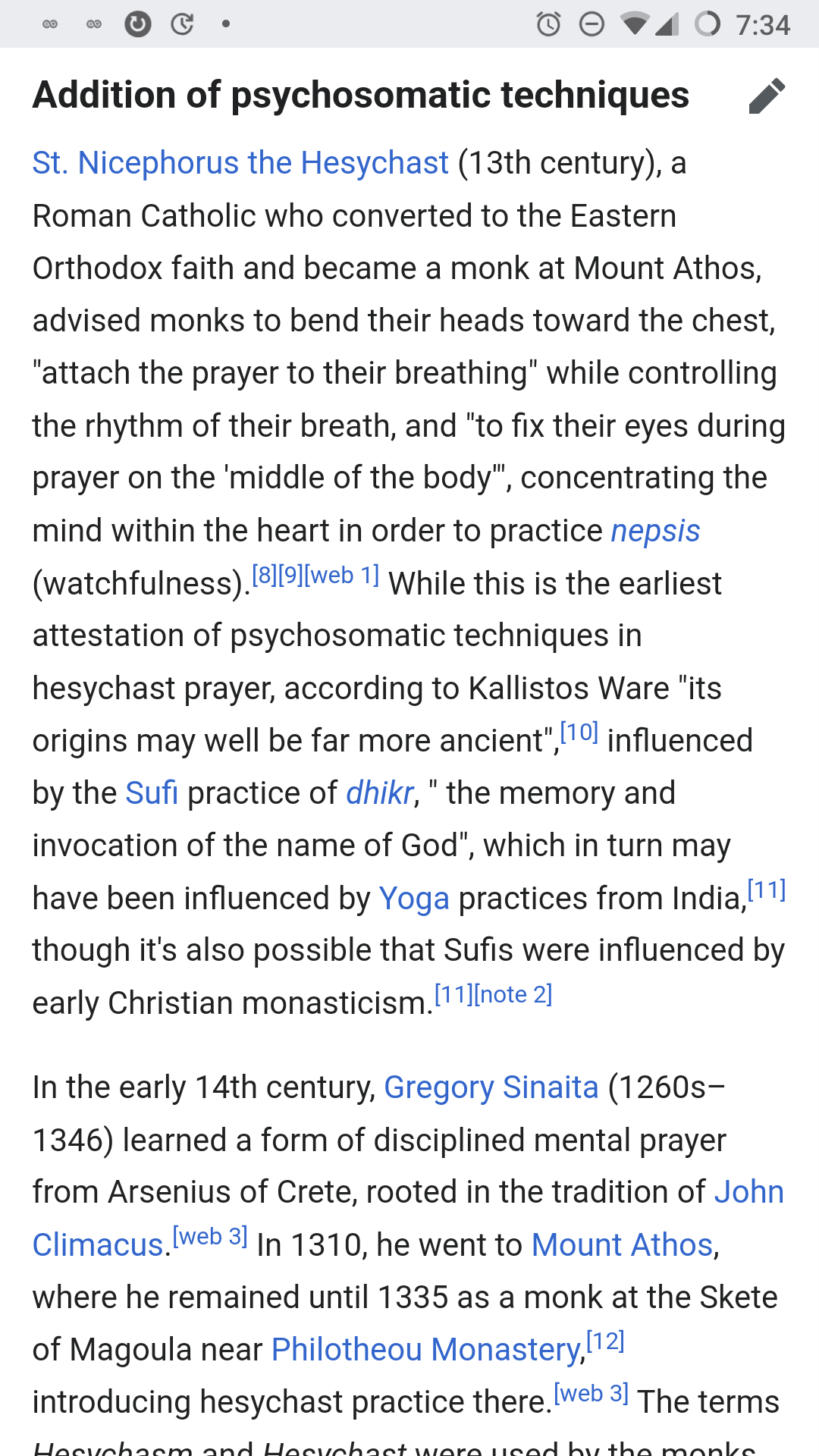
Nothing like this took off in Western Europe, the Amerindians didn't have anything like it, nor did Africa before getting Sufism. Shamanic trance states are universal but not meditations tied to a coherent language of posture.
I think it's more likely that this is something that was cultivated at some point in time by the Aryan tradition and then it enters others through unintentional syncretism.
2
0
1
georgia
georgia
2
0
0
Indra 🇺🇸 🇪🇺 🇺🇦
apollo@holos.social@georgia@netzsphaere.xyz @sathariel@diclonius.princess.wedding We don't know exactly where it comes from in Christianity and Islam afaik, it shows up in their literature abruptly at about the same time, the late medieval period, but we have examples of other things like this entering Christianity by accident.
Byzantine mystics have thought icons get their language and distinctive style directly from Jesus and the Apostles, but we know the exact same style is used for the Greek pantheon before the issue of images was settled by the Catholic Church. We have formative Christian theologians plagiarizing Platonists. The Cult of the Saints and images in the abstract are defended using the exact same logic Greco-Romans do to explain how the gods can have a presence in the world.
In Europe, it happens more often in folklore. You expect Germans and Gaels to "convert", renounce their former worldview, and embrace the Christian one, but that's not really what happens. Instead they tend to view Jesus and Yahweh the same way they used to view Odin or Tyr or Ullr, and those gods + the lower one get demoted to ancestral heroes, still used for legitimacy in the exact same way, and in the poetry the characters are all given Biblical lineages tying them to the Book of Genesis.
The depth of the medieval Christian tradition (and Islamic to a lesser extent) is Christianity accidentally absorbing things like folklore, philosophy, and likely primitive yoga, that it was trying to replace, every time it spreads, while giving it a more universal language and identity to engage the world with. That's why it's so compelling and deep even though there's a lot of nonsense when you examine the supposed base of it.
1
0
1
Indra 🇺🇸 🇪🇺 🇺🇦
apollo@holos.social@georgia@netzsphaere.xyz @sathariel@diclonius.princess.wedding Forgot to mention this but the Catholic Church used to have at least one saint whose hagiography is just Shakyamuni Buddha's biography, except with monotheism added into his realization. St Josaphat. He's been gutted from Catholicism since Vatican 2 but he still has his own holiday in Eastern Orthodoxy.
The Byzantine Empire was absorbing Indian culture well into the medieval period through Persia.
0
0
1
Indra 🇺🇸 🇪🇺 🇺🇦
apollo@holos.social@georgia@netzsphaere.xyz @sathariel@diclonius.princess.wedding Ok, but the point being, it's not a universal. It seems to specifically show up where you have, or had, PIE traditions transmitted.
1
0
0
1
0
0
georgia
georgia
1
0
0
georgia
georgia
1
0
0
georgia
georgia
1
0
1
Indra 🇺🇸 🇪🇺 🇺🇦
apollo@holos.social@georgia@netzsphaere.xyz @sathariel@diclonius.princess.wedding I didn't know Hasidism had anything like it.
I guess it's technically universal in that way but so is every basic human experience so Idk exactly what you're getting at.
1
0
0
georgia
georgia
1
0
0
Indra 🇺🇸 🇪🇺 🇺🇦
apollo@holos.social@georgia@netzsphaere.xyz @sathariel@diclonius.princess.wedding Oh. Yeah, troo.
0
0
0
0
0
2