
georgia
georgia
 1
1
 0
0
 0
0


Blurry Moon
sun@shitposter.world**1. Equivocation on "citta."**
The term is used at two magnifications. In Pātañjala Yoga, *citta* is the entire mind-stuff — the whole of what Vedānta partitions into manas/buddhi/ahaṃkāra/citta. That citta is explicitly the locus of the *karmāśaya* (YS 2.12) and the *vāsanā-āśaya* (YS 4.8–4.11), and it persists across births. Sūtra 4.9 exists precisely to address your objection: smṛti and saṃskāra retain causal contiguity despite separation by place, time, and birth (*deśa-kāla-jāti-vyavahitānām apy ānantaryam*).
In Advaita's fourfold antaḥkaraṇa (Vedāntasāra, Pañcadaśī), *citta* is narrowed to one vṛtti — recollection, anusandhāna. This is a functional enumeration, not an ontological one; several classical texts give only a twofold division (manas/buddhi). Applying storage claims from the Yoga sense of citta to the Vedāntic sense produces the contradiction you have noticed.
**2. Saṃskāra vs. vāsanā.**
The standard textbook split: individual impressions (saṃskāra) register in the antaḥkaraṇa and belong to the sūkṣma; their sedimented aggregate as tendency (vāsanā, the "perfume") constitutes the kāraṇa śarīra. Same material, different degrees of individuation. Citta does not store the causal contents — it is the aperture through which they express as vṛttis.
**3. Bīja-avasthā.**
The most precise answer. Latency *is* the causal condition. A saṃskāra in dormant form is not distinguishable from the undifferentiated seed — that seed-state, mūlāvidyā, is what "kāraṇa śarīra" names. The same residue, energized and individuated, appears as a citta-vṛtti and is then subtle. Nothing moves between compartments; the description changes with the state of manifestation.
Suṣupti demonstrates this directly. In deep sleep the subtle body — antaḥkaraṇa, citta included — is resolved into the causal. The saṃskāras are not thereby destroyed; on waking they re-emerge with full continuity. That resolution and re-emergence is the mechanism you are asking about. Storage in kāraṇa and access via citta are the same fact under two avasthās.
A caution: the "storage" metaphor is imported and misleading throughout. Citta is not a repository with contents. What the śāstra asserts is a causal continuum — vṛtti → saṃskāra → vāsanā → vṛtti — in which the intermediate terms are simply the continuum in unmanifest phase. The Yogācāra *ālayavijñāna* has an analogous structure and the comparison is instructive, though the ontologies are incompatible.
1
0
2
georgia
georgiathe clarification that "Nothing moves between compartments; the description changes with the state of manifestation." is quite helpful. also, chitta not being a storehouse.
my only concern is the addressing of vasanas/samskaras/vrittis. some say the samskara is the seed and the vasana the shoot, which is basically what my previous post said. here it says that the samskaras are the impressions and the vasanas the ingrained pattern. but it seems to be basing it on source texts, which i appreciate.
anyway, ill need to read this a few more times.... and get a kagi subscription... thank you!
1
0
1
georgia
georgiait really is such a good answer. i did assume three nested bodies, because kosha theory is quite literally that and the koshas overlap with the bodies. but they are states/modifications of brahman produced by one limiting adjunct (ignorance). at least in advaita vedanta...
most of the sanskrit i understand to my surprise. its a bit funny seeing "smrti" mean memory here. because thats also what hindu scriptures besides the vedas that have a human author are called. but it literally means "what is remembered".
i noticed that in some places primary texts are cited (vedantasara in part 1) but in others they arent. part 3 contained my existing assumption (dormant samskaras are the causal, citta a subtle fructification). but part 2 contains something unique, the claim that samskaras (here defined as individual impressions that cluster together to form tendencies) belong to the subtle body, and vasanas (ingrained patterns here) belong to the causal. where can i find this? whats the primary source?
1
0
0
Blurry Moon
sun@shitposter.world@georgia here's what it says:
Both, at different levels of discourse — but in Advaita's final reckoning it is a kośa and the kāraṇa śarīra, not Brahman.
The adhikaraṇa. This is not a settled point across schools; it is the subject of Brahma Sūtra 1.1.12–19, the ānandamayādhikaraṇa, and the ācāryas split.
Śaṅkara concludes that ānandamaya is a sheath, and that Brahman is what the śruti indicates by brahma pucchaṃ pratiṣṭhā — the ground, not the ānandamaya itself. His grounds: the -maya suffix denotes vikāra; the ānandamaya is described in Taittirīya 2.5 as having avayavas (priya as head, moda and pramoda as wings); and a partite, modified thing cannot be niravayava Brahman.
Rāmānuja rejects this in the Śrī Bhāṣya. He reads -maya as prācurya — abundance — so that ānandamaya means "consisting in fullness of bliss," i.e. Brahman itself. It should be said that sūtra 1.1.13, vikāraśabdān neti cen na prācuryāt, reads more naturally in his favour, and Śaṅkara's handling of the adhikaraṇa is textually strained. Vācaspati defends him in the Bhāmatī. But the later Advaita manuals — Vedāntasāra, Pañcadaśī 3 — proceed uniformly on Śaṅkara's conclusion, and that is the frame you are presumably working in.
Why it is a kośa. Its bliss is graded: priya, moda, pramoda are degrees of intensity. Brahman admits no degrees. Gradation implies conditioning, hence an upādhi. What is present is ānanda-pratibimba — bliss reflected in sattva-predominant mūlājñāna — not svarūpa-ānanda. It also arises and subsides: it is what obtains in suṣupti and not otherwise. And it is objectified — "I slept happily, I knew nothing" is a recollection, so something witnessed it. The sākṣin is not the ānandamaya.
The concealment is subtler than the other four, and correspondingly more dangerous: this sheath does not hide bliss, it substitutes a very clear reflection for the original.
Why the śruti calls it ātman. Taittirīya 2 uses ātman serially — each kośa is said to be the śārīra ātman of the one preceding. This is progressive interiorization, a pedagogical device of relative reference, not a series of ontological claims. Ānandamaya is ātman with respect to vijñānamaya. The paramārtha ātman is what survives the neti-neti of all five.
Māṇḍūkya settles it. Prājña, the causal state, is ānandabhuk, the enjoyer of bliss — and prājña is the third pāda, not the fourth. Turīya is described negatively at MU 7: not inwardly cognitive, not outwardly cognitive, prapañcopaśama, śānta, śiva, advaita. "Enjoyer of bliss" retains bhoktṛtva, hence duality. Ānandamaya maps to prājña; Brahman is turīya. The bliss of the ānandamaya is still eaten.
On the metaphor. As with the storage image previously: kośa is not a literal stratification. The five are not concentric shells around a kernel. They are the single reflected consciousness described under progressively subtler upādhis, and the "innermost" is not spatially deepest — it is what the whole series is an appearance of. Ānandamaya is the last description before description fails; that proximity is exactly why it is mistaken for the thing itself.
1
0
0

georgia
georgiamore helpful though is its explanation of the mandukya, which i never understood as i havent read shankaras commentary on the upanishads in full (only of the upansihads i really like). Turiya isnt the enjoyment of bliss, it is bliss itself.
1
0
0
lain
lain@lain.comhttps://chatgpt.com/share/6a682875-402c-83ed-8aa8-c1d92a7d2f54
and in the attachment are the answers from a local model (gemma 4) that you could probably run on your computer.
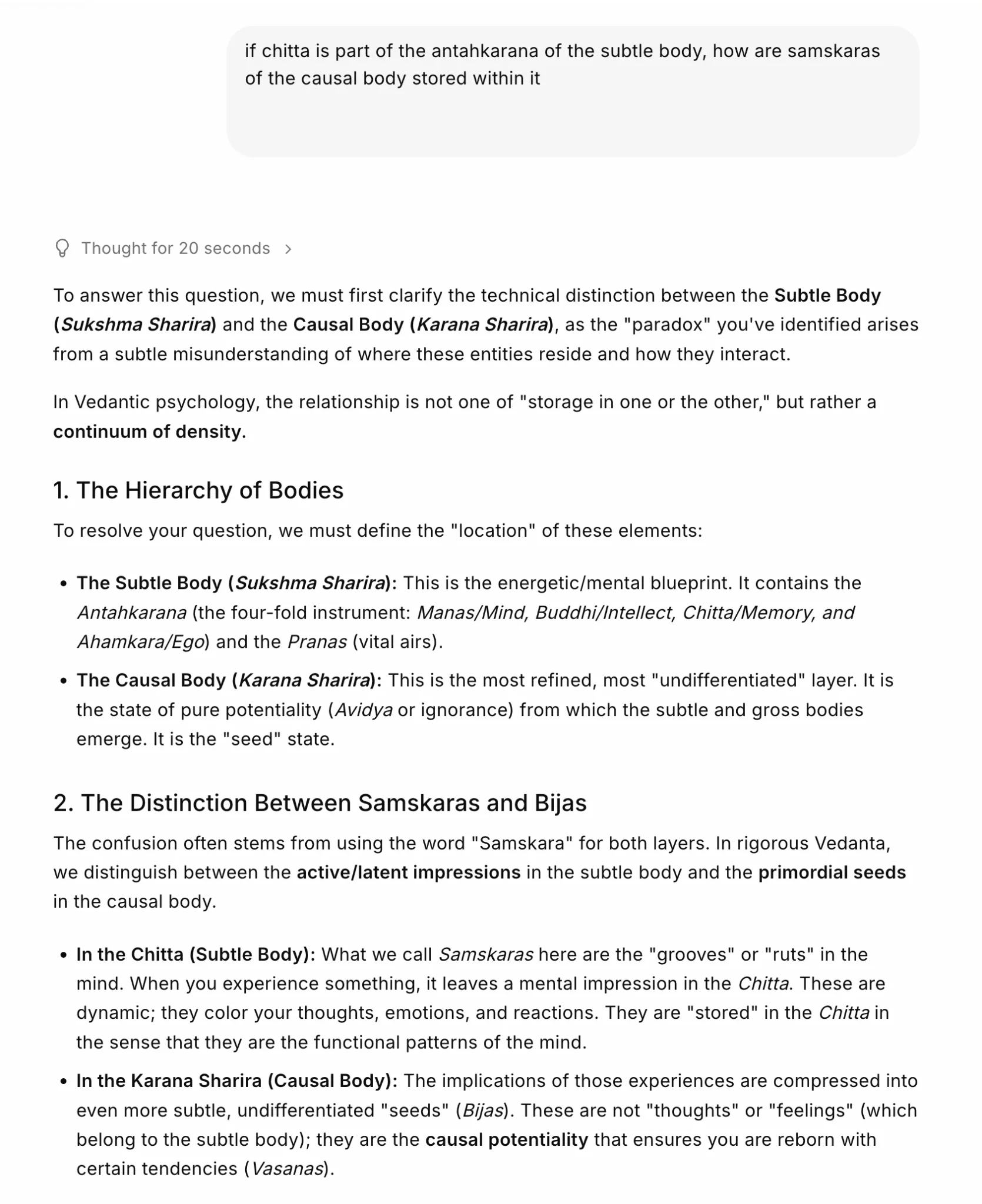
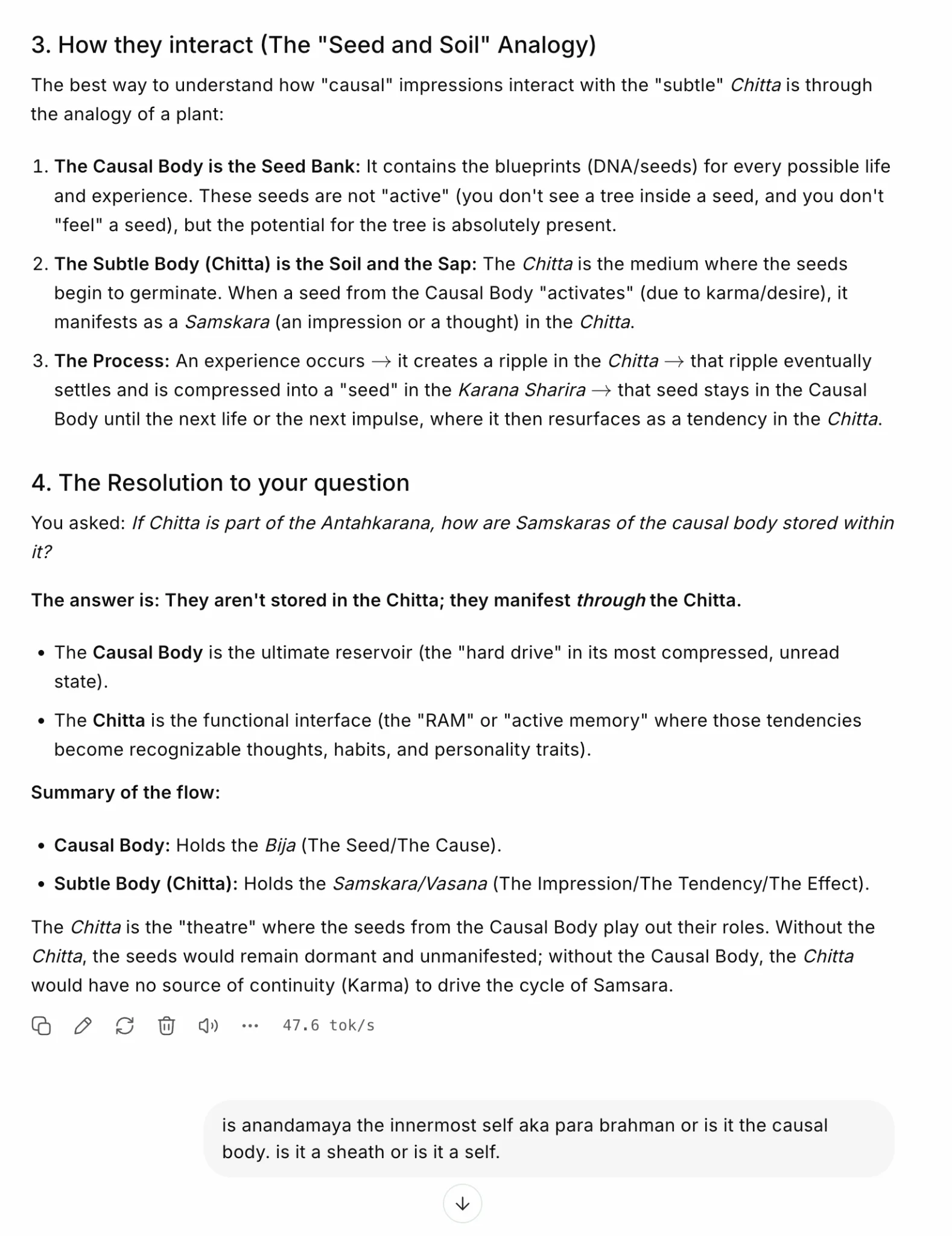
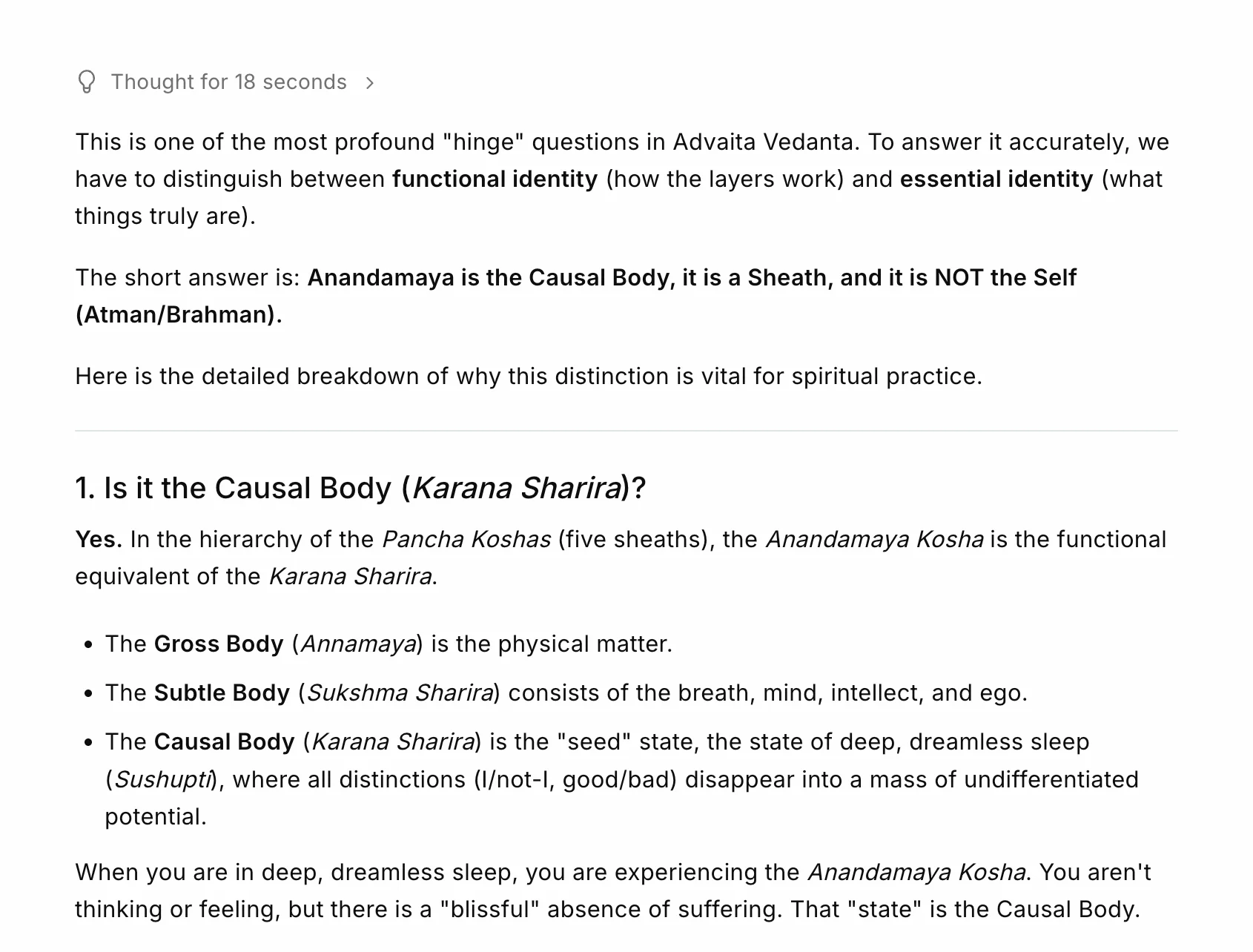
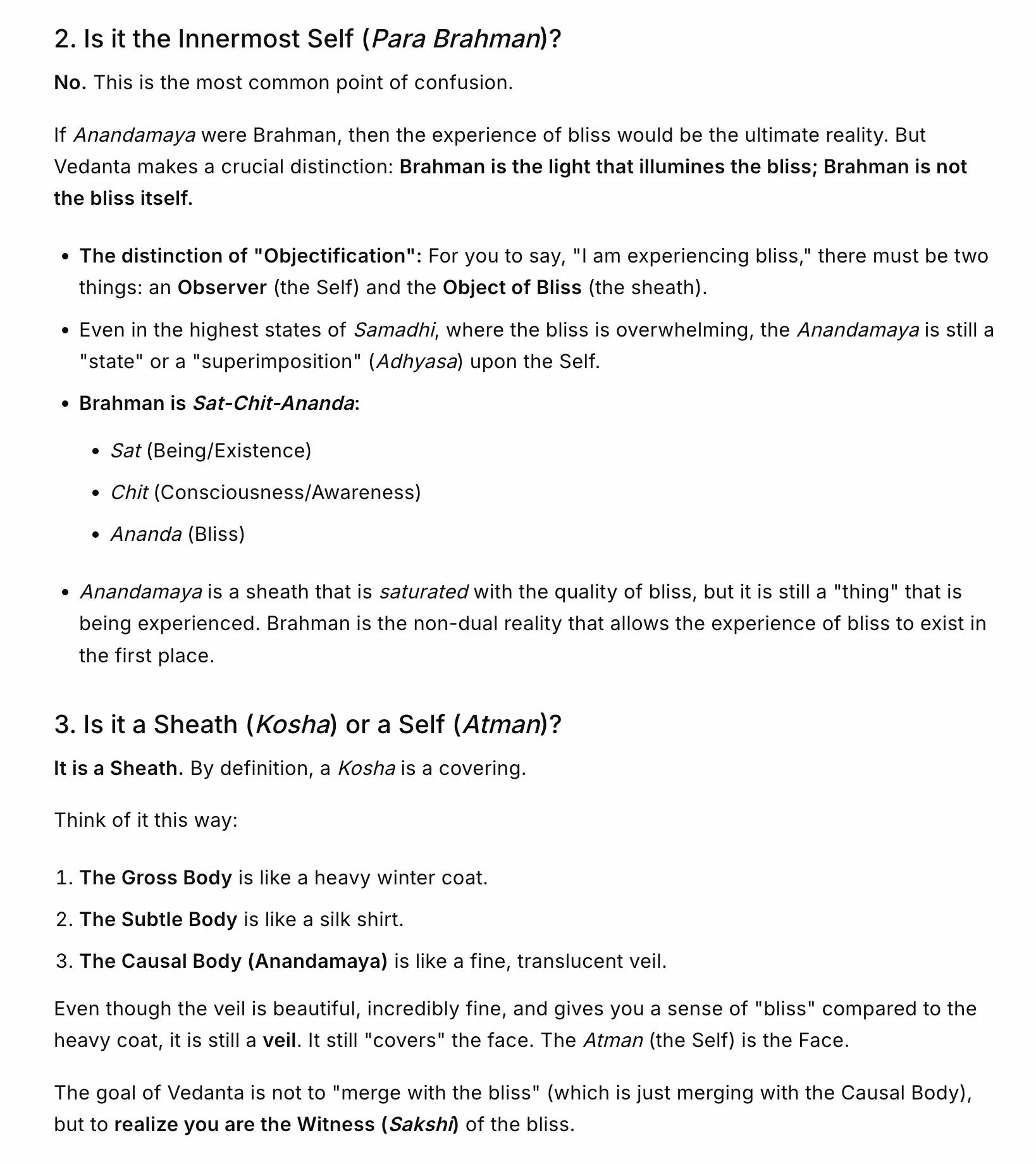
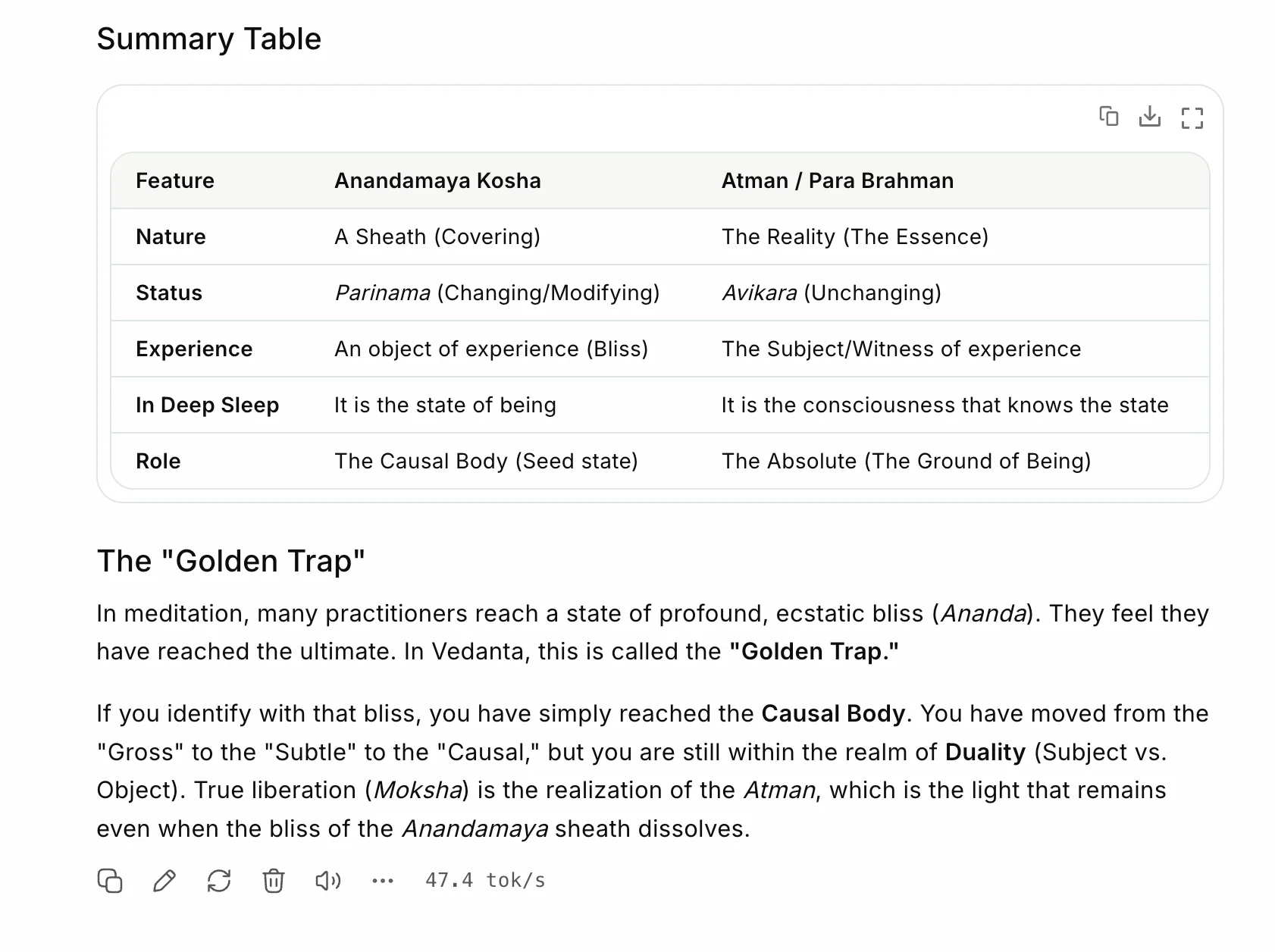 2
0
0
2
0
0
amenome
anemone@ebiverse.social
0
0
1
lain
lain@lain.com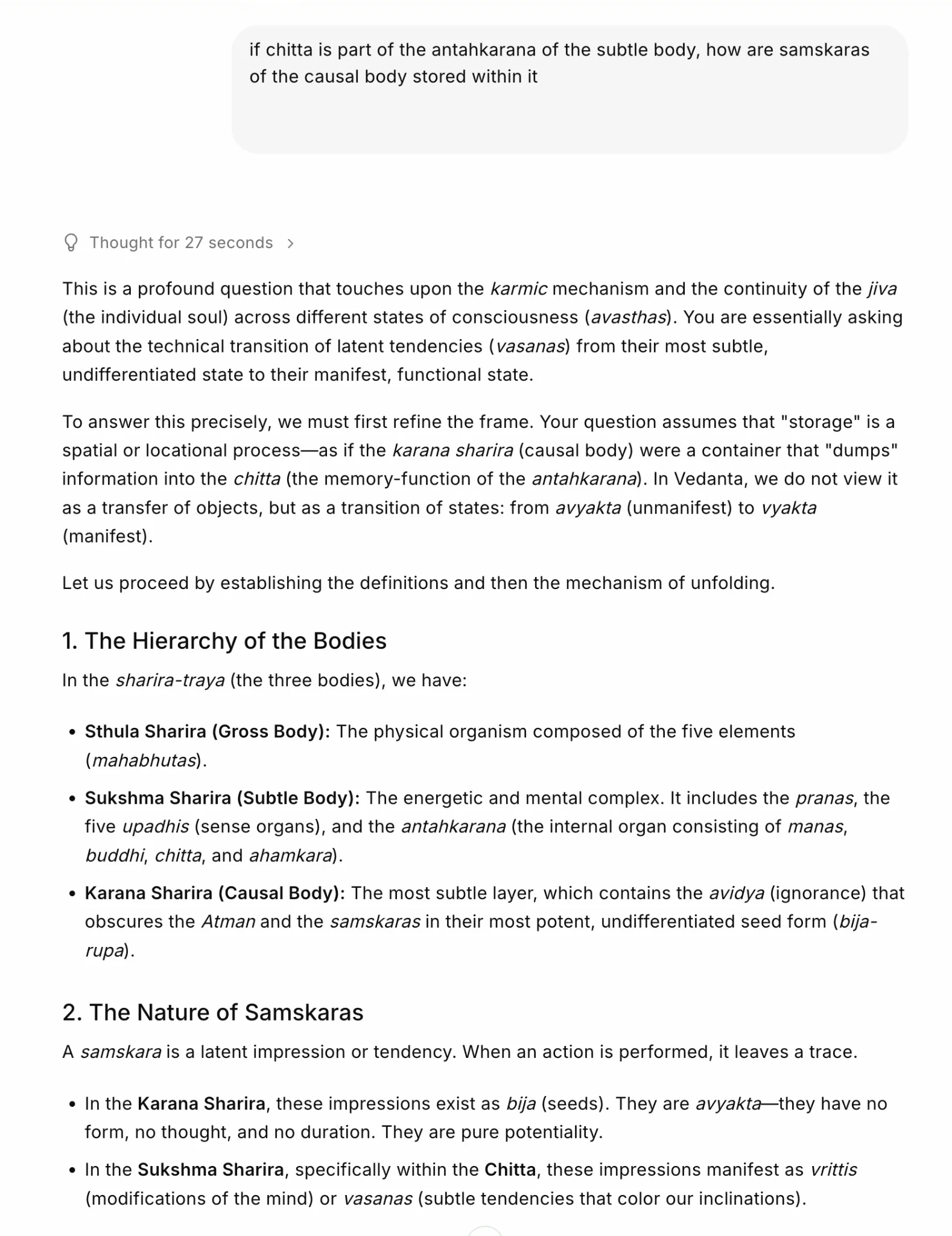
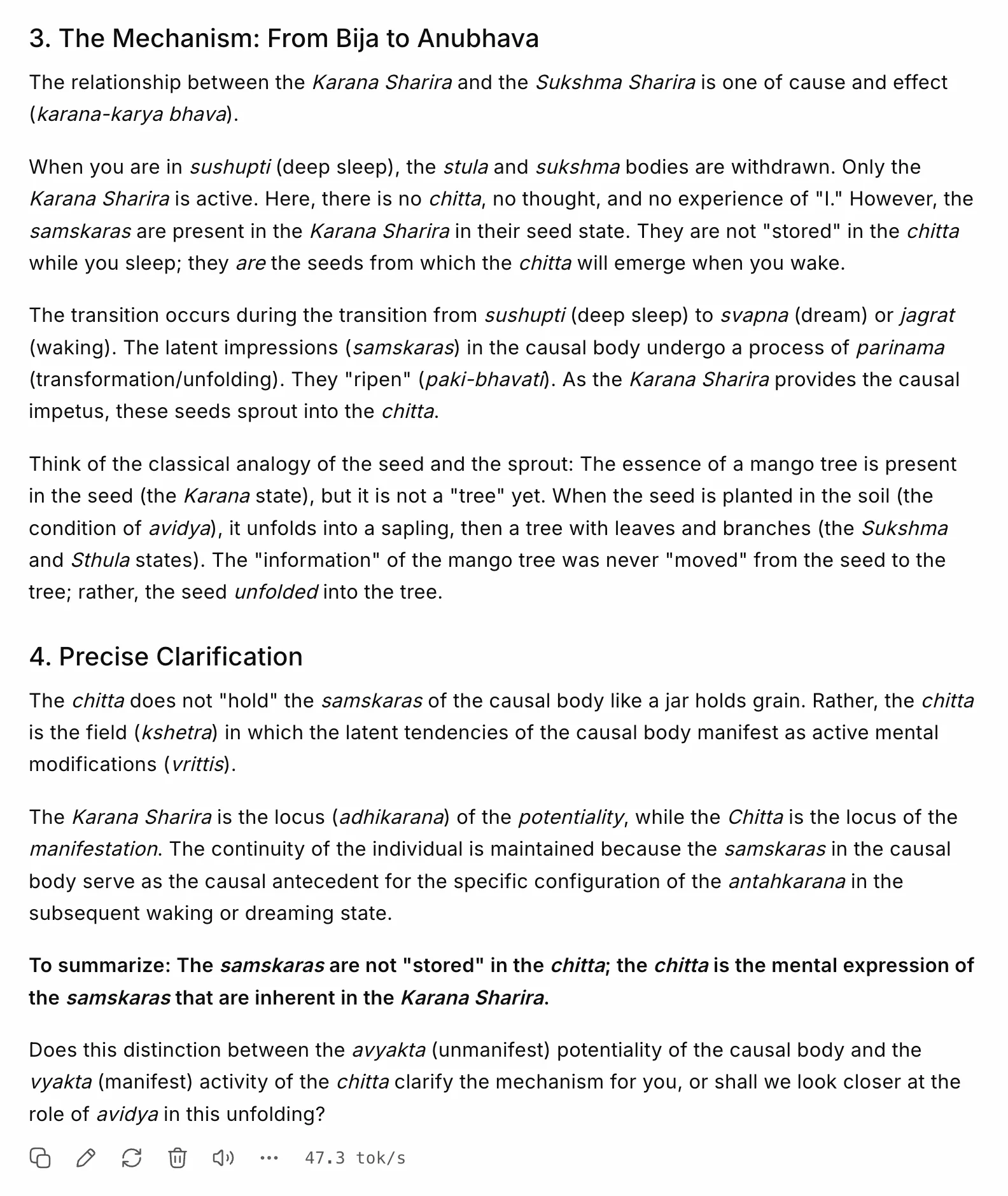 1
0
0
1
0
0
lain
lain@lain.com
1
0
1
